Blue blocker glasses
The optical shield that protects you from the artificial light wrecking your biology
An ordinary evening: dinner is over and you are watching your favourite series on television. You decide it is time to turn in, but first you go to the kitchen for a glass of water. As you open the fridge, its seemingly harmless LED bulb fires one last jolt of light straight into your retina. To finish the job, you step into the bathroom and switch on the white spotlights above the mirror to brush your teeth.
You may think you are getting ready to sleep, but your body inhabits a parallel reality: as far as your cells are concerned, the sun has just risen. We live immersed in an artificial “endless lighting spring” inside our own homes, trapped in constant overexposure to isolated blue wavelengths at the very hours when our biology would demand absolute darkness.
Why does blue light affect us?
To understand the danger of this domestic “false day”, we have to travel to the back of the eye. A few decades ago, science discovered a third group of essential photoreceptors in the retina: the intrinsically photosensitive retinal ganglion cells (ipRGCs). These cells play no part in forming images; they are of no use for “seeing” the world. Their only function is to act as a biological light meter that measures the intensity and colour of light in order to tell the brain what time it is.
ipRGCs contain a photopigment called melanopsin, whose peak sensitivity is triggered by wavelengths between 460 and 480 nanometres — precisely the blue of the daytime sky. When melanopsin detects that frequency, the ipRGCs send an immediate electrical signal to the suprachiasmatic nucleus — the brain’s master clock — telling it that it is midday. That sets off a drastic order: slam the brakes on the production of melatonin, the hormone in charge of inducing sleep, repairing cells and synchronising our circadian rhythms. The result of keeping the lights on at night is chronodisruption: a biological misalignment that disturbs the endocrine system, degrades vitamin D status and damages metabolic health.
The daytime danger: cellular destruction and unbalanced light
Artificial blue light has traditionally been thought harmful only at night, because of insomnia. Yet experts in environmental health and popularisers of circadian biology warn that this spectrum is harmful both at night and during the day when it arrives in isolation.
Sunlight is a complete, perfectly balanced spectrum: its blue photons come accompanied by red and infrared light, which has regenerative properties and mitigates cellular damage. The problem with modern interiors is not only the LED bulb, but also the windows of our houses and cars, which act as a filter blocking much of the red and infrared spectrum outside.
The daytime danger of screens is not blindness but toxicity through fatigue: a bombardment of pure blue photons stripped of the sun’s regenerative red.
Spending the day under artificial ceilings or in front of screens subjects our eyes and our skin to a bombardment of pure blue photons. Work from the University of Toledo (USA) shows that this unbalanced stimulus hijacks cellular signalling cascades — specifically the membrane phosphoinositide PIP2 — causing a massive, damaging influx of calcium into the cytoplasm that ends in cell death. On top of that, retinal itself, the aldehyde form of vitamin A that makes vision possible, turns toxic when blue light excites it: over the years its derivatives accumulate in the pigment epithelium as lipofuscin, the pigment of retinal ageing, behind severe visual fatigue and premature cellular deterioration.
Yellow lenses versus red lenses
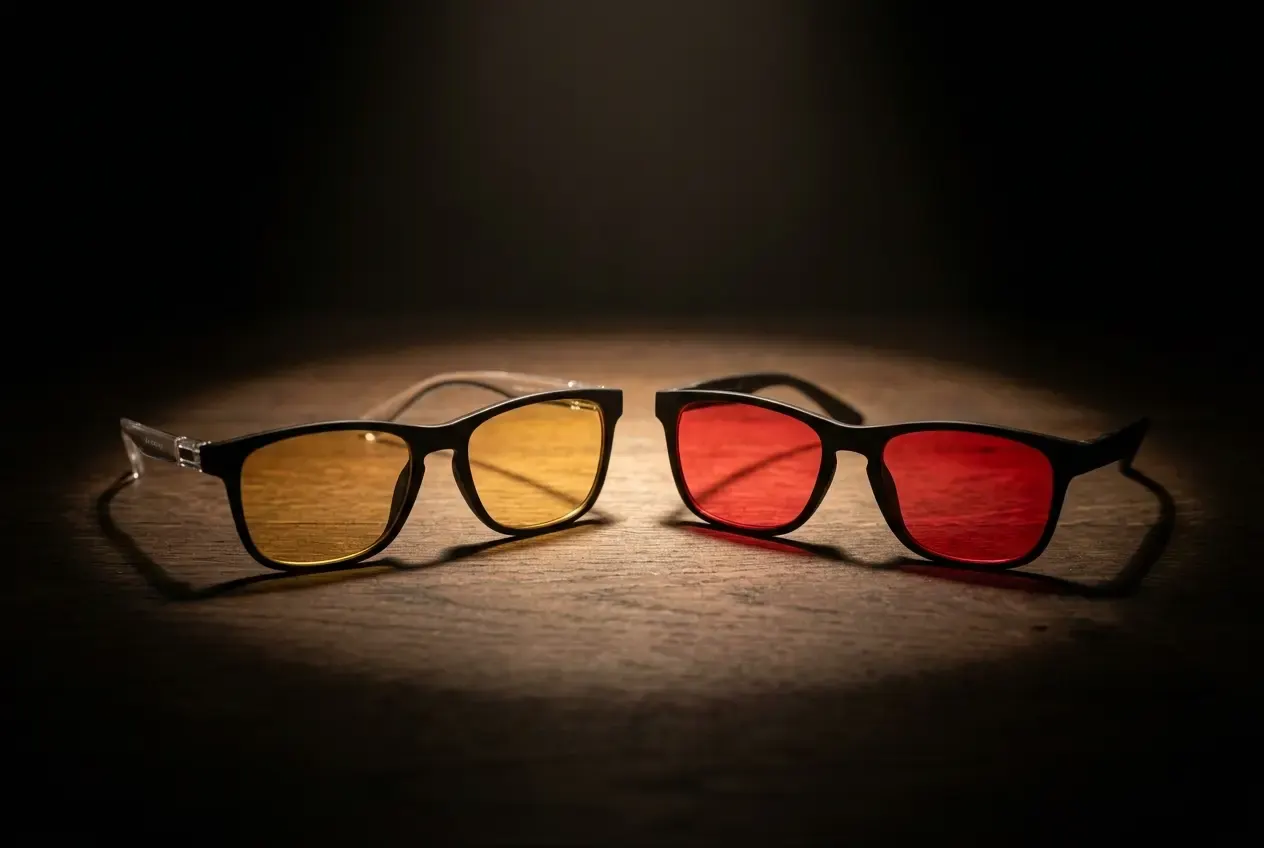
Since living in the dark or giving up technology is not an option, blue-light-blocking glasses (or blue blockers) have become a biological necessity of adaptation. Their physical properties and practical applications, however, change completely with their colour:
| Property | Yellow-lens glasses | Red-lens glasses |
|---|---|---|
| Share filtered | Filter part of the blue light: roughly 30-60%. | Block 100% of blue light and much of the green. |
| Optical mechanism | Damp the high-energy peaks, balancing indoor light. | Act as an absolute physical cut-off filter, up to 550 nm. |
| Visual effect | Barely alter colour; they improve contrast and reduce glare. | Tint everything red, completely altering colour perception. |
| Ideal time of use | During the day: in offices, supermarkets, cars or under LED lighting. | At night: from sunset until bedtime, at home. |
| Main benefit | Curb oxidative stress and ease computer vision syndrome. | Protect melatonin and allow deep, restorative rest. |
To fit these optical tools into our routine without disturbing the body’s natural functions, it is crucial to understand that the colour of the lens dictates the exact moment and the right setting for wearing it.
Yellow-lens glasses
They are the right engineering answer to the challenges of modern indoor working life. By filtering a selective share of high-energy blue, their main job is to cushion the impact of aggressive chromatic peaks without plunging the eye into an artificial darkness that would bring on drowsiness during working hours.
- When and where to wear them. For daytime use. They are especially useful in over-lit offices with fluorescent panels, in supermarkets and shopping centres, or during long stretches in front of computer screens and tablets. They are also an excellent resource when driving during the day in a modern car, since laminated vehicle glass filters out the sun’s infrared rays, leaving a cabin saturated with floating blue light that exhausts the eye muscles.
- The biological benefit. By balancing the spectrum of light entering the retina, they reduce digital asthenopia — the familiar picture of red eyes, blurred vision, itching and tension headache. They let the ipRGCs go on detecting enough ambient light to keep us alert, focused and engaged, while removing the cellular toxicity and mitochondrial stress produced by the isolated blue photon.
Red-lens glasses
These are the true “disconnection shield”, and their purpose is purely chronobiological rather than one of visual comfort. They do not damp light: they cut it off at the root. By removing every frequency below 550 nanometres (blue and green), they act as an endocrine protection filter that instantly insulates the wearer’s hormonal system from the technological environment around them.
- When and where to wear them. They should be put on strictly after sunset, at the very moment the household’s artificial lighting, the television or mobile devices come on. The optimal protocol calls for wearing them two to three hours before going to bed. Since they block the green and blue channels, they drastically alter colour perception — everything takes on a reddish cast — so the brain needs a few minutes of neurological adaptation to settle into the environment. For strict road-safety reasons, because they suppress the visibility of certain traffic and signage colours, they are in no way suitable for driving at night.
- The biological benefit. By creating a state of absolute physiological darkness with the eyes open, they stop melanopsin from halting the cellular machinery of sleep. The brain receives the unambiguous signal that night has come, and begins the natural, pulsatile secretion of melatonin even though the kitchen or the bathroom is flooded with LED light. They are the most effective way to counter sleep-onset insomnia and the fragmented rest brought on by the Western way of life.
Conclusion
Legislating the incandescent bulb out of existence inadvertently deprived us of the only night-time light spectrum that respected our nature. In banning that orange light which imitated ancestral fire and emitted large amounts of red and infrared, governments legislated while wholly ignoring the impact on human health. They confined us to an environment dominated by LED chips that emit spikes of pure blue light camouflaged with yellow phosphor. Faced with this regulatory disconnection, which puts the electricity meter ahead of our biology, blue-light-blocking glasses are no longer an aesthetic fad: they are a tool of biological resistance in a world designed with no regard for our evolution.
Ideally, our health would depend on nothing more than keeping our lives perfectly synchronised with the rhythms of natural sunlight: waking at dawn, working under an open sky and letting the darkness of night dictate our rest. But since the demands of modern life, working hours and the design of our homes do not always allow us that luxury, we are forced to improvise ways of coming to our own biology’s aid. When modern structures fail to protect our health, the strategic use of yellow lenses through the office day and red lenses after sunset at home becomes, quite simply, an intelligent way of giving our cells back the balance they have lost.
References and scientific support
- The discovery of the ipRGCs: the retina has a light meter that is no use for seeing. Berson, D. M., Dunn, F. A., & Takao, M. (2002). Phototransduction by Retinal Ganglion Cells That Set the Circadian Clock. Science, 295(5557), 1070-1073. View study (DOI)
- The exact spectrum at which melatonin switches off. Brainard, G. C., Hanifin, J. P., Greeson, J. M., Byrne, B., Glickman, G., Gerner, E., & Rollag, M. D. (2001). Action Spectrum for Melatonin Regulation in Humans: Evidence for a Novel Circadian Photoreceptor. The Journal of Neuroscience, 21(16), 6405-6412. View study (DOI)
- The same 460 nm peak, found simultaneously by another laboratory. Thapan, K., Arendt, J., & Skene, D. J. (2001). An action spectrum for melatonin suppression: evidence for a novel non-rod, non-cone photoreceptor system in humans. The Journal of Physiology, 535(1), 261-267. View study (DOI)
- Reading on a screen before bed delays the clock and REM sleep. Chang, A.-M., Aeschbach, D., Duffy, J. F., & Czeisler, C. A. (2015). Evening use of light-emitting eReaders negatively affects sleep, circadian timing, and next-morning alertness. Proceedings of the National Academy of Sciences, 112(4), 1232-1237. View study (DOI)
- What living with the lights on at night does to health. Touitou, Y., Reinberg, A., & Touitou, D. (2017). Association between light at night, melatonin secretion, sleep deprivation, and the internal clock: Health impacts and mechanisms of circadian disruption. Life Sciences, 173, 94-106. View study (DOI)
- The University of Toledo study: blue light excites retinal and hijacks cellular signalling. Ratnayake, K., Payton, J. L., Lakmal, O. H., & Karunarathne, A. (2018). Blue light excited retinal intercepts cellular signaling. Scientific Reports, 8, 10207. View study (DOI)
- Lipofuscin and blue-light damage to the pigment epithelium. Sparrow, J. R., Nakanishi, K., & Parish, C. A. (2000). The lipofuscin fluorophore A2E mediates blue light-induced damage to retinal pigmented epithelial cells. Investigative Ophthalmology & Visual Science, 41(7), 1981-1989. View study on PubMed
- Red and infrared light protect the photoreceptor from blue-light damage. Heinig, N., Schumann, U., Calzia, D., Panfoli, I., Ader, M., Schmidt, M. H. H., Funk, R. H. W., & Roehlecke, C. (2020). Photobiomodulation Mediates Neuroprotection against Blue Light Induced Retinal Photoreceptor Degeneration. International Journal of Molecular Sciences, 21(7), 2370. View study (DOI)
- What digital asthenopia actually is, and how many people have it. Sheppard, A. L., & Wolffsohn, J. S. (2018). Digital eye strain: prevalence, measurement and amelioration. BMJ Open Ophthalmology, 3(1), e000146. View study (DOI)
- With blocking lenses on, not even bright light suppresses melatonin. Sasseville, A., Paquet, N., Sévigny, J., & Hébert, M. (2006). Blue blocker glasses impede the capacity of bright light to suppress melatonin production. Journal of Pineal Research, 41(1), 73-78. View study (DOI)
- The randomised trial of amber lenses three hours before bedtime. Burkhart, K., & Phelps, J. R. (2009). Amber lenses to block blue light and improve sleep: a randomized trial. Chronobiology International, 26(8), 1602-1612. View study (DOI)
- The same lenses, this time in patients with diagnosed insomnia. Shechter, A., Kim, E. W., St-Onge, M.-P., & Westwood, A. J. (2018). Blocking nocturnal blue light for insomnia: A randomized controlled trial. Journal of Psychiatric Research, 96, 196-202. View study (DOI)
We're building the space for you to comment on the articles.
Continue reading

The problem with the modern eye
The visual toll of modern life, and the scientific evidence on how the sun restores the metabolism of vision

The physiology of dawn
Why the sunlight you meet on waking is the biochemical signal your body needs to oxidise fat efficiently

The invisible link between the sun and the gut microbiota
How UVB radiation switches on receptors that reinforce the intestinal barrier and tune immunity