The problem with the modern eye
The visual toll of modern life, and the scientific evidence on how the sun restores the metabolism of vision
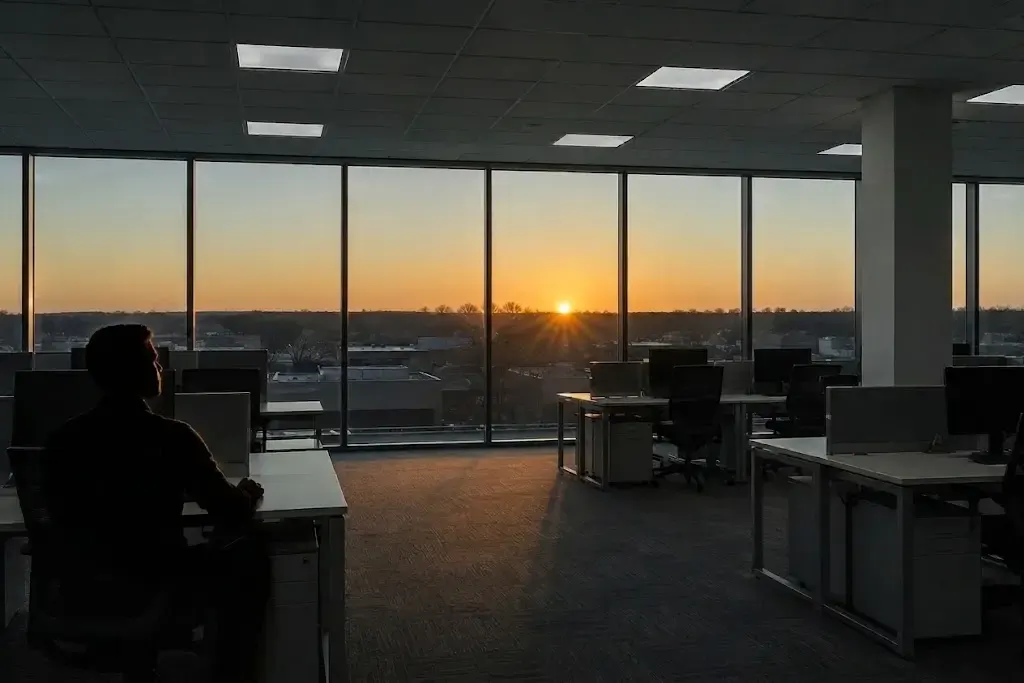
Our species evolved under the constant influence of solar radiation, a continuous spectrum running from the ultraviolet to the far infrared. Yet in the space of a few decades life has moved indoors, subjecting our visual system to a severely impoverished diet of light.
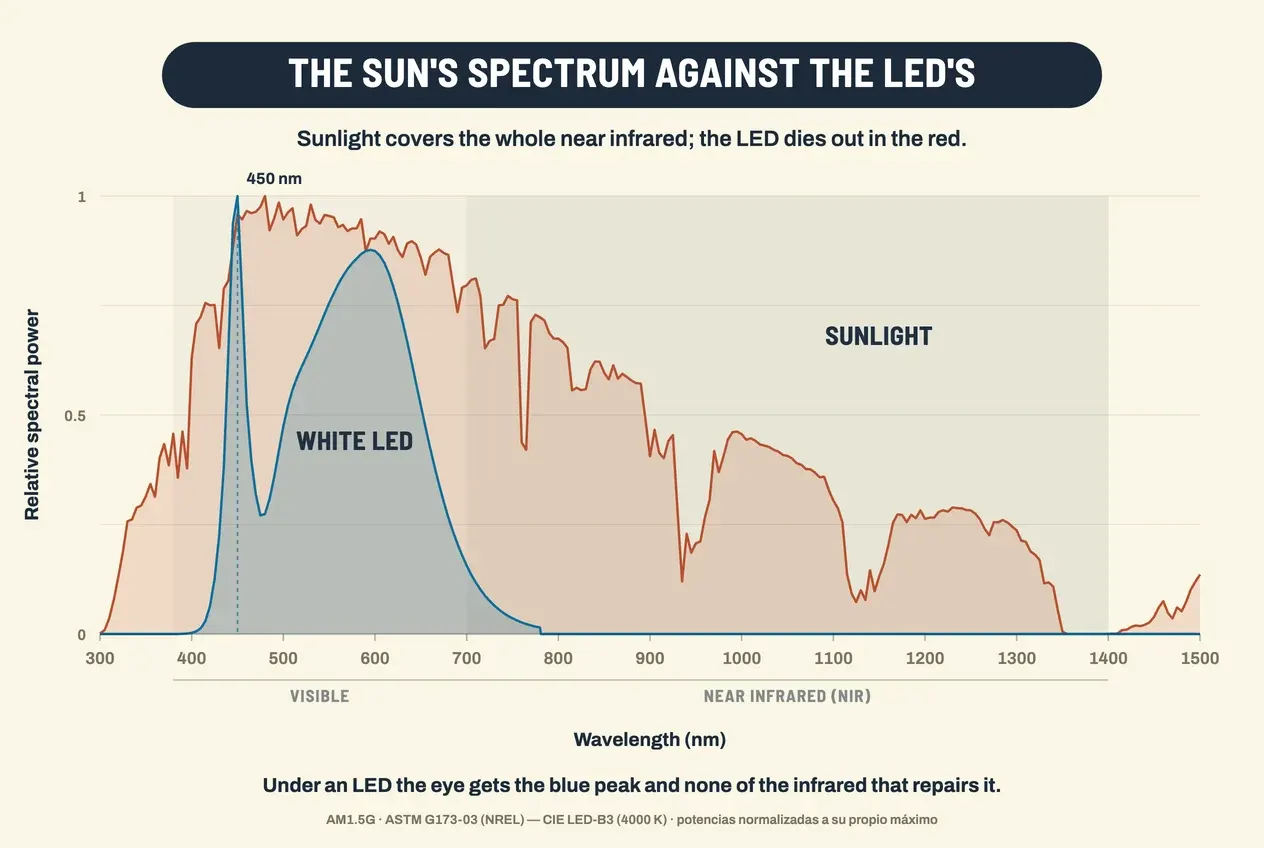
We live immersed in a lighting environment without precedent in human history. We spend around 90% of our time under artificial light from LED sources and digital screens. In photonic terms, these lights have an aberrant spectral signature: disproportionate peaks at the short wavelengths (blue light, around 450 nanometres) and almost no emission at all in the near infrared (NIR, 700 to 1400 nm).
This disconnection from natural light is not harmless. High-energy blue light drives prolonged oxidative stress in the retinal pigment epithelium, while the absence of infrared radiation deprives the ocular structures of their natural mechanism for repair and energy support. The global myopia crisis and premature visual decline are not the consequence of faulty genetics, but the physiological response of an eye cut off from its primary biological stimulus: full-spectrum sunlight.
The filter of modern windows
On top of this artificial-lighting deficit comes the impact of contemporary architecture. Working beside a large office window, or driving behind a windscreen, is not the same as being out in the sun. Energy-efficient architectural glass (such as low-emissivity or Low-E panes) and vehicle glazing are designed to block solar thermal radiation.
Biologically, that means they block the near-infrared spectrum almost entirely. The result is a “trap lighting”: the eye registers brightness and ambient light, but the photons with photobiomodulating capacity have been filtered out.
Stripped of the long-wave infrared radiation that, in nature, balances the oxidative stress caused by blue light, the light coming through the glass becomes an unbalanced emission. That imbalance deprives the choroid and the sclera of the stimulus they need to stay properly oxygenated, encouraging scleral hypoxia (a lack of oxygen in the fibrous tunic of the eye). The consequence is a softening of the ocular tissues and the subsequent elongation of the eyeball, which drives myopia progression. For light to act as a signal of visual health, looking through a pane of glass is not enough: you have to go outside.
What about prescription glasses and sunglasses? The lenses of conventional glasses behave much like the windows of a building: they filter the near-infrared wavelengths and interfere with photons reaching the retina directly. Sunglasses and blue-light filters worn outdoors do something further — they cut the photon intensity, and with it the dopamine signal the eye uses to hold back its own elongation.
The physics of the sun and the mitochondrial nourishment of the retina
There is a fundamental property of solar radiation that tends to be overlooked in eye health: the human body is partly translucent to near-infrared wavelengths. Experiments exposing a person’s back to midday sunlight show that infrared photons can pass through the dermis, the subcutaneous tissue and the muscle, and emerge on the front of the chest.
That capacity for deep penetration lets sunlight interact with the body systemically, producing metabolic benefits that reach the eyes without any light having to fall on them.
In one laboratory trial, 850 nm infrared light was applied to participants’ backs for just 15 minutes. To isolate the absorption pathway, one subgroup had their heads carefully wrapped in aluminium foil, blocking any photons from entering through the eyes; a third group went through the same protocol with the panels switched off. Twenty-four hours later, colour discrimination thresholds were measured:
- Participants with the body exposed and the head uncovered improved significantly on both axes tested, red-green and blue-yellow.
- Those with their heads shielded also improved significantly, though only on the blue-yellow axis: a more modest gain, but one obtained without a single photon reaching their eyes.
- The group with the panels switched off showed no change at all.
The energy machinery of vision
The explanation lies in cellular photobiomodulation. The retina is the most metabolically demanding tissue per gram in the entire human body, ahead even of brain tissue. Turning light signals into electrical impulses requires a constant supply of adenosine triphosphate (ATP), produced by retinal mitochondria.
Near-infrared wavelengths — abundant in sunlight, absent from LED bulbs — penetrate the body and are absorbed by the enzyme cytochrome c oxidase, a key component of the mitochondrial electron transport chain. That interaction stimulates ATP synthesis systemically. By raising overall energy availability, the bloodstream distributes this optimised metabolic state all the way to the photoreceptor cells of the retina, restoring their visual processing capacity for the following day.
Triggering this physiological response requires neither staring at the sun nor any elaborate device; it is enough to expose the skin outdoors and let full-spectrum sunlight restore the body’s biological balance.
Laboratory versus ancestral medicine
Once light was understood as a biological modulator, ophthalmic research set out to reproduce these mechanisms artificially in order to slow the elongation of the eyeball — the increase in axial length — which is responsible for the rise in dioptres (the spherical equivalent refraction).
Hence repeated low-level red-light therapy (RLRL), which applies wavelengths of 650 to 660 nanometres directly to the eye using lasers or LED devices. Clinical trials show that this concentrated stimulation can reverse scleral hypoxia, increase choroidal thickness and even induce a measurable shortening of axial length in children and adults with pathological myopia.
It is crucial, though, to place this kind of technology exactly where it belongs: these are clinical interventions designed as patches or partial cures for visual systems that have already suffered damage or structural change. The preventive power of the sun cannot be replicated artificially.
No laboratory treatment, however sophisticated or expensive, can substitute for the complexity and spectral richness of sunlight. Technology attempts to simulate, in a beam a few millimetres wide, what nature delivers globally, free and whole through the atmosphere.
Conclusion
Human biology was shaped by constant interaction with sunlight. Confinement indoors, work behind filtered glass and dependence on incomplete artificial lighting have left our visual system in a state of metabolic starvation and structural decline.
Ophthalmic medicine has managed to design sophisticated photonic tools for correcting vision, but the firmest conclusion science offers comes before any clinical intervention: eye health depends on going back outside. Restoring daily contact with full-spectrum sunlight is the most rigorous, most fundamental and most accessible measure available for protecting the metabolic and optical integrity of our eyes.
References and scientific support
- We spend almost all our lives indoors. Klepeis, N. E., Nelson, W. C., Ott, W. R., Robinson, J. P., Tsang, A. M., Switzer, P., Behar, J. V., Hern, S. C., & Engelmann, W. H. (2001). The National Human Activity Pattern Survey (NHAPS): a resource for assessing exposure to environmental pollutants. Journal of Exposure Analysis and Environmental Epidemiology, 11(3), 231-252. View study (DOI)
- Blue light damages the retinal pigment epithelium. Sparrow, J. R., Nakanishi, K., & Parish, C. A. (2000). The lipofuscin fluorophore A2E mediates blue light-induced damage to retinal pigmented epithelial cells. Investigative Ophthalmology & Visual Science, 41(7), 1981-1989. View study on PubMed
- Scleral hypoxia is the switch behind myopia. Wu, H., Chen, W., Zhao, F., Zhou, Q., Reinach, P. S., Deng, L., Ma, L., Luo, S., Srinivasalu, N., Pan, M., Hu, Y., Pei, X., Sun, J., Ren, R., Xiong, Y., Zhou, Z., Zhang, S., Tian, G., Fang, J., Zhang, L., Lang, J., Wu, D., Zeng, C., Qu, J., & Zhou, X. (2018). Scleral hypoxia is a target for myopia control. Proceedings of the National Academy of Sciences, 115(30), E7091-E7100. View study (DOI)
- Without bright light, the eye loses the dopamine signal that restrains it. Ashby, R., Ohlendorf, A., & Schaeffel, F. (2009). The effect of ambient illuminance on the development of deprivation myopia in chicks. Investigative Ophthalmology & Visual Science, 50(11), 5348-5354. View study (DOI)
- What happens inside an eye that lengthens. Jonas, J. B., Spaide, R. F., Ostrin, L. A., Logan, N. S., Flitcroft, I., & Panda-Jonas, S. (2023). IMI—Nonpathological Human Ocular Tissue Changes With Axial Myopia. Investigative Ophthalmology & Visual Science, 64(6), 5. View study (DOI)
- No tissue burns as much energy as the retina. Wong-Riley, M. T. T. (2010). Energy metabolism of the visual system. Eye and Brain, 2, 99-116. View study on PubMed Central
- The enzyme that turns photons into ATP. Hamblin, M. R. (2018). Mechanisms and Mitochondrial Redox Signaling in Photobiomodulation. Photochemistry and Photobiology, 94(2), 199-212. View study on PubMed Central
- Infrared passes through the body and improves vision without going near the eyes. Jeffery, G., Fosbury, R., Barrett, E., Hogg, C., Rodriguez-Carmona, M., & Powner, M. B. (2025). Longer wavelengths in sunlight pass through the human body and have a systemic impact which improves vision. Scientific Reports, 15, 24435. View study on PubMed Central
- The first randomised trial of red light against childhood myopia. Jiang, Y., Zhu, Z., Tan, X., Kong, X., Zhong, H., Zhang, J., Xiong, R., Yuan, Y., Zeng, J., Morgan, I. G., & He, M. (2022). Effect of Repeated Low-Level Red-Light Therapy for Myopia Control in Children: A Multicenter Randomized Controlled Trial. Ophthalmology, 129(5), 509-519. View study (DOI)
- Choroidal thickening as the first sign of response. Dong, J., Zhu, Z., Xu, H., & He, M. (2023). Myopia Control Effect of Repeated Low-Level Red-Light Therapy in Chinese Children: A Randomized, Double-Blind, Controlled Clinical Trial. Ophthalmology, 130(2), 198-204. View study (DOI)
- The same therapy in children with high myopia. Xu, Y., Cui, L., Kong, M., Li, Q., Feng, X., Feng, K., Zhu, H., Cui, H., Shi, C., Zhang, J., & Zou, H. (2024). Repeated Low-Level Red Light Therapy for Myopia Control in High Myopia Children and Adolescents: A Randomized Clinical Trial. Ophthalmology, 131(11), 1314-1323. View study (DOI)
- Two adults with pathological myopia, and an eye that shortens. Zhang, J., Zou, Y., Zhang, H., Zou, H., & Xu, Y. (2026). Repeated low-level red light therapy for pathologic myopia: a case series of two adult patients. British Journal of Ophthalmology, bjo-2025-329303. View study (DOI)
We're building the space for you to comment on the articles.
Continue reading
Blue blocker glasses
The optical shield that protects you from the artificial light wrecking your biology

The physiology of dawn
Why the sunlight you meet on waking is the biochemical signal your body needs to oxidise fat efficiently

Sunlight against H. pylori
How UVB radiation and vitamin D3 switch on the natural defenses that fight this gastric pathogen