Introduction
The alphabet of life: the nutrients the human body needs in order to work
If we reduced everything your body needs to get through a single day to one shopping basket, we would run into a fascinating paradox. On one side we would be carrying kilos of protein, carbohydrate and fat: the heavy fuel, the bricks of the machine. But hidden at the bottom of the bag, in a dose so ridiculously small it would fit on the head of a pin, would be the real conductors of the orchestra.
Without them, those kilos of food would be useless. The body’s engine would simply stall.
Welcome to the universe of the essential vitamins, a select club of thirteen molecules without which our species would never have survived, but which our own body — through a kind of «venerable evolutionary laziness» — forgot how to make.
Why «essential»?
In the language of biology, calling a nutrient essential does not merely mean that it matters: it means that your body cannot synthesise it on its own (or not in sufficient quantity), and that you are therefore condemned to obtain it through your diet.
Think about that for a second. Most animals on the planet make their own vitamin C in the liver or the kidneys. A dog or a cat will never fall ill with scurvy: if their levels drop, their cells simply step up production. Around 61 million years ago, however, a common ancestor of the primates suffered a genetic mutation that switched off the last enzyme needed to manufacture ascorbic acid.
Was it a tragic mistake? It was really a natural step in evolution. At that time our ancestors lived surrounded by tropical fruit: vitamin C was so abundant in the environment that it paid the body to save the metabolic energy of making it and delegate the job to the diet. A Faustian pact with nature: «I save energy, you feed me». The problem arrived millennia later, when we swapped the jungle for restricted agriculture and polar winters.
Water-soluble and fat-soluble
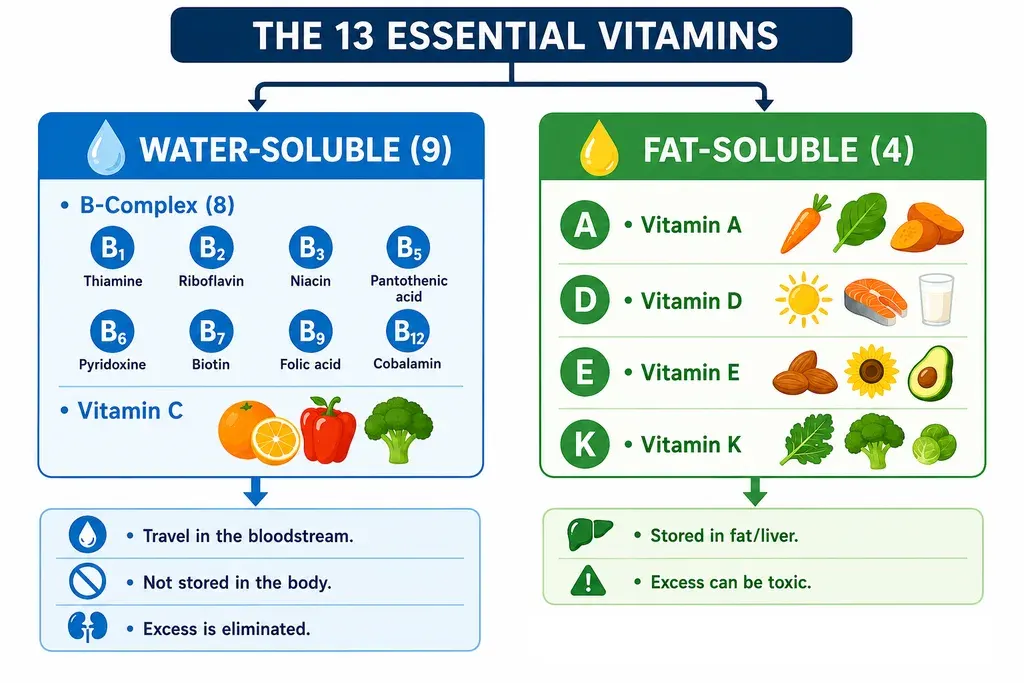
The thirteen essential vitamins are not one tight-knit chemical family. In fact, they look nothing like one another: some are tiny, others are complex spiral structures; some carry metals inside them and others are almost lipids. To make sense of them, science divides them into two large «tribes» according to their relationship with water.
The water-soluble ones
These are the eight vitamins of the B complex (B1, B2, B3, B5, B6, B7, B9 and B12) plus vitamin C.
- How they work: they flow freely through the bloodstream. Since the body is mostly water, these vitamins are in their element.
- The catch: they have all the permanence of a passing guest. Whatever the body does not use day to day is filtered out by the kidneys and eliminated in urine. That is why, apart from very specific exceptions such as B12, you need to replace them almost daily.
The fat-soluble ones
Here we find the royal flush: A, D, E and K.
- How they work: they need the fat in food in order to be absorbed in the intestine. Once inside they do not travel loose through the blood: they require special transport vehicles.
- The advantage (and the risk): unlike their water-soluble sisters, the body does keep reserves of these vitamins in fatty tissue and in the liver. If you go weeks without taking in vitamin A, your body raids the pantry. The flip side is hypervitaminosis toxicity: if you go massively overboard with fat-soluble vitamin supplements, the body has a hard time getting rid of them.
Bioavailability: it is not what you eat, it is what you absorb
There is a common mistake in modern nutrition: assuming that if a label says a food contains 100 mg of a vitamin, your body automatically receives those 100 mg. The biological reality is considerably more complex and hinges on a crucial concept: bioavailability.
Bioavailability is the proportion of a vitamin present in food that your digestive system is able to absorb, transform and genuinely put to use at the cellular level. A great many factors shape that process:
- The chemical form: many vitamins exist in several «versions». Iron or vitamin A of animal origin, for instance, are absorbed far more directly than their plant-based equivalents.
- Preparation and cooking: heat, light or cooking water can destroy some water-soluble vitamins (such as C), but they can curiously increase the bioavailability of others by breaking down the plant’s cell walls, as happens with carotenoids.
- The combinations on the plate: vitamins do not work alone. Vitamin D needs fat present in order to be absorbed; vitamin C multiplies iron absorption; and a coffee or a tea right after a meal can block the absorption of several B vitamins.
Understanding bioavailability is the key to moving from simply «eating well» to genuinely nourishing your cells.
The modern paradox
The story of how vitamins were discovered is a detective novel. Until the late nineteenth century, medicine believed that disease was only ever caused by «external agents»: bacteria, viruses or toxins. The idea that an illness might be caused by the absence of something invisible seemed preposterous.
It took thousands of sailors dying at sea (scurvy) and entire populations fed on nothing but refined rice losing the ability to walk (beriberi) for scientists such as Casimir Funk — who coined the word «vitamin» in 1912 — to grasp the truth: there is life in what is missing.
Did you know? The original term was «vitamine», with a final «e»: a blend of vital and amine, because all of them were thought to contain nitrogen. When chemistry discovered that many were not amines the «e» was dropped, but the word had already stuck for good.
Today we live inside a fascinating paradox. We have all but eradicated the great plagues of extreme deficiency, yet we have fallen into an obsession with mega-dosing: we are surrounded by gummy supplements, fortified drinks and multivitamin «hits».
Current science is clear: more is not always better. Vitamins are not fuel you can stockpile; they are chemical keys (coenzymes and antioxidants). If you have ten locks and ten keys, buying a thousand more keys will not make the door open any faster.
The journey that starts today
Over the course of this series we will publish an article on each of the thirteen essential vitamins. We will dismantle the simplistic pharmacy-bottle view and look at these molecules through the microscope of cutting-edge science.
Each instalment will examine one vitamin in depth, answering what usually goes untold elsewhere: its history, its biochemical mechanisms, its myths and its day-to-day bioavailability tricks.
Bring your curiosity. We are heading into the universe of invisible chemistry that keeps you alive every second.
In the next article we open the series with a heavyweight: vitamin A, the molecule of vision and the pigments of life.
We're building the space for you to comment on the articles.
Continue reading

Glycine: the forgotten building block of life
The key amino acid that slows cellular ageing, improves sleep and rebuilds your tissues from within

The truth about antioxidants
The biology behind our real defence network against oxidative stress

The electricity of food
The metabolic pathways of the macronutrients and how mitochondria reduce food to a source of electrons