Vitamin A
The pigment of sight and the secret code of the skin
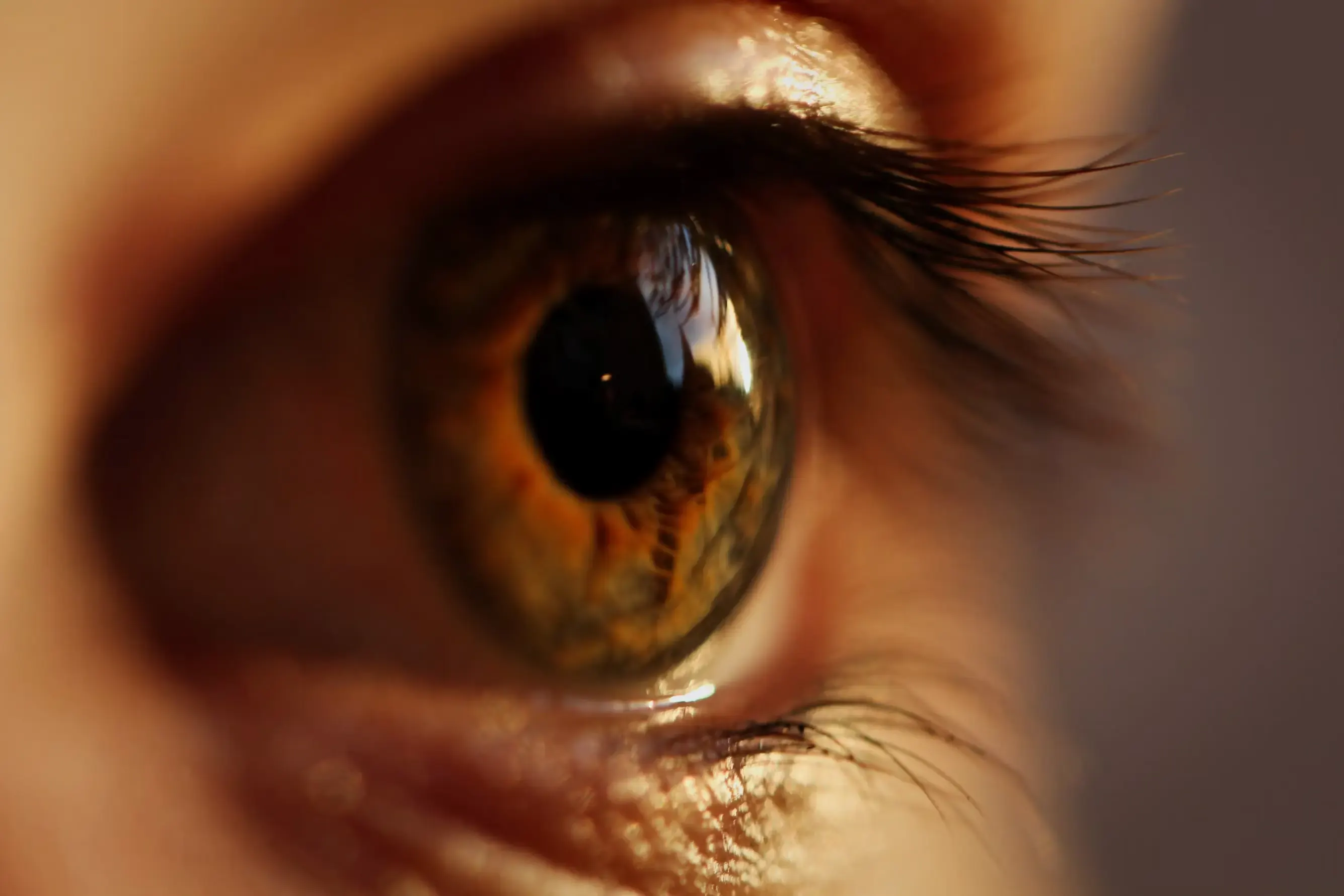
The chronicles of old sailors tell that, after months at sea living on hard biscuit and salted meat, their eyes began to fail the moment the sun went down. They called it «night blindness», and they knew, through an empirical wisdom passed down the generations, that the cure lay in no potion: it lay in eating fresh ox or fish liver. What those sailors could not have imagined is that, in the darkness of their dilated pupils, the liver was delivering a massive cargo of a small fat-soluble molecule able to capture photons and translate them into light for the brain.
Far to the north, on the Arctic expeditions of the nineteenth century, explorers suffered the dark flip side of that very same molecule. After killing polar bears and feasting on their enormous livers, entire crews fell prey to vomiting, terrible dizziness and a lethal drowsiness. A few days later, the skin of their faces and bodies began to peel off in strips. The food that cured the blindness of tropical sailors turned into a searing poison on the polar ice.
Both scenes, separated by thousands of kilometres and centuries of history, are bound together by the same chemical substance. Vitamin A is not merely a nutrient: it is one of the most powerful molecular communication tools ever to have evolved in the animal kingdom, able to switch genes on, direct how cells mature, and allow the miraculous transduction of light into thought.
Fact sheet
| Parameter | Detail |
|---|---|
| Chemical names | Retinol, retinal and retinoic acid (preformed forms); provitamin A carotenoids, such as beta-carotene. |
| Type | Fat-soluble: it dissolves in fat and is stored mainly in the liver. |
| Main superpower | Turning light into electrical signals for the brain, and reprogramming how cells differentiate. |
| Quick fun fact | A polar bear’s liver holds so much concentrated vitamin A that a single serving can be fatal to a human through acute hypervitaminosis. |
A little history…
At the beginning of the twentieth century, nutrition science was going through a deeply reductionist phase. Life, it was believed, needed nothing more than a balanced diet of carbohydrates, proteins, fats and purified minerals. In the laboratories of the University of Wisconsin-Madison, however, the biochemist Elmer McCollum and his young collaborator Marguerite Davis suspected that something else was hiding inside natural foods.
Between 1912 and 1915, McCollum and Davis fed several groups of rats an impeccable synthetic diet of casein, starch, lard and mineral salts. The result was heartbreaking: the animals stopped growing, developed severe inflammation of the conjunctiva until they went blind, and died prematurely. When the lard was swapped for butter or egg-yolk extract, however, the rats recovered their health and their sight almost miraculously.
Both researchers understood that an essential substance was dissolved in the fat of butter, and they named it «fat-soluble factor A», to distinguish it from the «water-soluble factor B» that prevented beriberi. In parallel, at Yale University, Thomas Osborne and Lafayette Mendel independently reached the same conclusion working with cod liver oil.
Two decades later, in the 1930s, the Swiss chemist Paul Karrer solved the molecular puzzle: he described the structure of retinol and showed that beta-carotene — the orange pigment of carrots — was converted into vitamin A inside the human body. The discovery earned him the Nobel Prize in Chemistry in 1937.
A manual of cellular mechanics: what does vitamin A do in your body?
To understand vitamin A you first have to abandon the idea that it simply acts as an «antioxidant». It actually behaves like a genuine steroid hormone. Once inside the body it takes on two great metabolic roles through its different chemical forms.
Retinal: the switch for ocular light
At the back of the eye lies the retina, covered with two kinds of specialised cells: the cones, which perceive colour, and the rods, which capture dim light in black and white and are therefore responsible for low-light vision. Inside the rods there is a protein called opsin.
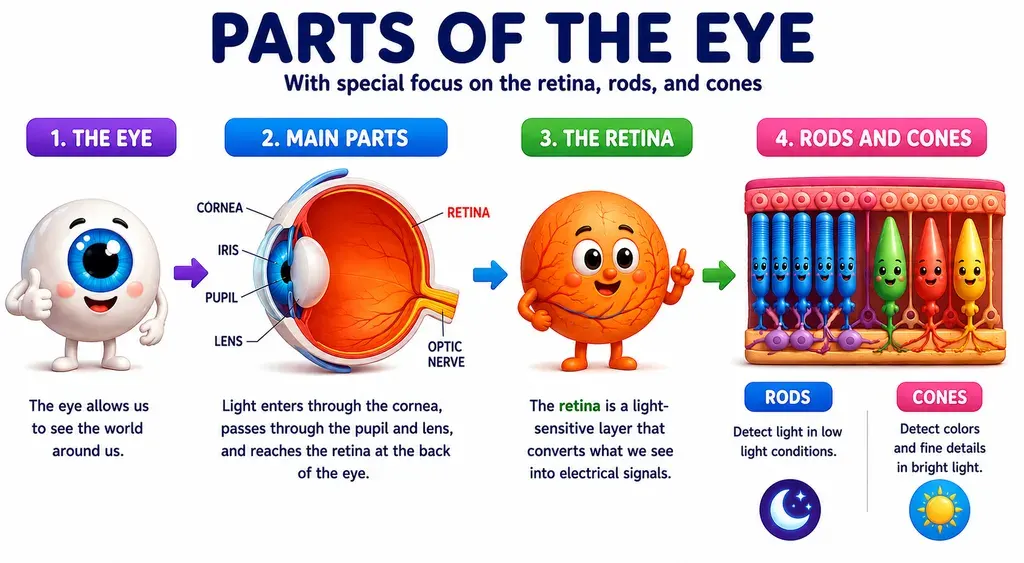
- When vitamin A enters the eye as 11-cis-retinal, it slots into opsin like a key into its lock, forming a complex called rhodopsin.
- When a single photon of light strikes rhodopsin, the retinal molecule undergoes an instantaneous structural change: its chain straightens out and becomes all-trans-retinal.
- That molecular «snap» alters the shape of the protein and triggers an electrical impulse that travels along the optic nerve to the brain. This is the magic of biological physics: light has become information.
- To see again, the body has to unhook that retinal, enzymatically regenerate it back to the 11-cis form, and reassemble rhodopsin. If vitamin A is missing, the circuit breaks and vision in dim light collapses.
Retinoic acid: the sculptor of DNA
While retinal takes care of the eyes, retinoic acid acts far more like a hormone than like a vitamin. It travels to the nucleus of cells and binds to specific receptors — RAR and RXR — that switch hundreds of genes on or off.
Its job? To dictate cell differentiation. It is what tells a stem cell whether it should become protective skin tissue, respiratory mucosa or intestinal lining.
Without enough retinoic acid, the moist cells of the mucous membranes — eyes, lungs, gut — lose their ability to secrete the mucus that protects them, and begin to harden and flake off in a pathological process called keratinisation.
The art of bioavailability
Not all the vitamin A we eat is identical, nor does the body process it in the same way. This is where most people get confused, and where culinary chemistry becomes decisive. There are two main dietary sources, and their metabolic behaviour could hardly be more different.
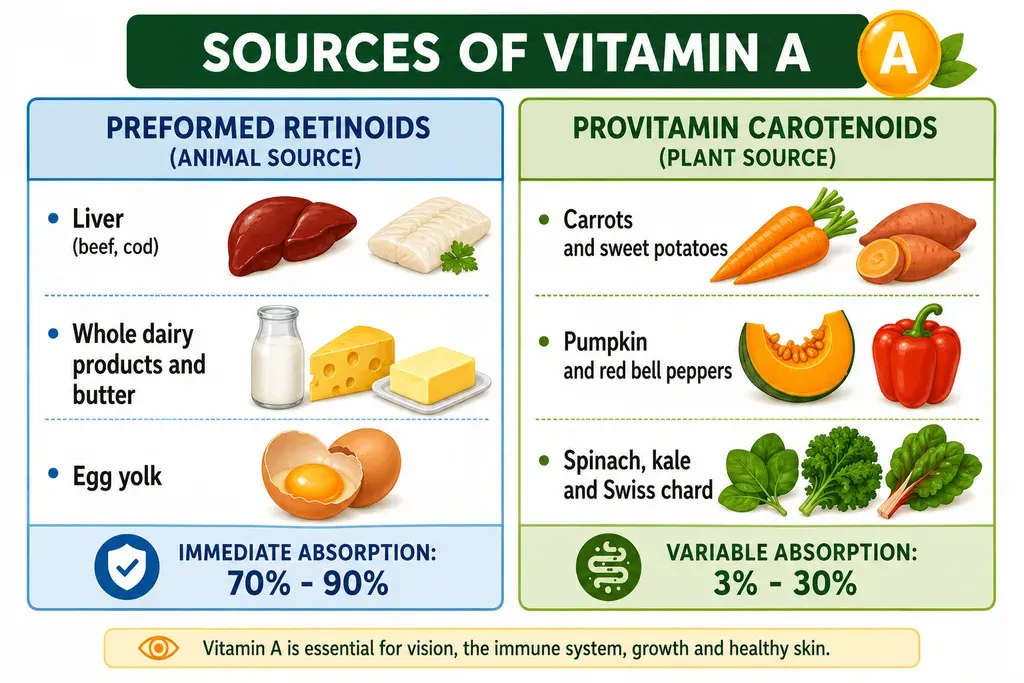
Preformed vitamin A (retinoids)
Found exclusively in foods of animal origin: liver, butter, egg yolk and oily fish. The body absorbs it directly and with very high efficiency, between 70 % and 90 %. It is the active form, ready to go to work.
Provitamin A (carotenoids)
Found in the yellow, orange, red and dark green pigments of the plant kingdom: carrots, sweet potatoes, pumpkin, spinach, peppers. The most famous of them all is beta-carotene.
The catch is that beta-carotene is not active vitamin A: it is a precursor. Your small intestine has to cut that molecule in half using a specific enzyme in order to make retinol, and the conversion rate is surprisingly inefficient. It takes roughly 12 micrograms of dietary beta-carotene to synthesise a single microgram of retinol in the body.
Kitchen strategies to maximise absorption
If you would still rather rely on plant sources, there are ways to squeeze out their bioavailability. The plant matrix locks carotenoids inside very tough cellulose cell walls, so releasing them comes down to three rules:
- Cook and blend. Unlike vitamin C, which is heat-sensitive, gentle or steam cooking and blending carrots and pumpkin break the plant cell membranes and multiply the release of beta-carotene by up to three.
- Always add fat. Because this is a fat-soluble vitamin, the presence of lipids stimulates the secretion of bile salts, which form the mixed micelles needed to carry vitamin A across the intestinal mucosa. A drizzle of extra virgin olive oil over a vegetable soup or a spinach salad raises absorption enormously.
- Mind the synergies and the antagonists.
- Zinc is indispensable: without it, the liver cannot synthesise retinol-binding protein (RBP), and vitamin A stays trapped there, unable to reach the bloodstream.
- Alcohol and light destroy it: chronic alcohol consumption competes for the same dehydrogenase enzymes that convert retinol into retinal, steadily draining liver reserves. Ultraviolet light, for its part, rapidly degrades the carotenoids in food.
Light and shadow: deficiency versus toxicity
Being a fat-soluble molecule, the body does not flush excess vitamin A out in the urine: it stores it in specialised liver cells, the stellate or Ito cells. That depot makes it possible to endure months of scarcity, but it also opens the door to toxicity from excess.
Deficiency: gloom and dryness
Worldwide, vitamin A deficiency remains one of the great public health crises in developing countries, especially among children. The symptoms progress in well-defined stages:
- Nyctalopia (night blindness): the inability to see in dim light, because rhodopsin can no longer be regenerated in the rods.
- Xerophthalmia: the lack of retinoic acid halts mucus production in the conjunctiva. The eye dries out, whitish patches appear on the cornea — Bitot’s spots — and finally the cornea ulcerates and is destroyed (keratomalacia), resulting in irreversible blindness.
- Follicular hyperkeratosis: the skin turns extremely dry, rough and scaly, much like goosebumps, from the build-up of keratin in the hair follicles.
- Immunodeficiency: the loss of integrity in the digestive and respiratory epithelia means that common infections, such as measles or diarrhoea, can turn fatal.
Toxicity: the danger of hypervitaminosis A
Unlike the water-soluble vitamins — C or the B complex — which are easily excreted in the urine when there is a surplus, leftover vitamin A is not eliminated: it accumulates.
- Acute toxicity. It follows massive doses taken in a very short time, as in the case of the polar explorers and the bear liver. It causes intracranial hypertension, violent vomiting, severe dizziness and widespread peeling of the skin.
- Chronic toxicity. It comes from the prolonged use of high-dose synthetic retinol supplements. It can cause liver damage, bone weakness and fractures — by unbalancing bone remodelling — and hypercalcaemia.
- Teratogenic danger. An excess of retinol during the first trimester of pregnancy is extremely dangerous: it disrupts the differentiation of embryonic cells and causes serious congenital malformations.
Mind the distinction: plant beta-carotene does not produce this toxicity. When the stores are full, the body slows down its own enzymatic conversion. The risk lives in preformed retinol and, above all, in supplements.
The myth corner
«Carrots let you see in the dark»
This is one of the most successful myths of the twentieth century, and its origin lies not in a medical laboratory but in the British Air Ministry during the Second World War.
In 1940 the Royal Air Force developed a secret radar system mounted on the aircraft themselves (Airborne Interception radar) that let its pilots shoot down German night fighters before being detected. To hide that technology from enemy intelligence, the British government launched a propaganda campaign attributing the extraordinary night-time performance of the flying ace John Cunningham — nicknamed Cat’s Eyes — and his colleagues to the enormous quantities of carrots they ate. The public believed it, carrot sales soared, and the legend has reached us intact.
The scientific reality is rather more sober: vitamin A prevents night blindness caused by deficiency, but taking more vitamin A when your levels are already normal grants no superhuman vision and does not improve visual acuity.
At the scientific frontier
Current research has stopped looking at vitamin A as a mere nutrient for eyesight and started studying it as a modulator of the immune system and of ageing.
It turns out that the retinoic acid produced in the gut is essential for «educating» T lymphocytes: it stamps them with a kind of molecular postcode that directs them to the intestinal mucosa, and pushes their differentiation towards regulatory T cells, the ones charged with stopping the immune system from attacking our own tissues or our beneficial microbiota. Synthetic vitamin A analogues are now being investigated to treat autoimmune diseases and as differentiating agents in cancer therapies, able to «reprogram» tumour cells so that they behave like normal cells again.
In dermatology, the derivatives of retinoic acid — topical tretinoin, oral isotretinoin — remain the gold standard for reversing photoageing and treating severe acne, because they speed up cell turnover and hold back the breakdown of the collagen matrix in the dermis.
Next stop…
Vitamin A shows how a single molecule can connect the physics of the light entering our eyes with the deep genetics that builds our skin. With the first letter of the biochemical alphabet learned, we are ready to move on.
Next up: vitamin B1 (thiamine), the spark plug of the human engine.
References and scientific support
- The discovery of the «fat-soluble factor A». McCollum, E. V., & Davis, M. (1913). The necessity of certain lipins in the diet during growth. Journal of Biological Chemistry, 15(1), 167-175. View study on ScienceDirect
- The molecular mechanism of vision. Wald, G. (1968). Molecular basis of visual excitation. Science, 162(3850), 230-239. View study on PubMed
- The nuclear receptors of retinoic acid. Chambon, P. (1996). A decade of molecular biology of retinoic acid receptors. FASEB Journal, 10(9), 940-954. View study on PubMed
- How much beta-carotene it takes to make retinol. Tang, G. (2010). Bioconversion of dietary provitamin A carotenoids to vitamin A in humans. The American Journal of Clinical Nutrition, 91(5), 1468S-1473S. View study on PubMed
- The toxicity of polar bear liver. Rodahl, K., & Moore, T. (1943). The vitamin A content and toxicity of bear and seal liver. Biochemical Journal, 37(2), 166-168. View study on PubMed
- The teratogenic risk of excess retinol. Rothman, K. J., Moore, L. L., Singer, M. R., Nguyen, U. S., Mannino, S., & Milunsky, A. (1995). Teratogenicity of high vitamin A intake. The New England Journal of Medicine, 333(21), 1369-1373. View study on PubMed
- The gut «postcode» of T lymphocytes. Iwata, M., Hirakiyama, A., Eshima, Y., Kagechika, H., Kato, C., & Song, S. Y. (2004). Retinoic acid imprints gut-homing specificity on T cells. Immunity, 21(4), 527-538. View study on PubMed
- Retinoic acid and immune tolerance. Mucida, D., Park, Y., Kim, G., Turovskaya, O., Scott, I., Kronenberg, M., & Cheroutre, H. (2007). Reciprocal TH17 and regulatory T cell differentiation mediated by retinoic acid. Science, 317(5835), 256-260. View study on PubMed
- How retinoids hold back photoageing. Fisher, G. J., Datta, S. C., Talwar, H. S., Wang, Z. Q., Varani, J., Kang, S., & Voorhees, J. J. (1996). Molecular basis of sun-induced premature skin ageing and retinoid antagonism. Nature, 379(6563), 335-339. View study on PubMed
We're building the space for you to comment on the articles.
Continue reading
Glycine: the forgotten building block of life
The key amino acid that slows cellular ageing, improves sleep and rebuilds your tissues from within

The truth about antioxidants
The biology behind our real defence network against oxidative stress
The electricity of food
The metabolic pathways of the macronutrients and how mitochondria reduce food to a source of electrons