The cellular response to light
Lipid peroxidation, internal photoprotection and a practical guide to eating: from the armour of grass-fed fat to the danger of industrial oils

In the first part of this series we looked at how chain length and degree of saturation determine the biochemical stability of each kind of fat. That structure does not stay a matter of digestive theory: the fats we eat are built directly into the membranes of our cells. We now turn to the interaction between the lipid composition of the skin and the real environment, the anatomy of oxidation under the sun, and the practical rules for choosing genuinely protective fats day to day.
How the body behaves under sunlight
Sunlight is the most powerful biological stimulus and environmental synchronizer there is. It gives health, regulates our circadian rhythms, promotes the synthesis of nitric oxide for cardiovascular health and is the only source for endogenous vitamin D production. The sun is not a latent biological threat; the real variable is how our internal biochemistry responds when it receives its photons.
The long-chain fats we eat do not float around in a vacuum: they are literally incorporated into the phospholipids that form the membranes of our skin cells. The stability of the skin under ultraviolet radiation therefore depends directly on the kind of fat we used to build those cells.
How unstable fats respond: the anatomy of lipid peroxidation
When someone habitually eats a diet rich in refined vegetable seed oils — abundant in processed food, dressings and fried dishes — the membranes of their skin cells become saturated with polyunsaturated fatty acids: long-chain omega-6.
When ultraviolet rays hit that biologically unstable skin, a destructive process in three phases is set off, known as lipid peroxidation:
- Initiation. The energy of the solar photons rips a hydrogen atom from the vulnerable double bonds of the fatty acids in the cell membrane. That turns a previously normal fat into a highly reactive lipid free radical.
- Propagation. Having no molecular stability, that fatty radical tries to «stabilize» itself by stealing an electron from the oxygen molecule around it, and becomes a peroxyl radical. Immediately, that radical attacks the healthy neighbouring fat in the membrane to steal its hydrogen, which creates a new fatty free radical and a lipid hydroperoxide. The process becomes an uncontrollable domino effect that destroys the architecture of the entire cell membrane in a chain.
- Termination and degradation. As the cell structure breaks down, the final by-products fragment into cytotoxic and mutagenic compounds such as malondialdehyde (MDA) and 4-hydroxynonenal (4-HNE).
The visible consequences of this internal molecular war are drastic:
- Accelerated destruction of collagen and elastin, which leads to deep premature ageing: photoageing.
- The appearance of sun spots, which are nothing more than an accumulation of oxidized pigments and cellular debris.
- A sharp fall in the skin’s tolerance to light, showing up as erythema — burns and redness — after very brief exposures.
The real problem in this scenario is not the ray of sunlight: it is that we have built our skin tissue out of a highly flammable fuel that explodes at the slightest thermal and light stimulus.
How stable fats respond: the cellular shield
When nutrition gives priority to stable fats — the medium-chain fats of coconut and MCT, and quality long-chain saturated and monounsaturated fats — the composition of the cell membranes changes completely.
Under solar stimulus these fats, stripped of vulnerable double bonds, behave in an inert and resistant way. They do not oxidize, they do not break down through peroxidation and they do not generate free radicals. By keeping the integrity and the structure of the cell intact, they act as a genuine internal molecular shield. That lets the body process solar radiation harmoniously and optimally, making the safe synthesis of vitamin D and the protective melanic tan easier while significantly minimizing the inflammatory cascade and oxidative stress.
The systemic protective role of short-chain fats
The short-chain fats produced in the colon are not part of the physical structure of the skin in the way long-chain fats are. Their impact on our relationship with the sun, however, is systemic and profound.
Prolonged sun exposure naturally produces mild local immunosuppression and temporary inflammation in the skin while the body adapts to the stimulus. Short-chain fats — butyrate above all — travel through the bloodstream acting as powerful epigenetic signals that switch off the genes of chronic inflammation and improve the overall immune response. A healthy microbiota producing plenty of short-chain fats ensures that, after sun exposure, the body efficiently activates its cellular repair mechanisms and prevents excessive immune responses or systemic damage.
The myth of the chemical patch versus biological responsibility
If our resilience and our skin health are orchestrated at the cellular level through nutrition, the modern approach of relying blindly on conventional chemical sunscreens reveals its deep shortcomings. The beauty industry has commodified and distorted the very concept of protection, promoting industrial lotions as a «magic patch» that supposedly cancels out any irresponsible behaviour under the sun.
Biological reality is very different. Most conventional commercial sunscreens use chemical filters such as oxybenzone, octinoxate or homosalate. Current scientific literature has shown that these compounds easily penetrate the skin barrier, reach the bloodstream and act as powerful endocrine disruptors that interfere with our hormonal system.
What is more, by artificially blocking the full spectrum of sunlight, these patches keep the body from manufacturing the photoprotective and photomedicinal compounds that the sun itself stimulates, such as subcellular melatonin and vitamin D. It is a paradox of modern health: flooding the body with chemical toxins out of fear of a natural stimulus that the body is perfectly designed to make use of, provided it is properly nourished.
Arguing for sovereign health means replacing the artificial patch with responsible, conscious sun exposure. That rests on two fundamental pillars:
- Build the internal shield. Nourish the body with stable fats, structurally fit to receive light, and banish the industrial oils that make us vulnerable.
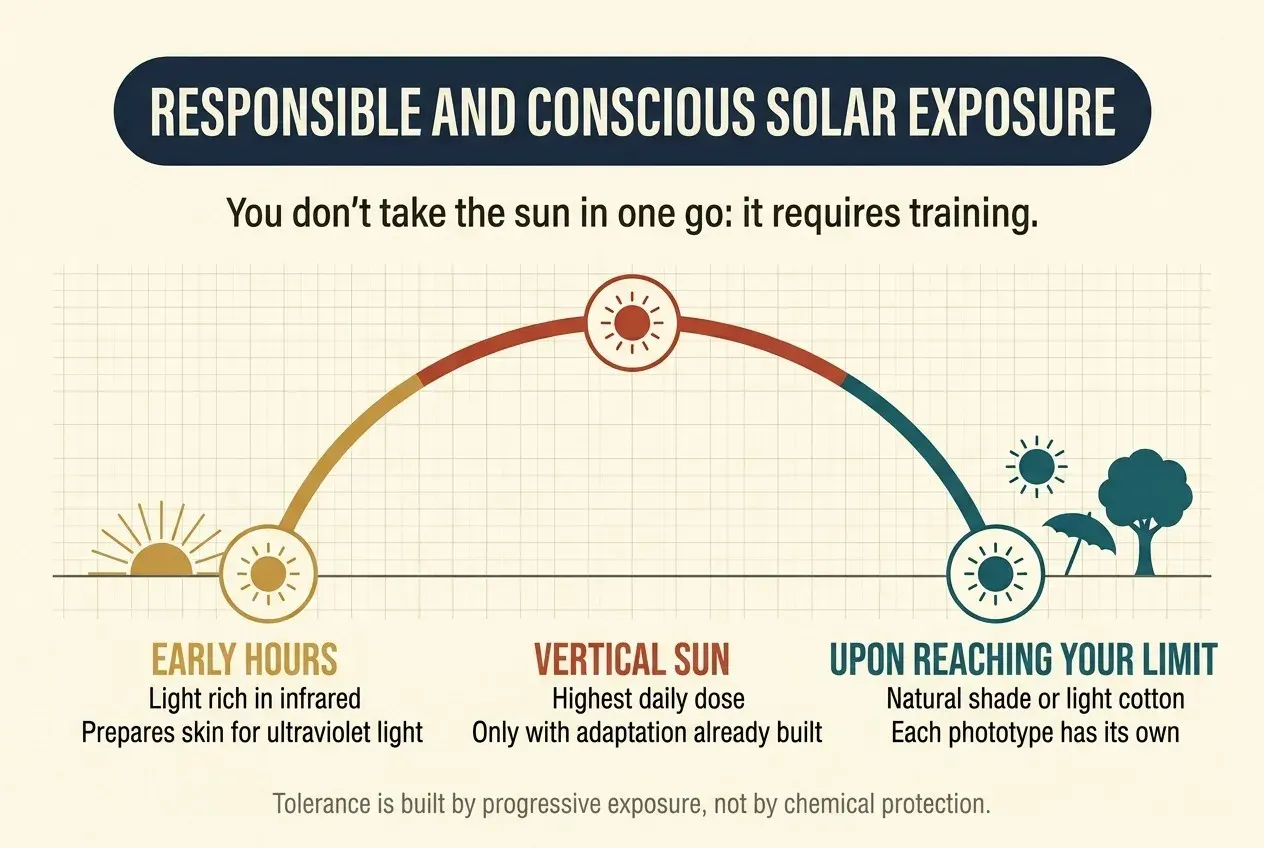
- Respect the timing of biology. Progressively develop what is called the «solar callus» by getting out in the first hours of the morning — light rich in infrared, which prepares the skin for the ultraviolet light that follows — avoid the hours when the sun is highest without proper adaptation, and turn to natural shade or light cotton clothing once you reach the tolerance limit of your own skin type.
A practical guide to the shopping basket
To turn molecular biochemistry into daily decisions that strengthen the body, the pantry should be reorganized around the premise of chemical stability.
Stable fats to prioritize
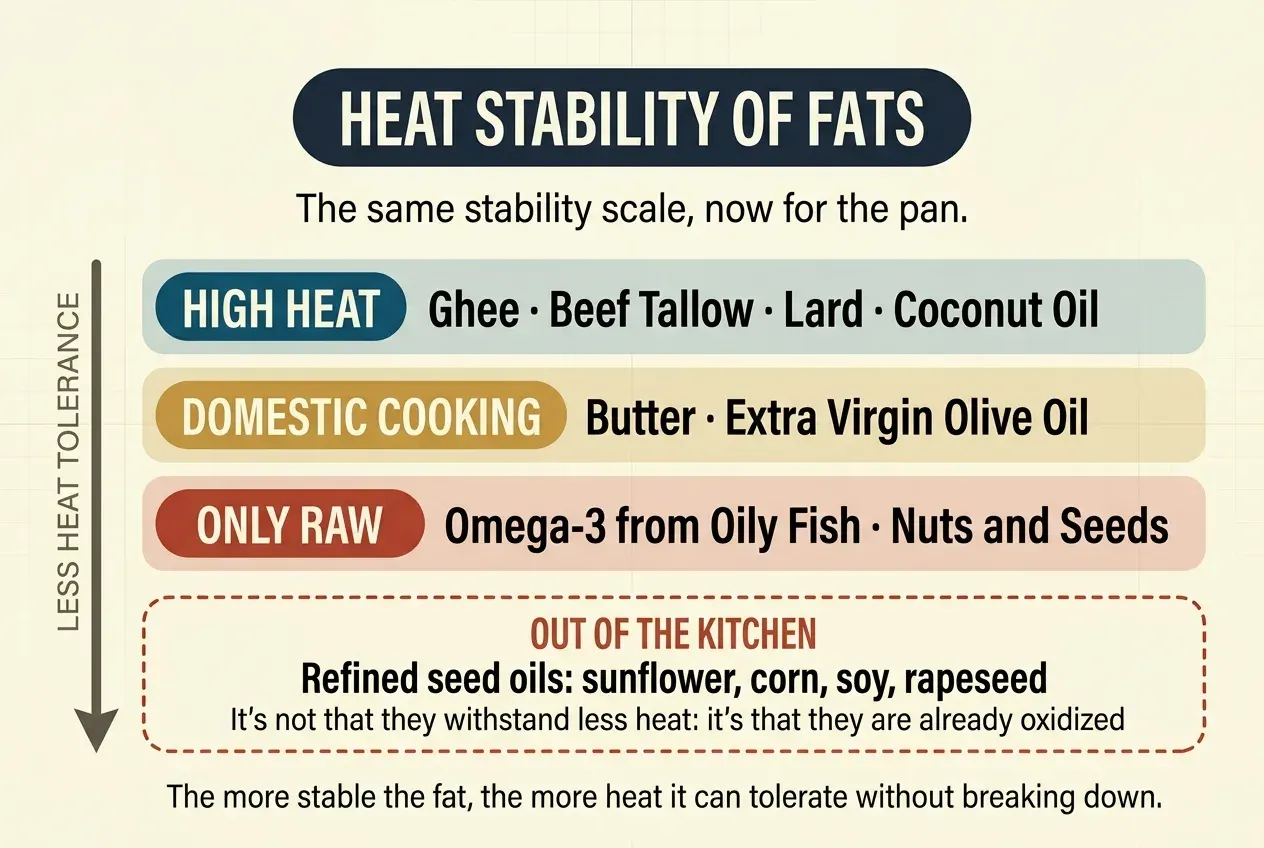
- Coconut oil and pure MCT oil. The kings of the medium chain. Excellent for delivering clean, immediate energy to the brain and the muscles, and practically invulnerable to oxidation by heat or sunlight.
- Fats from grass-fed animals: butter, ghee, beef tallow, lard. Foods from ruminants and animals raised outdoors and fed on pasture — rather than grain and industrial soy or corn feed — have a radically superior lipid profile. They are exceptionally rich in stable saturated long- and medium-chain fats, and contain very high concentrations of conjugated linoleic acid (CLA) and antioxidant precursors such as vitamin E and carotenoids. Those natural antioxidants act in the body by actively protecting the lipids of our membranes from degradation.
- Extra virgin olive oil. Rich in oleic acid, a long-chain monounsaturate. Its single double bond makes it resistant enough to cook at ordinary home temperatures, and it is ideal raw for its huge load of polyphenols, which assist in cellular protection.
Double-edged foods: nuts and seeds
Nuts — walnuts, almonds, hazelnuts — and seeds — flax, chia, sesame — are foods dense in nutrients and antioxidants. Their lipid profile, however, consists mainly of long-chain monounsaturated and polyunsaturated fats, and their evolutionary nature calls for caution: being the «embryos» of plants, they carry strong chemical protection in the form of antinutrients — phytates, oxalates and enzyme inhibitors — designed precisely to prevent their digestion.
In an optimal diet, most fat should come from evolutionarily cleaner and more stable sources: grass-fed animal fats, or fatty fruits such as avocado and coconut. If you decide to include nuts and seeds, their consumption should follow strict rules so that they work in favour of your health rather than against it:
- The danger of industrial processing. Supermarkets commonly stock nuts fried or roasted at high temperatures, often with cheap refined seed oils as the medium. That process destroys their natural antioxidants and oxidizes their fats before they ever reach your mouth. They should be avoided entirely.
- Raw consumption, with the natural armour intact. When you eat a nut or seed raw, its polyunsaturated fatty acids are naturally protected within their own cellular matrix, surrounded by vitamin E and phytonutrients that prevent their degradation. The body absorbs them intact and uses those same antioxidants to hold back lipid peroxidation in the skin endogenously.
- Choice and storage according to stability. Macadamia nuts and hazelnuts are predominantly monounsaturated, which makes them structurally more stable. Walnuts and flax or chia seeds, by contrast, are mostly polyunsaturated and therefore very fragile. If you buy flax or chia already ground so you can digest them, you must keep them in an opaque jar in the fridge; otherwise oxygen will turn them rancid and inflammatory within days.
Unstable fats to banish, or never to heat
- Industrial refined seed oils. Sunflower, corn, soy, canola or rapeseed, and the generic «vegetable» oils. They are massive sources of polyunsaturated omega-6, completely destabilized during industrial refining. Eating them directly weakens your cells’ resistance to the sun.
- Ultra-processed foods. Practically all pastries, ready meals and commercial snacks are made with these cheap, highly unstable fats.
- Healthy polyunsaturates, cold only. The omega-3 fatty acids of oily fish — salmon, sardines — are wonderful for cardiovascular and cognitive health because of their fluidity, but given their extreme instability they must never be heated or exposed to direct sunlight. They have to be kept refrigerated and eaten in their natural form so they do not enter the body already oxidized.
In the end, our body’s resilience does not depend on artificial barriers but on the sovereignty of our food decisions. Choosing the right fats is the first step towards recovering our biological confidence and enjoying the incalculable benefits of sunlight in full harmony once again.
References and scientific support
- Cutaneous lipid peroxidation induced by solar radiation. Ultraviolet radiation preferentially attacks the bis-allylic bonds of the polyunsaturated fatty acids in skin lipids, setting off the cascade of initiation, propagation and release of toxic aldehydes such as MDA and 4-HNE. Reviewed in Oxidative Stress and Skin Diseases: The Role of Lipid Peroxidation (Antioxidants, 2025), at PubMed Central (PMC12108378).
- Comparative stability under the sun: saturated versus unsaturated. In animal models and human sebaceous cells exposed to ultraviolet radiation, squalane — a saturated hydrocarbon — did not worsen oxidative damage or inflammation, while oleic and linoleic acid increased epidermal thickening, wrinkling and the pro-inflammatory cytokines of the PTGS2/IL-1β pathway. The study is Oxidative-Inflammatory Modulation of Skin Lipid Metabolism by Squalane, Oleic Acid, and Linoleic Acid, in Cosmetics, 2025.
- The gut–skin axis. Short-chain fatty acids produced in the colon reach the skin through the circulation and modulate the inflammatory response there via the FFAR2/3 receptors. Reviewed in The role of short-chain fatty acids in inflammatory skin diseases, Frontiers in Microbiology, 2023 (PMC9932284).
- Grass-fed fats, CLA and endogenous antioxidants. Ruminants raised on pasture produce two to three times more conjugated linoleic acid (CLA), triple the α-tocopherol and up to seven times the β-carotene in their fat compared with grain-fed animals. Daley and colleagues, A review of fatty acid profiles and antioxidant content in grass-fed and grain-fed beef, in Nutrition Journal, 2010 (PMC2846864).
- Antinutrients in seeds and nuts. Phytic acid chelates iron, zinc, calcium, magnesium and manganese and blocks their digestive absorption; soaking, germination and fermentation substantially reduce its content. Reduction of phytic acid and enhancement of bioavailable micronutrients in food grains, in Journal of Food Science and Technology (PMC4325021).
We're building the space for you to comment on the articles.
Continue reading

Glycine: the forgotten building block of life
The key amino acid that slows cellular ageing, improves sleep and rebuilds your tissues from within
The electricity of food
The metabolic pathways of the macronutrients and how mitochondria reduce food to a source of electrons

The truth about antioxidants
The biology behind our real defence network against oxidative stress