The molecular architecture
Chain length, degree of saturation and the metabolic fate of fatty acids

For decades the institutional message about nutrition has been flat and reductive: fats were measured almost exclusively by their calorie content, or by a simplistic split between «good» and «bad». Yet human biology does not respond to numbers, it responds to chemical information. A fat’s real identity, its behaviour inside our cells and its resistance to the environment do not depend on its calories but on its molecular architecture: the length of its carbon chain and its degree of saturation.
Understanding that structure is not an academic exercise. It directly dictates everything from how we produce energy in the liver to how the body reacts under a stimulus as vital and natural as sunlight.
The map of fats: chain length
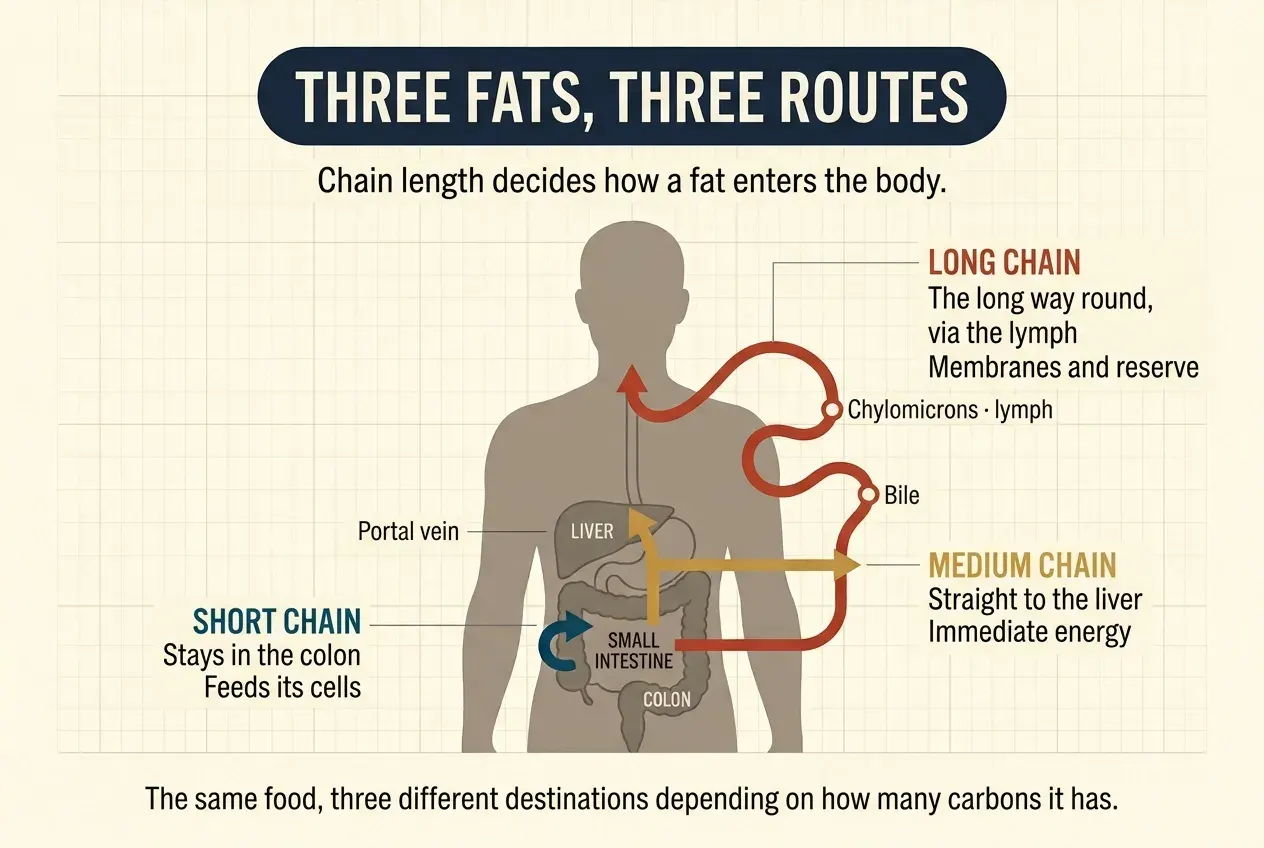
Chemically, the fats we eat — triglycerides — are made of a glycerol molecule bound to three fatty acid chains. Those chains are, essentially, filaments of carbon atoms joined to one another and covered in hydrogen. Depending on how many carbons they carry, we sort them into three broad groups, and each has a completely different fate and function inside the body.
Short-chain fatty acids (SCFA)
They have fewer than 6 carbon atoms in their structure. Their origin is fascinating: we do not usually eat them directly in any quantity, beyond small traces in fermented foods or in milk fat. Instead, our own gut microbiota produces them. When the trillions of bacteria living in the colon ferment the soluble fibre and resistant starches we cannot digest, they manufacture these fatty acids; the most crucial are acetate, propionate and, above all, butyrate.
Main function. They do not travel through the bloodstream to fuel the muscles. Their destination is local: they are the preferred food of the colonocytes, the cells that form the wall of the intestine. By nourishing them, they maintain the integrity of the intestinal barrier and keep toxins from passing into the blood, while also acting as powerful modulators of the immune system and of systemic inflammation.
Medium-chain fatty acids (MCFA or MCT)
They have between 6 and 12 carbon atoms. They occur naturally in coconut oil, palm kernel oil and, to a lesser extent, in goat and cow milk fat.
Main function. Their digestion is a physiological exception. Unlike common fats, medium-chain fats are so short that they need neither bile salts nor pancreatic enzymes to be broken down, and they do not have to be carried by the lymphatic system. They are absorbed directly in the small intestine and travel through the portal vein straight to the liver. There the body metabolizes them at the speed of carbohydrates and turns them at once into pure energy or ketone bodies. They are not easily stored as body fat, and they provide a clean cellular fuel that does not raise insulin.
Long-chain fatty acids (LCFA)
They have 14 or more carbon atoms. This is the most common and abundant group in nature and in the human diet. It includes both saturated fats — found in beef, cocoa and lard — and unsaturated ones: the oleic acid of olive oil and the linoleic and linolenic acids of vegetable oils, nuts and fish.
Main function. Because of their length, their processing is slow and complex. They require full emulsification by bile and then packaging into particles called chylomicrons in order to travel through the lymphatic system before reaching the blood. Their main fate is twofold: either they are used to build the membranes of every cell in the body and give them flexibility, or they are stored in adipose tissue as a dense long-term energy reserve. They are also indispensable vehicles for the absorption of the fat-soluble vitamins A, D, E and K.
The central axis: molecular stability versus instability
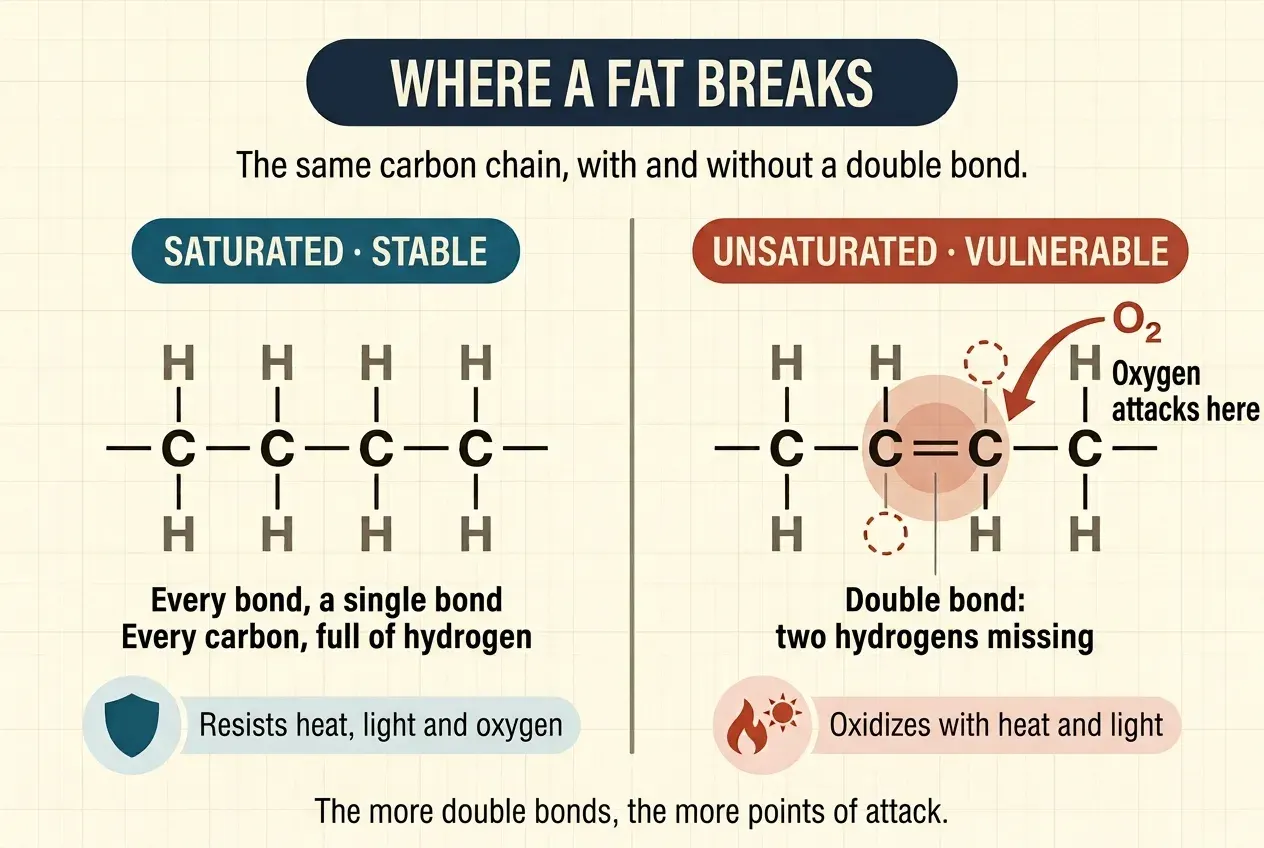
Beyond length there is a critical factor that decides whether a fat keeps its integrity or turns dangerous: the degree of saturation, that is, how the carbon atoms are joined to one another. A single bond keeps the chain rigid and complete; a double bond bends it and opens a flank. Everything else follows from that apparently minor difference.
The armour of saturated fats
In a saturated fat every bond between carbons is a single bond. That means each carbon atom is completely «saturated» with hydrogen atoms. Chemically it is a linear, rigid, compact and extremely stable structure. With no free spaces and no loose electrons, it does not react with oxygen — it does not oxidize — and it is not altered by heat. Coconut oil, which is medium-chain, and the fat of meat, which is long-chain, belong to this category: they keep their structure intact even at high temperatures.
The vulnerability of polyunsaturated fats
Unsaturated fats have one — the monounsaturated — or several — the polyunsaturated — double bonds along their carbon chain. Those double bonds mean hydrogen atoms are missing, which forces the carbons to join through a double bond that physically «bends» the molecule and gives it fluidity.
Biochemically, however, every double bond is a point of extreme weakness. It is a region of high electron density that pulls in the oxygen of the air like a magnet. When oxygen attacks those weak points — a process accelerated by heat and light — it breaks the molecule. Polyunsaturated fatty acids (PUFA), such as the omega-3 and omega-6 present in industrial vegetable seed oils (sunflower, corn, soy, rapeseed), are the most unstable in nature. Cooking with them, exposing them to light or simply storing them badly turns them into a cocktail of free radicals, toxic aldehydes and rancid compounds that are highly inflammatory for the body.
Classification and behaviour of fats
| Type of fat | Main sources | Stability and fate |
|---|---|---|
| Short-chain (SCFA) Fewer than 6 carbons |
Bacterial fermentation of fibre in the colon; traces in butter and ghee | Chemically stable, though volatile with heat. They act in the colon itself: they feed the colonocytes and regulate systemic immunity. |
| Medium-chain (MCT) 6 to 12 carbons |
Coconut oil, palm kernel oil, goat and cow milk fat | Very stable against oxygen and high temperatures. They go through the portal vein straight to the liver: immediate energy and ketone bodies. |
| Long-chain, saturated and monounsaturated (LCFA) 14 or more carbons |
Grass-fed meat, whole dairy, cocoa, extra virgin olive oil | Stable to moderately stable: they tolerate ordinary home cooking. They travel through the lymph in chylomicrons to build membranes, form an energy reserve and transport vitamins A, D, E and K. |
| Long-chain polyunsaturated (PUFA) 14 or more carbons |
Industrial vegetable seed oils, oily fish, nuts | Extremely unstable: they degrade with light, heat and oxygen. They give membranes fluidity and support cognitive function (omega-3), but they oxidize as soon as they are heated. |
From the molecule to the body
Understanding the molecular architecture of lipids shows us that fats are not mere calories but cellular building blocks. That chemical stability, however, goes beyond the laboratory: the real trial by fire comes when the body is exposed to the elements of its environment.
In the second part of this series we will look at what happens inside our cells when the structure of the fats we eat meets the stimulus of sunlight, and at how to put together a shopping basket built for biological resilience.
References and scientific support
- Differentiated absorption and metabolism of MCT versus LCT. Fatty acids with fewer than twelve carbons form no chylomicrons and do not travel through the lymph: they are absorbed directly through the portal vein to the liver, where they are rapidly oxidized to produce ketone bodies. The reference review is Triglycerides of medium-chain fatty acids: a concise review (Jadhav and Annapure, Journal of Food Science and Technology, 2022), available at PubMed Central (PMC9217113).
- MCT in metabolic regulation. The review Dietary medium-chain triacylglycerols in metabolic regulation, published in Trends in Endocrinology & Metabolism (2025), confirms that MCT modulate glucose homeostasis and gut–liver signalling without the peripheral adipose overload caused by long-chain triglycerides.
- Butyrate as a systemic epigenetic signal. Of all the short-chain fatty acids, butyrate is the strongest histone deacetylase inhibitor: it reprogrammes macrophages towards the anti-inflammatory M2 phenotype, favours the differentiation of regulatory T cells through the FOXP3 locus and regulates gene expression beyond the intestine, in the liver, the kidney and adipose tissue as well. Kopczyńska and Kowalczyk, The potential of short-chain fatty acid epigenetic regulation in chronic low-grade inflammation and obesity, in Frontiers in Immunology, 2024 (PMC11008232).
We're building the space for you to comment on the articles.
Continue reading

Glycine: the forgotten building block of life
The key amino acid that slows cellular ageing, improves sleep and rebuilds your tissues from within
The electricity of food
The metabolic pathways of the macronutrients and how mitochondria reduce food to a source of electrons