Structured water: the terrain of health
The liquid battery in your cells, and how to protect it from the modern environment

Traditional biology has taught us to picture the inside of our cells as a kind of microscopic swimming pool. Under this classical paradigm, the nucleus, the mitochondria and the rest of the organelles float in a purely liquid medium, much like the ordinary water that comes out of a tap or that we buy bottled: a chaotic, dynamic and electrically neutral fluid. Yet the most advanced models in contemporary biophysics are showing that this view is incomplete.
The human body is not simply a bag of liquid water. In reality, the element that sustains life inside us behaves like a highly ordered crystalline gel. This “fourth phase of water”, invisible to the naked eye but fundamental to cellular health, acts as a genuine biological battery.
When this gel loses its molecular order and becomes “unstructured”, cellular voltage drops, opening the door to chronic fatigue, premature aging and conditions as complex as cancer. Understanding how this microscopic engine works is the first step towards learning how to keep it running in a world saturated with artificial electromagnetism and disruptive technologies.
Essential glossary
| Term | Definition |
|---|---|
| EZ-phase water (exclusion zone) | The ordered, crystalline state water adopts on contact with cellular surfaces. It pushes out impurities and acts as a negatively charged liquid battery. |
| ATP (adenosine triphosphate) | The main carrier molecule of chemical energy that cells use to carry out their vital metabolic functions. |
| VGCC channels | Gates in the cell membrane that open or close according to electrical voltage, regulating the entry of calcium into the cell. |
| Warburg effect | The phenomenon in which tumor cells switch off their mitochondria and ferment glucose for energy, even in the presence of oxygen. |
| Electrosmog | Invisible pollution caused by the saturation of the environment with artificial electromagnetic fields (Wi-Fi, antennas, mobile networks). |
| Photobiomodulation | The biological mechanism by which cells absorb photons of natural light (such as infrared) to repair tissue and generate energy. |
| Hormesis | The biological process in which a brief exposure to a controlled stress (such as cold or heat) activates defense and repair mechanisms. |
| Mitophagy | The cellular recycling process by which the body breaks down and removes damaged or aged mitochondria. |
| Membrane potential | The difference in electrical voltage between the inside and the outside of a cell, essential for its proper communication and survival. |
| Schumann resonance | The natural electromagnetic frequency that pulses between the Earth’s surface and the ionosphere (approx. 7.83 Hz) and acts as a biological metronome. |
What is structured water?
To understand cellular water, we first need to look at how this liquid behaves at the molecular scale. In a glass of ordinary water, H₂O molecules move chaotically. They attract and repel one another at great speed, colliding billions of times per second in a state of constant thermal disorder.
The picture changes dramatically, however, when water comes into contact with specific surfaces known as hydrophilic (water-attracting). In the body, these surfaces are the macromolecules and biological membranes, such as proteins and collagen. On touching these vascular and cellular structures, a physical phenomenon of self-organization takes place.
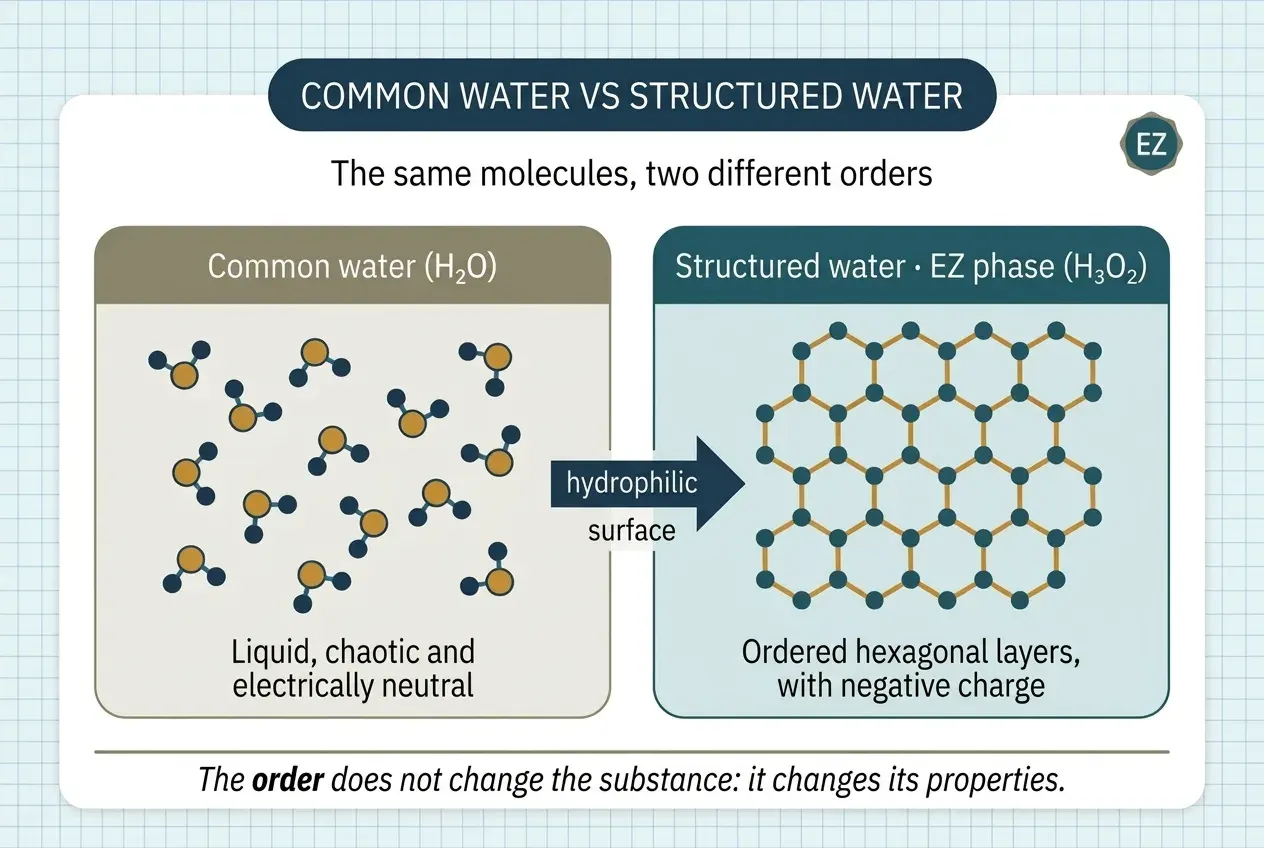
The molecules stop drifting at random and line up in perfect layers that take on a hexagonal geometry, identical to a honeycomb. The American bioengineer Gerald Pollack, of the University of Washington, named this phenomenon exclusion zone water (EZ water), because this molecular lattice is so dense and ordered that it physically pushes out any impurity, solute or bubble that tries to cross it.
As it organizes into this molecular honeycomb, the physical properties of water are transformed. It adopts a geometric arrangement whose ratio is equivalent to H₃O₂, even though chemically these are still tightly coordinated water molecules. Put another way: by packing into a honeycomb, the molecular lattice shares oxygen and hydrogen atoms in such a way that a snapshot of the fabric shows that mathematical signature. This transition changes the rules of the biological game in three fundamental ways.
The making of a biological battery
When water structures itself into the EZ phase, it naturally acquires a negative electrical charge. At the same time, the leftover protons (H⁺) are pushed just outside this zone, creating an adjacent region with a positive electrical charge.
With negative and positive charges separated by a nanometric boundary, the cell creates a potential difference; it literally becomes a living microbattery. This clean, endogenous electrical charge is used by the cell to carry out metabolic tasks without depending exclusively on ATP, the cell’s energy currency.
The invisible hydraulic engine
Traditional medicine assigns the heart the exclusive role of driving blood around the body. However, cutting-edge biophysical models suggest that this separation of charges generates an effect of continuous hydraulic propulsion. By lining the inside of blood vessels, EZ water helps the fluid move through microscopic capillaries that are narrower than the red blood cells themselves, noticeably easing the workload of the heart muscle.
The three-dimensional scaffold of proteins
Proteins and enzymes are the body’s workers, but to function they must “fold” into ultra-specific three-dimensional shapes. This gel of structured water wraps around proteins like a protective mold. If the water surrounding them loses its structure, the protein loses its shape (it denatures) and becomes completely inactive, halting vital functions of the body.
A historical note: the Gilbert Ling effect. This biophysical revolution was not born yesterday. Back in the 1960s, the renowned physiologist and researcher Gilbert Ling was already challenging the prevailing dogma by arguing that the potassium and the water inside cells were not in free solution. Ling put forward the association-induction hypothesis, according to which cellular water is fixed and organized in multiple layers over the cell’s proteins. While twentieth-century medicine focused almost exclusively on biochemistry (molecules and drugs), Ling and today’s biophysicists remind us that life is, above all, an electrical and electromechanical phenomenon in which water is the main stage.
How does the water in our cells become “unstructured”?
If structured water is the natural, healthy state of biology, why do we lose it? Unstructuring happens when the delicate hydrogen bonds holding the hexagonal “honeycomb” together break, causing the gel to collapse and revert to ordinary liquid water (H₂O), losing its electrical charge and its capacity to carry energy.
This collapse does not happen by chance; it is the direct consequence of a biological divorce between our modern lifestyle and the evolutionary environment we were designed for. The main unstructuring agents are:
- Artificial electromagnetic fields (EMFs). The frequencies emitted by Wi-Fi, mobile phones and Bluetooth are pulsed, modulated waves that interfere with the delicate electrical fields of the cell membrane, disturbing the scaffold on which water has to organize itself.
- Water malnutrition. Drinking water that lacks the essential electrolytes deprives the body of the electrostatic anchors it needs. The body is forced to spend its own mitochondrial energy trying to restructure that liquid from scratch.
- Environmental chemical poison. Toxins such as heavy metals or glyphosate (a commonly used herbicide) alter the electrical charges on the surface of cellular proteins, destroying the mold along which water must align.
The electromagnetic battle
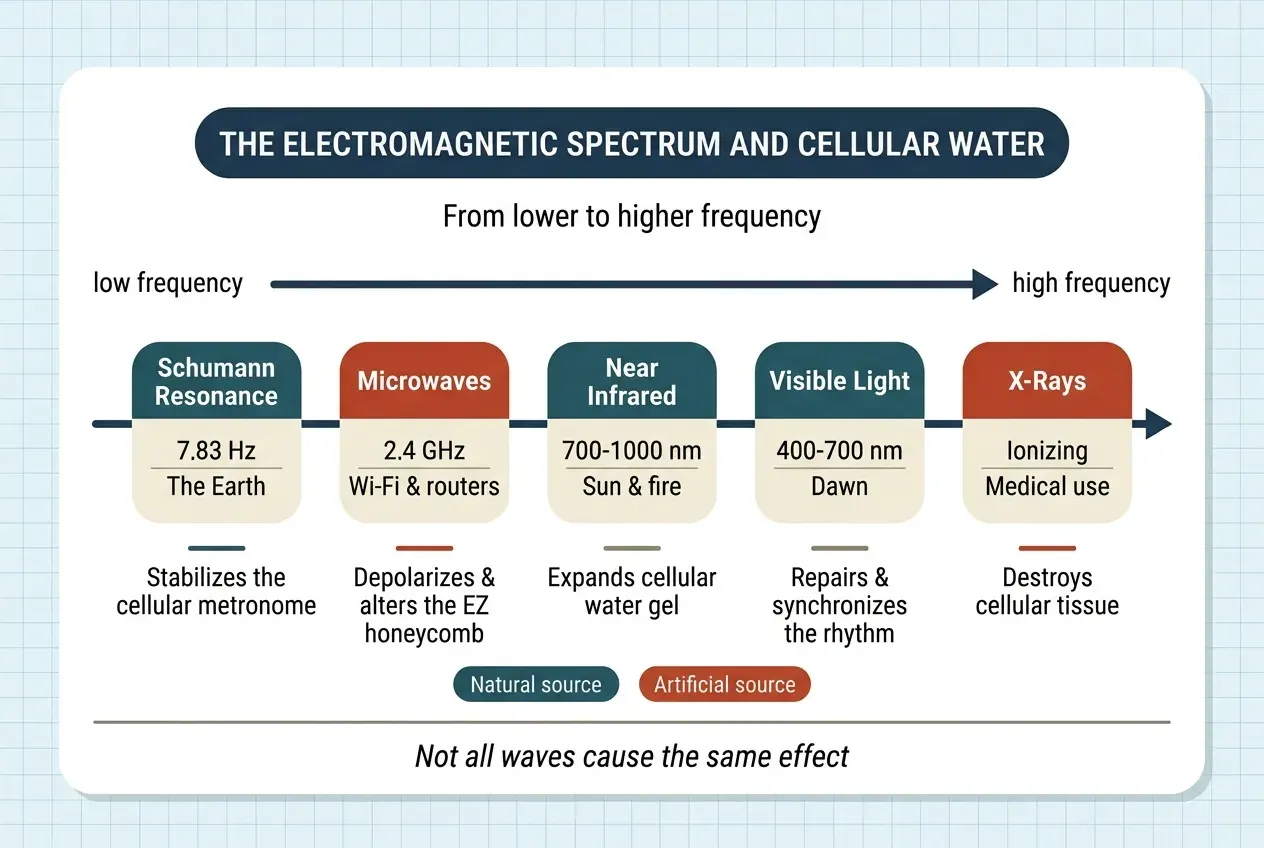
Exclusion zone water is a receiver and transducer of environmental energy. This means it reacts with astonishing sensitivity to the electromagnetic waves around us. But not all waves have the same effect: while artificial technology tends to disorganize it, nature acts as its ultimate charger.
To understand this biophysical clash, we can look at how the different regions of the electromagnetic spectrum interact with the lattice of cellular water:
The beneficial electromagnetic frequencies
The Sun and the Earth act as the chief engineers of our cellular water. Near-infrared light (NIR), which makes up more than 50% of the solar spectrum and reaches us as natural heat, is the most powerful fuel for expanding EZ water. When infrared photons penetrate our tissues, the hexagonal honeycomb of water absorbs that energy and the exclusion zone multiplies its size and its electrical charge.
In the same way, the Schumann resonance (7.83 Hz), the natural electromagnetic pulse that beats between the Earth’s surface and the ionosphere, works as a biological metronome. It keeps the baseline electrical fields of our membranes stable, allowing water to remain in its crystalline phase.
Modern artificial electromagnetic fields
On the other side of the scales we find electromagnetic pollution, or electrosmog. Waves such as those from Wi-Fi or mobile phones operate at microwave frequencies (typically 2.4 GHz or 5 GHz). These artificial frequencies, pulsed and modulated, do not exist continuously in nature.
When these waves pass through the body, they interfere disruptively with the charge sensors of the voltage-gated calcium channels (VGCCs) in the cell membrane. As the ionic balance is disturbed, the cell enters a state of secondary oxidative stress that degrades the protein scaffold and drains the cell’s liquid battery.
Unstructured water and cancer
For the last century, cancer research has focused almost exclusively on the genome: mutations in DNA that make a cell replicate out of control.
However, a growing scientific current is reviving the metabolic and biophysical theory of cancer, in which structured water plays a leading role: cancer cells show a depressed (depolarized) membrane potential. Whereas a healthy cell maintains a healthy negative voltage of between −60 and −70 millivolts thanks to its dense layer of structured EZ-phase water, tumor cells show an alarmingly low voltage, close to zero or even positive.
What happens when the water battery runs flat?
- Collapse of cellular stability. As the protective gel of EZ water disappears, the regulatory proteins responsible for overseeing DNA replication (such as the famous tumor suppressor protein p53) misfold because they have lost their water mold, and they stop working.
- The Warburg effect. Discovered by the Nobel laureate Otto Warburg, this phenomenon describes how cancer cells switch off their mitochondria (they stop using oxygen) and turn to fermenting glucose on a massive scale in the cytoplasm in order to survive. The mitochondrion is not just an ATP factory; it is an internal infrared lamp which, when healthy, emits light that structures the water around it. When the mitochondrion switches off, the cellular environment acidifies, altering the internal pH and destroying the biophysical conditions needed for water to order itself again.
- The archaic survival mechanism. Left without endogenous infrared radiation and without structured water, the cell enters a “state of biophysical panic”. Having lost its structural identity and its crystalline order, it activates the oldest genetic program of unicellular evolution: to proliferate and divide indefinitely at the expense of its surroundings so as not to die.
From this perspective, unstructured water is not a supporting actor: it is the degraded biological terrain that allows the seed of cancer to germinate.
The danger of miracle-water marketing
The appearance of this scientific research has, unfortunately, led to the proliferation of a pseudoscientific market. The internet is flooded with magnetic wands, jugs costing thousands of euros and bottles with supposedly magical vortices that promise to sell “bottled structured water, ready to drink”.
From a strictly physical point of view, it is vital to bear in mind that structured water is not something that can be stored in a plastic bottle on a shelf. EZ water is a dynamic state that depends on its interaction with living biological surfaces and constant energy fields. Buying water labeled as “structured” is biological nonsense; real restructuring happens inside the body when its cells are given the right environmental stimuli.
How to keep your water structured
Preventing the water in our cells from losing its structure does not require expensive technology, but a return to ancestral biophysical habits. Some of the fundamental pillars for keeping the cellular gel in optimal condition are:
- Natural photobiomodulation. Expose yourself to sunlight deliberately, especially at sunrise or sunset. At those times the sun emits its highest ratios of red and infrared light, which penetrates the skin and directly expands the exclusion zone of the cells without the risk of burns from concentrated UV radiation.
- Grounding. Walk on, and stay in direct contact with, grass, beach sand or nature in general. The Earth holds an unlimited negative electrical charge. By touching it with bare skin, we absorb free electrons that travel through the connective tissue, acting as an electrostatic anchor that stabilizes the negative charge of our internal water.
- Mineralization and real hydration. Modern filtering systems (such as reverse osmosis) often give us demineralized water lacking the essential electrolytes needed to fix the structure. If you drink this kind of water, it is advisable to add a pinch of unrefined sea salt (grey salt or Celtic salt) to supply minerals that serve as structural support for molecular ordering.
- Night-time electromagnetic hygiene. Rest is the moment when the cell cleans itself (mitophagy). Reducing artificial electromagnetic noise at night—for example, by switching off the home Wi-Fi router and mobile phones—and avoiding sleeping near large appliances or ungrounded sockets are good ways to protect this process.
- Thermotherapy: the power of cold through hormesis. Cold-water baths (close to 4 °C) trigger a beneficial thermal shock response. To defend themselves against the cold stimulus, mitochondria are forced to work and to emit endogenous infrared radiation from within the tissues, expanding EZ water as a mechanism of cellular protection.
Conclusion
In a medical and publishing environment dominated almost entirely by allopathic pharmacology and chemical treatments, the physics of structured water forces us to take other perspectives into account. Understanding that we are not mere containers of passive liquids, but complex electrical systems sustained by a living crystalline gel, profoundly changes the rules of prevention and wellbeing.
The degradation of EZ-phase water is not a disease in itself; it is the loss of primary molecular order. When artificial lights, the magnetic isolation of urban life and electromagnetic pollution silently drain the liquid battery of our cells, the body responds by shutting down its most sophisticated systems.
Reducing the incidence of modern degenerative conditions, or fighting chronic fatigue, could depend on something as fundamental as giving the cell back the evolutionary stimuli it was designed for. Ultimately, human health is not only an intricate biochemical equation of calories and nutrients, but a delicate biophysical balance of light, water and the Earth’s magnetism. Reconnecting with nature is no longer a mere lifestyle suggestion; it is a biological imperative for keeping the spark of life alight.
References and scientific support
- The reference work on exclusion zone water. Pollack, G. H. (2013). The Fourth Phase of Water: Beyond Solid, Liquid, and Vapor. Ebner & Sons Publishers. View the book at the publisher
- Hydrophilic surfaces order water over unexpectedly long distances. Zheng, J. M., Chin, W. C., Khijniak, E., Khijniak, E., Jr., & Pollack, G. H. (2006). Surfaces and interfacial water: evidence that hydrophilic surfaces have long-range impact. Advances in Colloid and Interface Science, 127(1), 19-27. View study (DOI)
- Infrared radiation expands the exclusion zone. Chai, B., Yoo, H., & Pollack, G. H. (2009). Effect of radiant energy on near-surface water. The Journal of Physical Chemistry B, 113(42), 13953-13958. View study (DOI)
- Ordered structures next to hydrophilic surfaces, seen by cryo-electron microscopy. Hwang, S. G., Hong, J. K., Sharma, A., Pollack, G. H., & Bahng, G. W. (2018). Exclusion zone and heterogeneous water structure at ambient temperature. PLOS ONE, 13(4), e0195057. View study (DOI)
- A spontaneous flow in hydrophilic tunnels, fuelled by infrared. Li, Z., & Pollack, G. H. (2020). Surface-induced flow: a natural microscopic engine using infrared energy as fuel. Science Advances, 6(19), eaba0941. View study (DOI)
- An independent critical review: the phenomenon reproduces, its explanation remains in dispute. Elton, D. C., Spencer, P. D., Riches, J. D., & Williams, E. D. (2020). Exclusion zone phenomena in water—a critical review of experimental findings and theories. International Journal of Molecular Sciences, 21(14), 5041. View study (DOI)
- The founding text of the association-induction hypothesis. Ling, G. N. (1962). A Physical Theory of the Living State: The Association-Induction Hypothesis. Blaisdell Publishing Co. View the book on the Internet Archive
- ATP as the cardinal adsorbent that keeps cellular water ordered. Ling, G. N. (2001). Life at the Cell and Below-Cell Level: The Hidden History of a Fundamental Revolution in Biology. Pacific Press. View the book on the Internet Archive
- Electromagnetic fields act through voltage-gated calcium channels. Pall, M. L. (2013). Electromagnetic fields act via activation of voltage-gated calcium channels to produce beneficial or adverse effects. Journal of Cellular and Molecular Medicine, 17(8), 958-965. View study (DOI)
- Oxidative stress in 93 of 100 studies on low-intensity radiofrequency. Yakymenko, I., Tsybulin, O., Sidorik, E., Henshel, D., Kyrylenko, O., & Kyrylenko, S. (2016). Oxidative mechanisms of biological activity of low-intensity radiofrequency radiation. Electromagnetic Biology and Medicine, 35(2), 186-202. View study (DOI)
- Twenty minutes of Wi-Fi shrank the exclusion zone by 15 to 20% (preprint, not peer-reviewed). Lee, J. W., & Pollack, G. H. (2021). Impact of Wi-Fi energy on EZ water. ScienceOpen Preprints. View preprint (DOI)
- The classic paper on the damaged respiration of the tumor cell. Warburg, O. (1956). On the origin of cancer cells. Science, 123(3191), 309-314. View study (DOI)
- The theory that linked membrane voltage to the control of mitosis and the origin of cancer. Cone, C. D., Jr. (1971). Unified theory on the basic mechanism of normal mitotic control and oncogenesis. Journal of Theoretical Biology, 30(1), 151-181. View study (DOI)
- Tumor cells are depolarized compared with healthy ones. Yang, M., & Brackenbury, W. J. (2013). Membrane potential and cancer progression. Frontiers in Physiology, 4, 185. View study (DOI)
- Cancer as a mitochondrial disease before a genetic one. Seyfried, T. N. (2012). Cancer as a Metabolic Disease: On the Origin, Management, and Prevention of Cancer. John Wiley & Sons. View the book (DOI)
- Membrane voltage directs the differentiation and proliferation of tissues. Levin, M. (2012). Molecular bioelectricity in developmental biology: new tools and recent discoveries. BioEssays, 34(3), 205-217. View study (DOI)
- How red and infrared light acts on mitochondrial cytochrome c oxidase. Hamblin, M. R. (2017). Mechanisms and applications of the anti-inflammatory effects of photobiomodulation. AIMS Biophysics, 4(3), 337-361. View study (DOI)
- Contact with the electrons of the Earth’s surface. Chevalier, G., Sinatra, S. T., Oschman, J. L., Sokal, K., & Sokal, P. (2012). Earthing: health implications of reconnecting the human body to the Earth’s surface electrons. Journal of Environmental and Public Health, 2012, 291541. View study (DOI)
- The principle of hormesis: a brief, controlled stress activates repair. Calabrese, E. J., & Baldwin, L. A. (2003). Hormesis: the dose-response revolution. Annual Review of Pharmacology and Toxicology, 43, 175-197. View study (DOI)
We're building the space for you to comment on the articles.
Continue reading

The physiology of dawn
Why the sunlight you meet on waking is the biochemical signal your body needs to oxidise fat efficiently

The problem with the modern eye
The visual toll of modern life, and the scientific evidence on how the sun restores the metabolism of vision
Bioelectricity: can voltage cure cancer?
The tissues of the human body coordinate their anatomy through voltage. What if cancer were, in fact, a problem of electrical communication?