On testosterone, status and metabolic health
A neurobiological journey through the hormone that governs how we position ourselves before others, and how to tune its inner factory

For decades, popular culture has cast testosterone as the chief villain of male behaviour, tying it almost exclusively to irrational aggression, violence and antisocial conduct. Modern neuroendocrinology, however, has begun to paint a far more complex and fascinating picture: testosterone is not simply the “aggression hormone” but a sophisticated behavioural modulator geared towards the pursuit and maintenance of social status.
Understanding this steroid molecule means examining both its impact on decision-making within society and the metabolic mechanisms that regulate its synthesis in the body.
The neuroscience of behaviour: dominance or reputation?
Early testosterone research drew its conclusions from correlations observed in prisons or in animal models. Today, through controlled experiments built on economic games — such as the well-known ultimatum game — science has been able to isolate its causal effect on the human brain.
When testosterone is administered exogenously in experimental settings, participants do not react with blind violence but with sensitivity to fairness and to status:
- Response to provocation. If a player makes an unfair offer, participants with higher testosterone levels are significantly more likely to punish the offender, even at a personal cost. This supports the hormone’s role in defending social standing against disrespect or abuse.
- Strategic prosociality. Surprisingly, when interactions are fair or generous, testosterone increases the willingness to reward the other party with greater magnanimity. Generosity, in the right context, is a key tool for building prestige within the group.
Testosterone does not push you to throw a punch: it pushes you not to end up beneath anyone. Sometimes that means punishing an offence; other times, being the most generous person in the room.
Wiping out the audience effect
A cornerstone of social psychology is the audience effect: our tendency to shift our decisions so as to appear more prosocial or altruistic when we know we are being watched.
Recent research shows that testosterone dampens or eliminates this effect. In a trial with almost two hundred participants who worked through a reinforcement-learning task, sometimes in private and sometimes under observation, a single dose of testosterone was enough to suppress feigned prosociality entirely. Under the hormone’s influence, individuals show less submission to audience expectations, and steer their choices by direct dominance rather than adjusting their behaviour strategically just to please onlookers. In evolutionary terms, testosterone reduces anxiety about social evaluation and subordination to others.
Physiology and natural optimisation
Grasping testosterone’s social role leads inevitably to the question: how does the body regulate its levels?
It is crucial to draw the line between lifestyle optimisation and clinical intervention. Testosterone replacement therapy (TRT) is a medical tool reserved strictly for hypogonadism or clinical deficiency, defined by a total testosterone concentration below 300 ng/dL measured on at least two consecutive morning tests and accompanied by clear symptoms, such as severe fatigue, erectile dysfunction or appreciable loss of muscle mass.
For a healthy population, genuine biological optimisation does not come from drugs but from balancing the hypothalamic-pituitary-gonadal axis through three lifestyle pillars:
- Sleep architecture. Testosterone secretion follows a circadian rhythm that peaks during deep-sleep phases. Chronically restricting rest is enough to cut circulating testosterone: one week of sleeping five hours a night lowers daytime levels by 10 to 15% in young, healthy men.
- Exercise and the neuromuscular response. Strength training with appropriate loads and high-intensity anaerobic exercise (HIIT) stimulate an acute release of testosterone and increase the sensitivity of its receptors. By contrast, prolonged and exhausting cardiovascular exercise drives up cortisol, a stress hormone that acts directly against androgen synthesis.
- Nutrition and micronutrients. Steroid hormones are synthesised from cholesterol, so diets severely restricted in healthy fats compromise their production. Correcting subclinical deficiencies of zinc and vitamin D3 is likewise indispensable to keep the endocrine machinery running at full capacity.
Endocrine interconnection
Testosterone is not regulated in isolation but within an interconnected hormonal network. One of the most relevant endocrine relationships, and one of the most frequently overlooked, is the interaction between the thyroid gland and the gonadal axis.
- The hypothyroidism and prolactin trap. When the thyroid slows down, the body responds by ramping up signals that secondarily stimulate prolactin production. This excess of circulating prolactin (hyperprolactinaemia) acts as a direct brake on the hypothalamus and the pituitary, suppressing the release of luteinising hormone (LH). Since LH is the main stimulus for testicular cells to synthesise testosterone, thyroid dysfunction ends up producing central or secondary hypogonadism.
- Symptomatic impact. This indirect cascade not only lowers blood levels but triggers clinical manifestations such as a sharp drop in libido, erectile dysfunction, infertility and even gynaecomastia (enlargement of breast tissue).
- Altered hormone metabolism. Thyroid disorders also directly modify the rate at which androgens are metabolised in plasma and how they are distributed, which shows that general metabolic health is the first cornerstone of hormonal availability.
The metabolic trap: oestradiol, visceral fat and sugar
To understand hormonal dynamics we need to talk about the relationship between testosterone and oestrogens, specifically oestradiol.
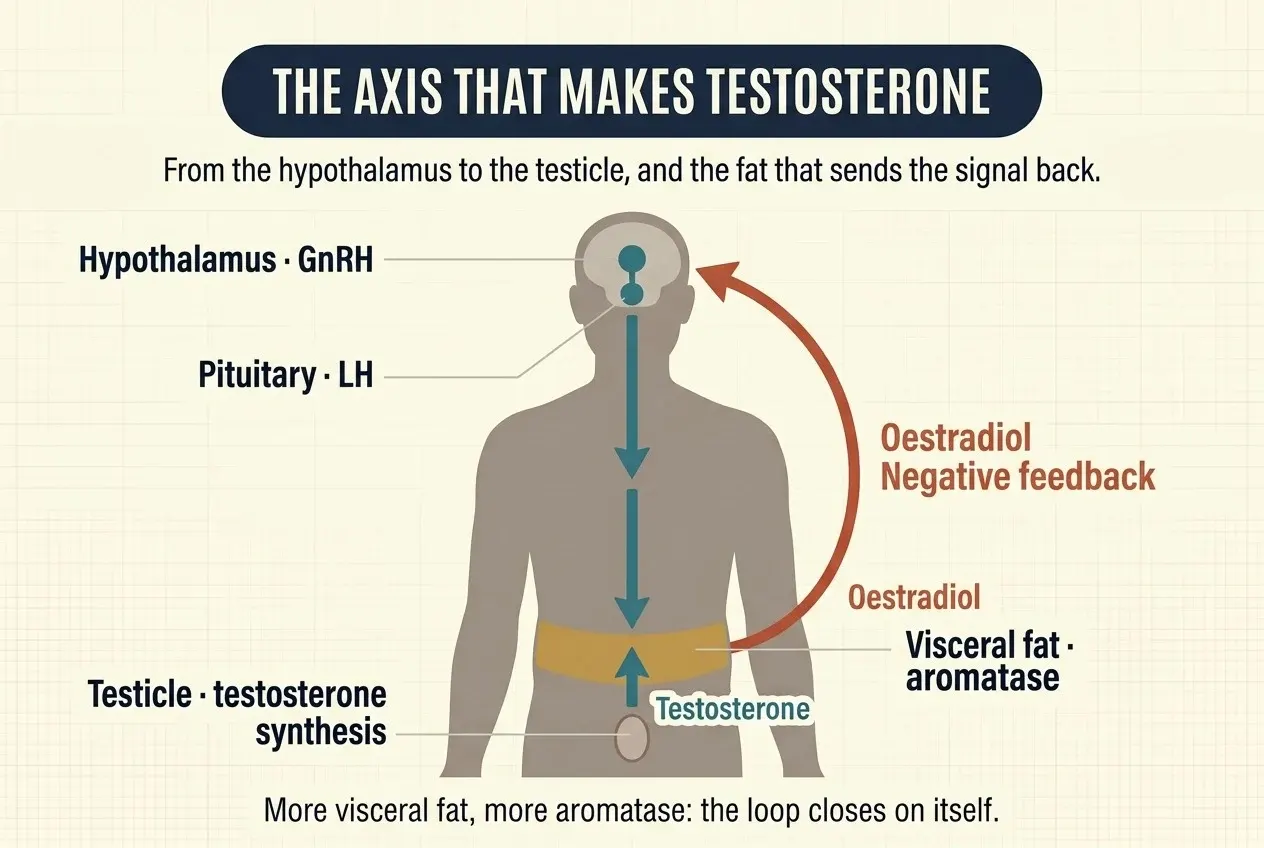
Oestradiol is the main form of oestrogen in the human body. In men, part of the testosterone is continuously converted into oestradiol by an enzyme called aromatase. A proper balance between the two hormones — the testosterone/oestradiol ratio — is vital for bone health, cardiovascular health and cognitive function. That balance, however, can easily break down through two metabolic factors.
Aromatisation by fat mass
Visceral adipose tissue — abdominal fat — is rich in aromatase. When there is excess weight or metabolic overweight, the enzyme’s activity surges and converts high proportions of free testosterone into oestradiol.
This creates a vicious circle: the less free testosterone available, the harder it is to maintain muscle mass and the greater the tendency to accumulate adipose tissue, which increases aromatisation further still. Excess oestradiol also feeds back negatively on the hypothalamic-pituitary axis and dampens the signal that orders testosterone production. Losing body fat reduces aromatase activity and naturally restores free testosterone levels.
It is not that fat merely accompanies low testosterone: it manufactures it. Visceral adipose tissue is, quite literally, a hormone conversion plant.
The acute impact of sugar
Consuming simple sugars and high-glycaemic-index carbohydrates causes rapid spikes in blood glucose and insulin. These hyperglycaemic spikes acutely and immediately suppress circulating testosterone: an oral glucose load depresses total testosterone over the following two hours, and the drop is pronounced enough to alter the result of a hormone test. Keeping blood glucose stable is therefore a direct strategy for preserving hormonal availability throughout the day.
Conclusion: a tool for social and physical adaptation
Testosterone is far more than a gym stereotype or a cliché of aggression. From a neurobiological standpoint, it is a hormone shaped by evolution to help the individual navigate social hierarchies, driving them to respond to injustice, protect their status and act generously when the context calls for it.
Physiologically, its levels work as a thermometer of our metabolic health. Optimising testosterone does not mean chasing aggression, but cultivating a biological environment that favours vitality, clarity of decision and the capacity to respond firmly to the challenges around us.
References and scientific support
- Testosterone, punishment and generosity in the same experiment. Dreher, J. C., Dunne, S., Pazderska, A., Frodl, T., Nolan, J. J., & O’Doherty, J. P. (2016). Testosterone causes both prosocial and antisocial status-enhancing behaviors in human males. Proceedings of the National Academy of Sciences, 113(41), 11633-11638. View study on PubMed Central
- Testosterone eliminates feigned prosociality. Kutlikova, H. H., Zhang, L., Eisenegger, C., van Honk, J., & Lamm, C. (2023). Testosterone eliminates strategic prosocial behavior through impacting choice consistency in healthy males. Neuropsychopharmacology, 48(10), 1541-1550. View study on PubMed Central
- The role of testosterone in social interaction. Eisenegger, C., Haushofer, J., & Fehr, E. (2011). The role of testosterone in social interaction. Trends in Cognitive Sciences, 15(6), 263-271. View study (DOI)
- Dominance versus submissiveness: a neural framework. Terburg, D., & van Honk, J. (2013). Approach-avoidance versus dominance-submissiveness: a multilevel neural framework on how testosterone promotes social status. Emotion Review, 5(3), 296-302. View study (DOI)
- The 300 ng/dL diagnostic criterion. Mulhall, J. P., Trost, L. W., Brannigan, R. E., Kurtz, E. G., Redmon, J. B., Chiles, K. A., Lightner, D. J., Miner, M. M., Murad, M. H., Nelson, C. J., Platz, E. A., Ramanathan, L. V., & Lewis, R. W. (2018). Evaluation and management of testosterone deficiency: AUA guideline. The Journal of Urology, 200(2), 423-432. View study (DOI)
- One week of short sleep is enough to lower testosterone. Leproult, R., & Van Cauter, E. (2011). Effect of 1 week of sleep restriction on testosterone levels in young healthy men. JAMA, 305(21), 2173-2174. View study on PubMed Central
- Impaired sleep and low testosterone in the general population. Patel, P., Shiff, B., Kohn, T. P., & Ramasamy, R. (2019). Impaired sleep is associated with low testosterone in US adult males: results from the National Health and Nutrition Examination Survey. World Journal of Urology, 37(7), 1449-1453. View study (DOI)
- Eight weeks of HIIT against testosterone and cortisol. Ambroży, T., Rydzik, Ł., Obmiński, Z., Błach, W., Serafin, N., Błach, B., Jaszczur-Nowicki, J., & Ozimek, M. (2021). The effect of high-intensity interval training periods on morning serum testosterone and cortisol levels and physical fitness in men aged 35-40 years. Journal of Clinical Medicine, 10(10), 2143. View study on PubMed Central
- The thyroid as a regulator of the gonadal axis. Krassas, G. E., Poppe, K., & Glinoer, D. (2010). Thyroid function and human reproductive health. Endocrine Reviews, 31(5), 702-755. View study (DOI)
- Hypothyroidism and hypogonadism in men and boys. Meikle, A. W. (2004). The interrelationships between thyroid dysfunction and hypogonadism in men and boys. Thyroid, 14(Suppl. 1), S17-S25. View study (DOI)
- Visceral fat, aromatase and secondary hypogonadism. Fernandez, C. J., Chacko, E. C., & Pappachan, J. M. (2019). Male obesity-related secondary hypogonadism: pathophysiology, clinical implications and management. European Endocrinology, 15(2), 83-90. View study on PubMed Central
- What adipose tissue actually does to androgens. Genchi, V. A., Rossi, E., Lauriola, C., D’Oria, R., Palma, G., Borrelli, A., Caccioppoli, C., Giorgino, F., & Cignarelli, A. (2022). Adipose tissue dysfunction and obesity-related male hypogonadism. International Journal of Molecular Sciences, 23(15), 8194. View study on PubMed Central
- Low testosterone, high oestradiol and insulin resistance. Li, J., Lai, H., Chen, S., Zhu, H., & Lai, S. (2017). Interaction of sex steroid hormones and obesity on insulin resistance and type 2 diabetes in men: the Third National Health and Nutrition Examination Survey. Journal of Diabetes and its Complications, 31(2), 318-327. View study (DOI)
- A glucose load sinks testosterone within minutes. Caronia, L. M., Dwyer, A. A., Hayden, D., Amati, F., Pitteloud, N., & Hayes, F. J. (2013). Abrupt decrease in serum testosterone levels after an oral glucose load in men: implications for screening for hypogonadism. Clinical Endocrinology, 78(2), 291-296. View study (DOI)
- Testosterone, insulin sensitivity and mitochondrial function. Pitteloud, N., Mootha, V. K., Dwyer, A. A., Hardin, M., Lee, H., Eriksson, K. F., Tripathy, D., Yialamas, M., Groop, L., Elahi, D., & Hayes, F. J. (2005). Relationship between testosterone levels, insulin sensitivity, and mitochondrial function in men. Diabetes Care, 28(7), 1636-1642. View study (DOI)
We're building the space for you to comment on the articles.
Continue reading

Draughts and summer colds
The mystery of peripheral thermal sensitivity and the false alarms of the autonomic nervous system


Serotonin
The mood thermostat: why serotonin is much more than the «happiness hormone»