Draughts and summer colds
The mystery of peripheral thermal sensitivity and the false alarms of the autonomic nervous system
It is the middle of August, the thermometer outside is touching thirty degrees and the temperature indoors is slightly high, so you dress in the way the season demands: shorts and a vest top. You are still hot, so you switch on the fan or the air conditioning which, without your noticing, has overcooled your shoulders and your knees.
You have dodged the stifling summer heat. You feel some relief. Yet after a while of exposure a physiological response is triggered: nasal congestion, watery rhinorrhoea (a runny, clear discharge) and epiphora (watering eyes).
The sufferer’s usual conclusion is immediate: “I’ve caught a cold.” And yet, on taking a hot shower or stepping into direct sunlight to recover body temperature, the symptoms subside completely within minutes. Look the phenomenon up and you will often get generic diagnoses, or suspicions of seasonal allergy that never quite fit the timing of the episode. How can a respiratory illness appear and disappear over such a short interval? Does local cooling of the periphery really have the power to induce an instantaneous infection?
The answer from medicine and neurobiology is conclusive: there is no underlying infection, the body is not harbouring a pathogen and the immune system has not suffered any drop in activity. The phenomenon is a reflex mediated by the autonomic nervous system in response to a physical stimulus.
Microbiology versus physical stimulus: cold does not create pathogens
Popular culture holds firmly to the axiom that cold is the causal agent of the common cold. Clinical microbiology, however, is emphatic on the point: for a case of common cold to occur — a strictly infectious diagnosis — the colonisation and replication of a pathogen is obligatory. A drop in ambient temperature has no power in itself to generate viable microorganisms spontaneously, nor does it guarantee that the body will be weakened into greater vulnerability to microbes.
How can you catch a cold and recover from it in twenty minutes? Science shows that we are often not looking at an infection at all, but at a spectacular false alarm of the nervous system.
The reason this physical process mimics the symptoms of an infection so precisely lies in the limited repertoire of the nasopharyngeal mucosa. The upper respiratory tissue has common effector mechanisms for responding to stress, regardless of whether the stimulus is biological (a microbe), chemical (pollution or tobacco smoke) or physical (a change in temperature). Tissue inflammation and mucus hypersecretion are a final common pathway of protection; hence the symptoms are identical even though the aetiology is completely different.
The reflex arc of vasomotor rhinitis
The clinical picture that appears when the knees or the deltoid region cool down is called vasomotor rhinitis, or non-allergic cold-induced rhinitis. It is a dysfunction of the autonomic nervous system that tends to show up from the second decade of life onwards, turning certain areas of the body into targets of thermal hypersensitivity.
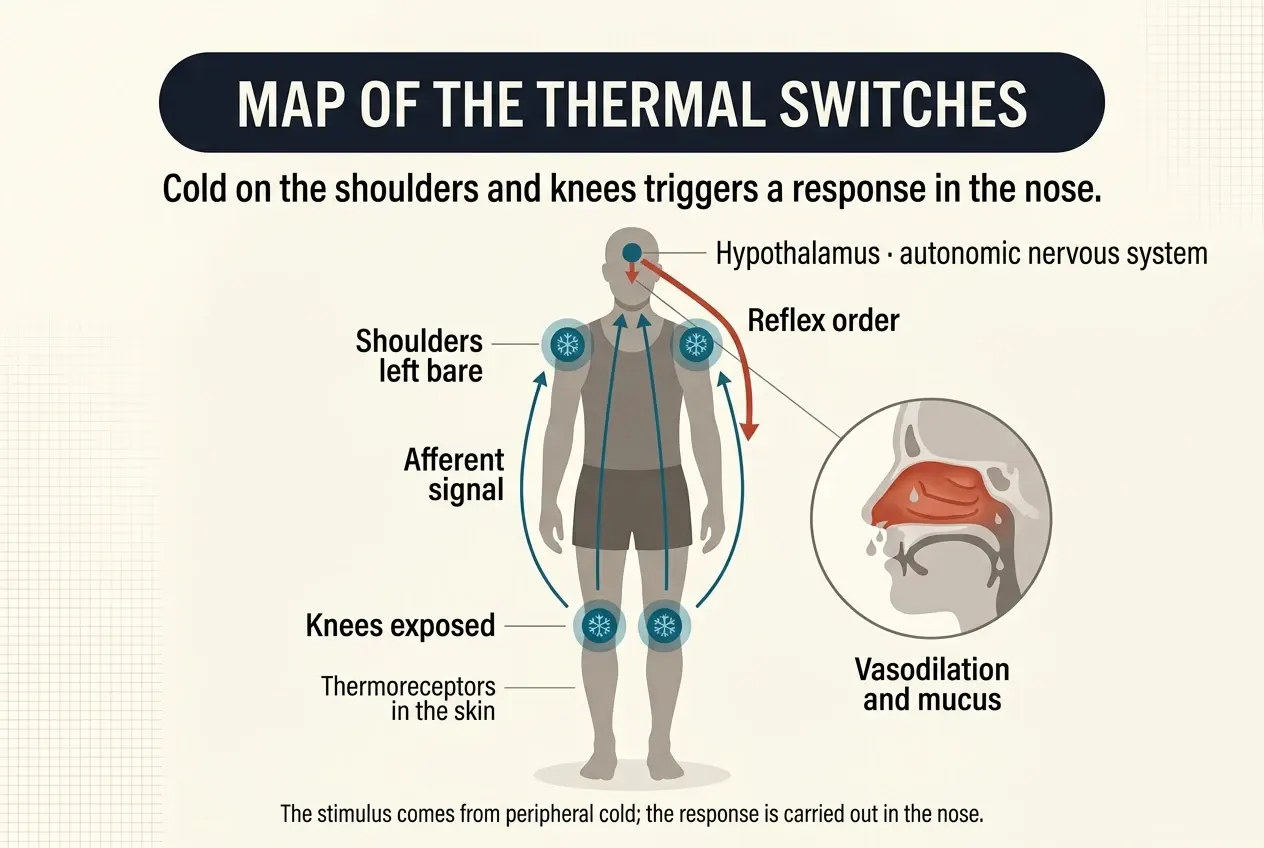
The skin of the limbs carries a high density of peripheral thermoreceptors, which send a constant stream of information to the central nervous system in order to maintain thermal homeostasis. In individuals who have this reflex, the shoulders and the knees act as triggers. When those areas are left exposed and undergo a localised drop in temperature, they fire an emergency action potential.
In vasomotor rhinitis the knees and shoulders act as thermal switches: as they cool, the brain mistakenly orders the nose to inflame in order to protect the body.
The autonomic nervous system processes this signal and, in an attempt at adaptive anticipation, issues a reflex order to the nasopharyngeal territory: it induces vasodilation of the capillaries of the nasal mucosa in order to warm the inhaled air, and it activates the submucosal glands to produce mucus and tears as a physical protective barrier. The result is nasal obstruction of neurogenic origin. Apply a direct source of heat — hot water or sunlight — and the afferent stimulus ceases, the nervous system cancels the alarm signal and the nasal vasculature returns to its normal calibre.
Sleep deprivation as an amplifying factor
There is one critical concomitant factor behind these episodes: sleep deprivation, or poor-quality rest, raises susceptibility to this reflex exponentially. The explanation lies in the neurobiology of the hypothalamic axis.
The hypothalamus is the brain structure responsible for coordinating circadian rhythms (sleep and wakefulness) and central thermoregulation. Faced with sleep debt, the hypothalamus loses functional precision. This produces instability in autonomic tone and lowers the activation threshold of peripheral reflexes. As a consequence, a cooling stimulus that under conditions of normal sleep would be ignored by the central system is, after a night of sleep deprivation, read as a severe thermal threat, amplifying the nasal inflammatory response.
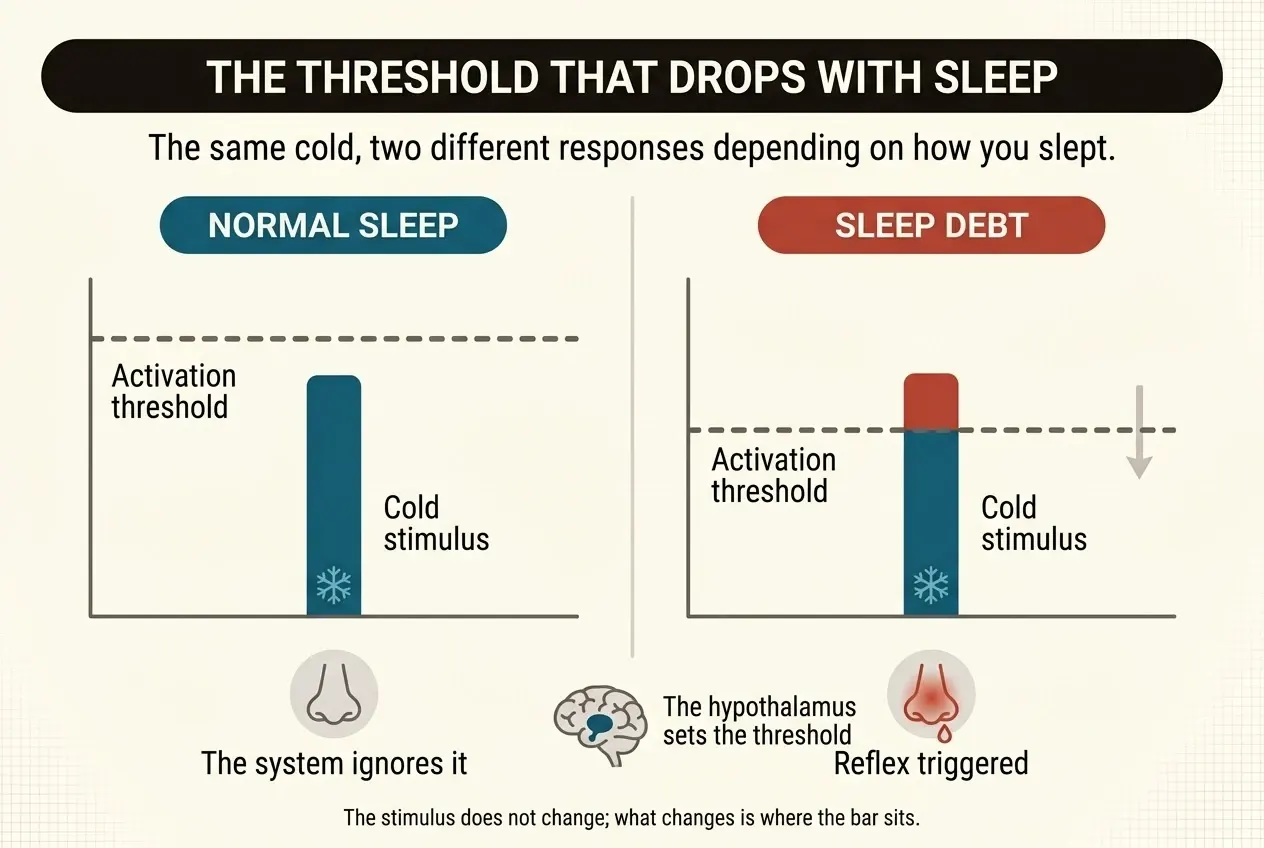
Faced with sleep debt, the hypothalamus loses precision and lowers its activation threshold, so that a light summer breeze is read as a polar threat.
A physiological approach versus drug treatment
Faced with the discomfort of a runny nose, the usual recourse is a combined cold-and-flu remedy containing an analgesic (paracetamol), a cough suppressant and a first-generation antihistamine (chlorphenamine). While it is true that these do halt the process, thanks to the anticholinergic effect of the antihistamine — which blocks nerve transmission to the nasal glands — the pharmacological approach is disproportionate.
Using such complex active ingredients to resolve a strictly physical reflex subjects the body to an unnecessary hepatic metabolic load because of the paracetamol. On top of that, classic antihistamines induce drowsiness through their ability to cross the blood-brain barrier and, if used continuously for weeks, cause a rebound effect through the upregulation of histamine receptors in the nasal mucosa.
For anyone who would rather keep pharmacological intervention to a minimum, there are strategies grounded in physics and physiology that modulate the reflex effectively:
- Selective protective barriers. The most efficient prophylactic method is to avoid activating the thermoreceptors at all. On days with seasonal swings in temperature, or after a poor night’s sleep, favour clothing that covers the joints and the upper limbs, regardless of the ambient temperature of the room.
- Countering the stimulus with heat therapy. If the reflex has already started, applying concentrated local heat — an electric heat pad or a hot water bottle — to the shoulders or the knees for fifteen minutes sends an afferent signal of raised temperature that interrupts the order for nasal congestion at the central level.
- Natural osmotic mechanisms. Hypertonic seawater solutions (sea water with a high salt concentration) reduce nasal congestion through the physical process of osmosis, draining excess fluid from the inflamed tissue outwards, with no interaction with pharmacological receptors and no systemic absorption.
- Nutritional modulation of inflammation. Adding compounds with thermogenic activity, such as the gingerols in ginger, improves peripheral microcirculation. Likewise, eating foods rich in quercetin — a flavonoid found in red onion and in apples — contributes to the natural stabilisation of the mucosa’s target cells and softens the intensity of the local inflammatory response.
Understanding human physiology lets us shift from the paradigm of infectious self-diagnosis towards an understanding of how the nervous system adapts. The “summer cold”, in these particular cases, is not a failure of the immune system but a demonstration of how precise and reactive our biological alarm system is to its surroundings.
References and scientific support
- The common cold: what actually causes it. Eccles, R. (2023). Common cold. Frontiers in Allergy, 4, 1224988. View study on PubMed Central
- Cooling of the body surface and the common cold. Eccles, R. (2002). Acute cooling of the body surface and the common cold. Rhinology, 40(3), 109-114. View study (PDF)
- Cooling the feet and triggering the symptoms. Johnson, C., & Eccles, R. (2005). Acute cooling of the feet and the onset of common cold symptoms. Family Practice, 22(6), 608-613. View study (DOI)
- Cold dry air as a nasal provocation test. Braat, J. P., Mulder, P. G., Fokkens, W. J., Gerth van Wijk, R., & Rijntjes, E. (1998). Intranasal cold dry air is superior to histamine challenge in determining the presence and degree of nasal hyperreactivity in nonallergic noninfectious perennial rhinitis. American Journal of Respiratory and Critical Care Medicine, 157(6), 1748-1755. View study (DOI)
- Vasomotor rhinitis: the condition and its triggers. Pattanaik, D., & Lieberman, P. (2010). Vasomotor rhinitis. Current Allergy and Asthma Reports, 10(2), 84-91. View study (DOI)
- Mechanisms of idiopathic non-allergic rhinitis. Baraniuk, J. N. (2009). Pathogenic mechanisms of idiopathic nonallergic rhinitis. World Allergy Organization Journal, 2(6), 106-114. View study on PubMed Central
- Lack of sleep and instability of autonomic tone. Greenlund, I. M., & Carter, J. R. (2022). Sympathetic neural responses to sleep disorders and insufficiencies. American Journal of Physiology — Heart and Circulatory Physiology, 322(3), H337-H349. View study on PubMed Central
- The risks of first-generation antihistamines. Church, M. K., Maurer, M., Simons, F. E. R., Bindslev-Jensen, C., van Cauwenberge, P., Bousquet, J., Holgate, S. T., & Zuberbier, T. (2010). Risk of first-generation H1-antihistamines: a GA2LEN position paper. Allergy, 65(4), 459-466. View study (DOI)
- Hypertonic versus isotonic saline in nasal irrigation. Kanjanawasee, D., Seresirikachorn, K., Chitsuthipakorn, W., & Snidvongs, K. (2018). Hypertonic saline versus isotonic saline nasal irrigation: systematic review and meta-analysis. American Journal of Rhinology & Allergy, 32(4), 269-279. View study (DOI)
- Quercetin as a mast cell stabiliser. Weng, Z., Zhang, B., Asadi, S., Sismanopoulos, N., Butcher, A., Fu, X., Katsarou-Katsari, A., Antoniou, C., & Theoharides, T. C. (2012). Quercetin is more effective than cromolyn in blocking human mast cell cytokine release and inhibits contact dermatitis and photosensitivity in humans. PLoS ONE, 7(3), e33805. View study on PubMed Central
- Ginger: antioxidant, anti-inflammatory and immunomodulatory activity. Ayustaningwarno, F., Anjani, G., Ayu, A. M., & Fogliano, V. (2024). A critical review of Ginger’s (Zingiber officinale) antioxidant, anti-inflammatory, and immunomodulatory activities. Frontiers in Nutrition, 11, 1364836. View study on PubMed Central
We're building the space for you to comment on the articles.
Continue reading

On testosterone, status and metabolic health
A neurobiological journey through the hormone that governs how we position ourselves before others, and how to tune its inner factory

Blue blocker glasses
The optical shield that protects you from the artificial light wrecking your biology