AGI, quantum computing and the future of humanity
From artificial general intelligence to quantum acceleration and the geopolitics of silicon: reflections on the role of humanity in the synthetic era

Few technologies in the history of civilisation have travelled from academic speculation to global disruption with the dizzying speed of artificial intelligence. What began as a modest experiment in formal logic and cybernetics in the mid-20th century has become the geopolitical, economic and cognitive engine of the 21st.
Yet as synthetic systems reach ever higher levels of autonomy, analytical skill and creative capacity, society finds itself at a profound crossroads. Between the commercial triumphalism of the big corporations and the apocalyptic catastrophism of science fiction, there is a rigorous space for science: analysing where the physical limits of computing are taking us, what the idea of a general intelligence really means, and what place the human mind will have in a world where cognitive capacity is no longer an exclusively biological monopoly.
The myth and the reality of AGI
The term AGI (artificial general intelligence) has become an omnipresent marketing acronym in the technology industry. For the general public, raised on science fiction, it evokes a synthetic entity with self-awareness, emotions, free will and an intelligence similar or superior to ours in every possible domain.
From the standpoint of theoretical computer science and cognitive science, the definition is much more sober: an AGI would be a system able to learn, reason and generalise autonomously in order to solve any intellectual task a human being can perform, at a comparable or higher level of competence, adapting to new environments without specific retraining. Even so, there is no agreed definition, and each lab works with its own. Researchers at Google DeepMind have proposed measuring it in levels, according to how many skilled people the system outperforms and across what range of tasks, instead of treating it as a finish line crossed all at once.
To separate scientific rigour from mere corporate marketing, it is essential to define the steps of this evolution precisely:
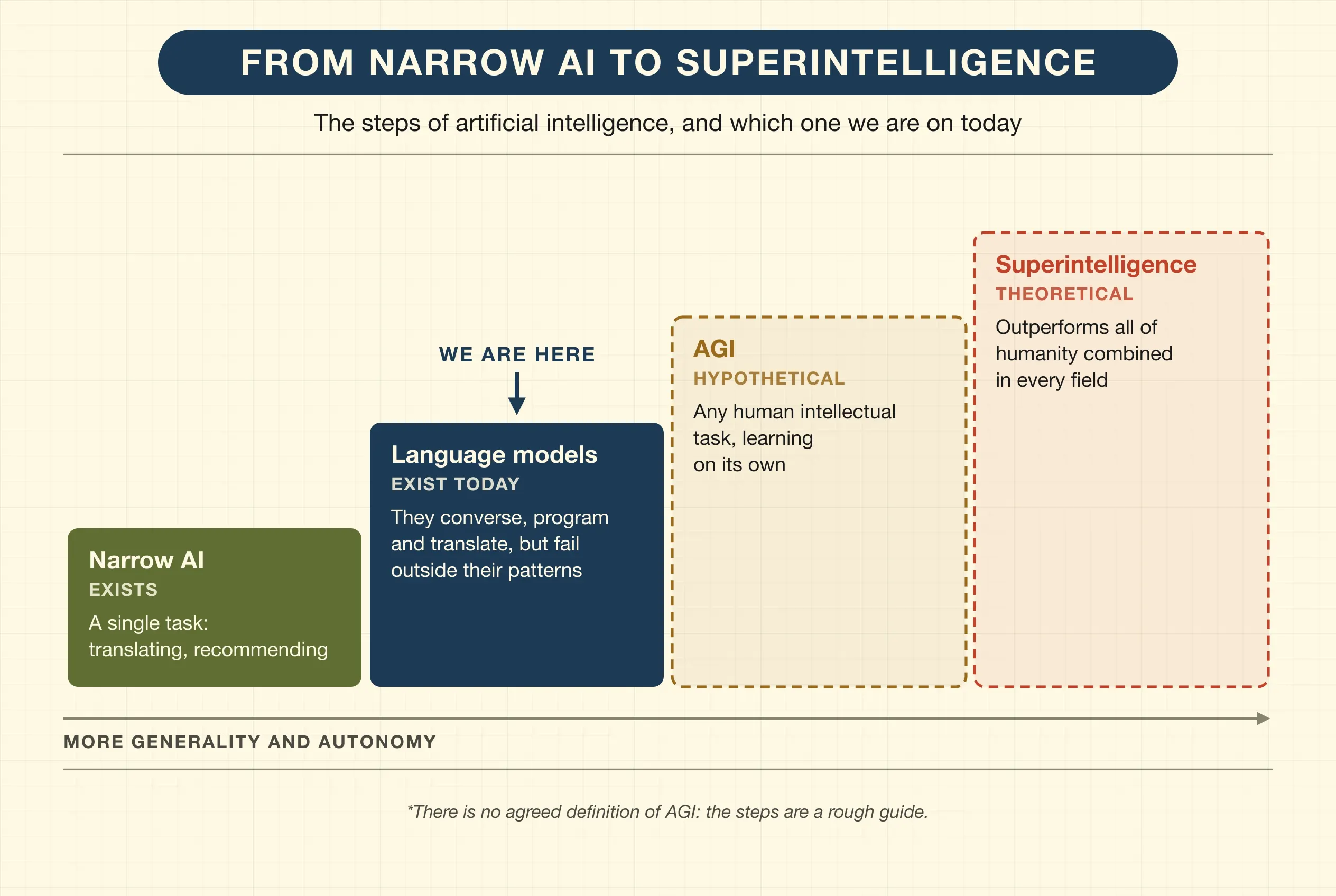
- Narrow AI: highly specialised systems designed to solve specific tasks, such as translating, analysing X-rays or recommending content. They lack self-awareness, generalised transfer of knowledge and autonomous purpose. Today’s large language models sit in an intermediate zone: they are no longer narrow in the classic sense, since they converse, program and translate, but they do not meet the definition of AGI either, because they still fail outside the patterns of their data and do not learn from experience on their own.
- AGI (artificial general intelligence): a hypothetical autonomous system able to learn, reason, plan and adapt with the same cognitive flexibility as a human being when faced with any intellectual task, in an open and unfamiliar environment. An AGI would not only be able to solve the problems it was trained for, but could invent new science, reconfigure itself and learn skills its creators never anticipated.
- ASI (artificial superintelligence): the theoretical threshold at which artificial intelligence would far exceed the combined cognitive capacity of all of humanity in every possible domain.
The limits of scaling
In recent years, the industry has bet heavily on the so-called scaling laws, which we saw in part two: the empirical observation that a model’s performance improves predictably as training data, computing power and the number of parameters increase. From this came the hypothesis that, if they keep being multiplied, the abilities of an AGI will emerge naturally.
However, this paradigm is showing increasingly clear limits:
- The source is running dry: as we saw in part four, the internet is running out of good-quality human text to train on.
- Diminishing returns: because of the very mathematical form of these laws, each improvement requires multiplying the resources. Ten times more computation no longer guarantees an equivalent qualitative leap in deep reasoning; models accumulate memory and statistical fluency, but still lack a genuine causal understanding of the physical world.
The industry has responded by opening a second front: instead of building ever larger models, giving them more computing time to “think” before answering. This is what the reasoning models we saw in part three do, and on certain tasks it pays off more than multiplying the size of the model.
Even so, many researchers believe that reaching a true AGI will require a new architectural paradigm: a hybrid approach that fuses the connectionism of deep neural networks with classical symbolic reasoning and the principles of cognitive neurobiology. Others argue the opposite: that the history of AI shows that general methods able to exploit more computation end up beating those that build in human knowledge. It is one of the great open questions in the field.
The geopolitics of silicon and the hardware of the future
The great fallacy of the digital era is to imagine artificial intelligence as something purely immaterial, ethereal and disconnected from matter. In reality, the battle for supremacy in AI is, above all, a battle of materials physics, precision engineering and industrial geopolitics.
The semiconductor bottleneck
The most advanced software on the planet is completely useless without a hardware supply chain synchronised to the millimetre, which depends on a small number of critical points worldwide:
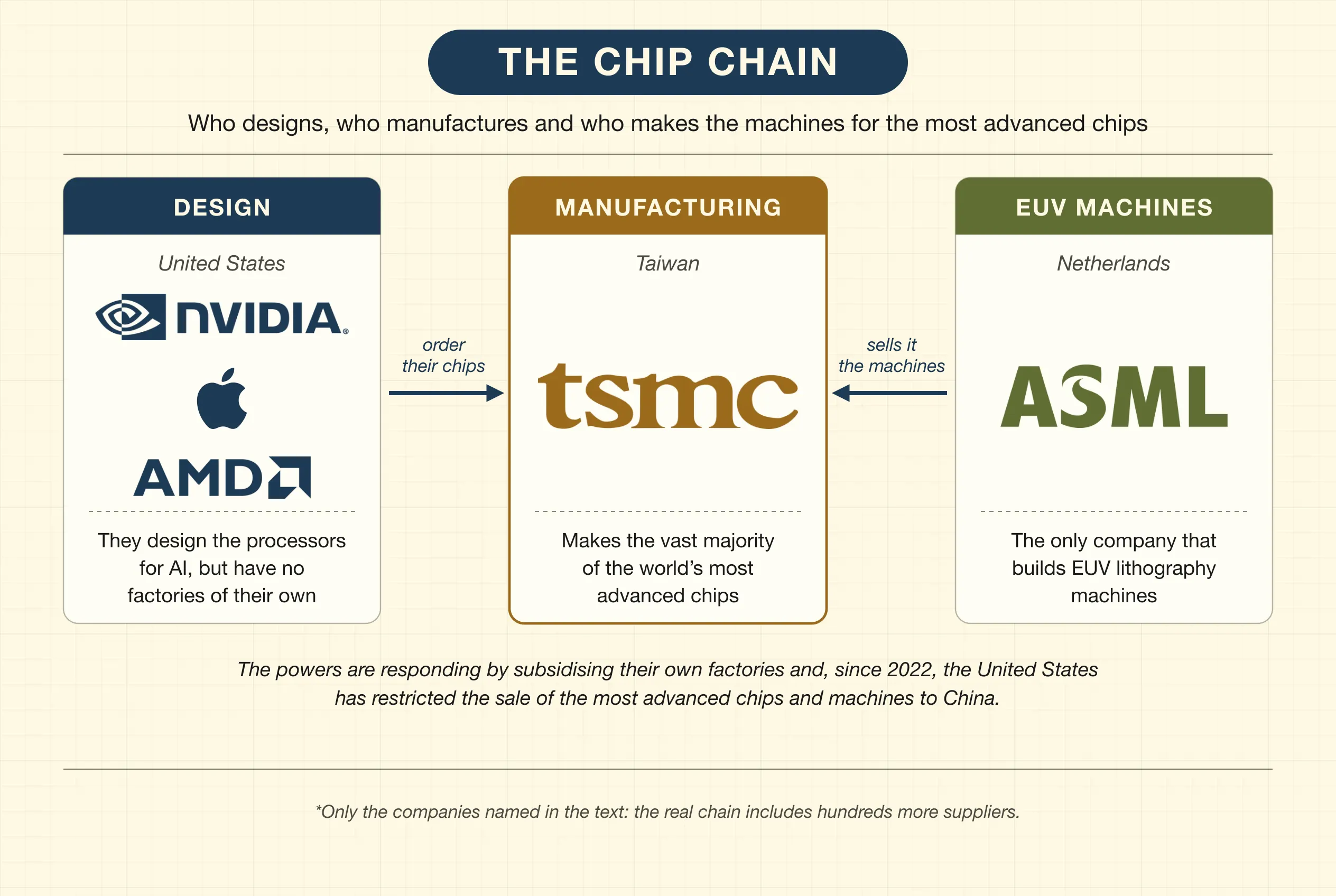
- Extreme ultraviolet (EUV) lithography: making the world’s most advanced chips depends on a single company in the Netherlands, ASML, the only one that builds the machines able to etch the tiniest circuits onto silicon wafers with extreme ultraviolet light.
- Centralised foundries: the vast majority of the most advanced processors designed by companies such as Nvidia, Apple or AMD are manufactured in TSMC’s foundries in Taiwan, which makes the island one of the most sensitive geostrategic points on the planet.
Faced with this vulnerability, the United States, China and the European Union are competing for hardware sovereignty: they are subsidising with billions the construction of semiconductor plants (fabs) on their own soil, and since 2022 the United States has restricted the sale of the most advanced chips and machines to China.
Quantum computing
As the famous Moore’s law —the doubling of the number of transistors on a chip roughly every two years— approaches its physical limits, the industry is running into an atomic barrier. When transistors shrink to a few dozen atoms, electrons start to pass through barriers they should not in theory be able to cross, through a quantum phenomenon called tunnelling, and the chips leak current and heat up. Faced with this wall, part of the research community is looking to quantum computing. It is worth making clear from the start that it is not a faster chip that will replace today’s, but a different way of computing that only beats the classical one on certain very specific problems.
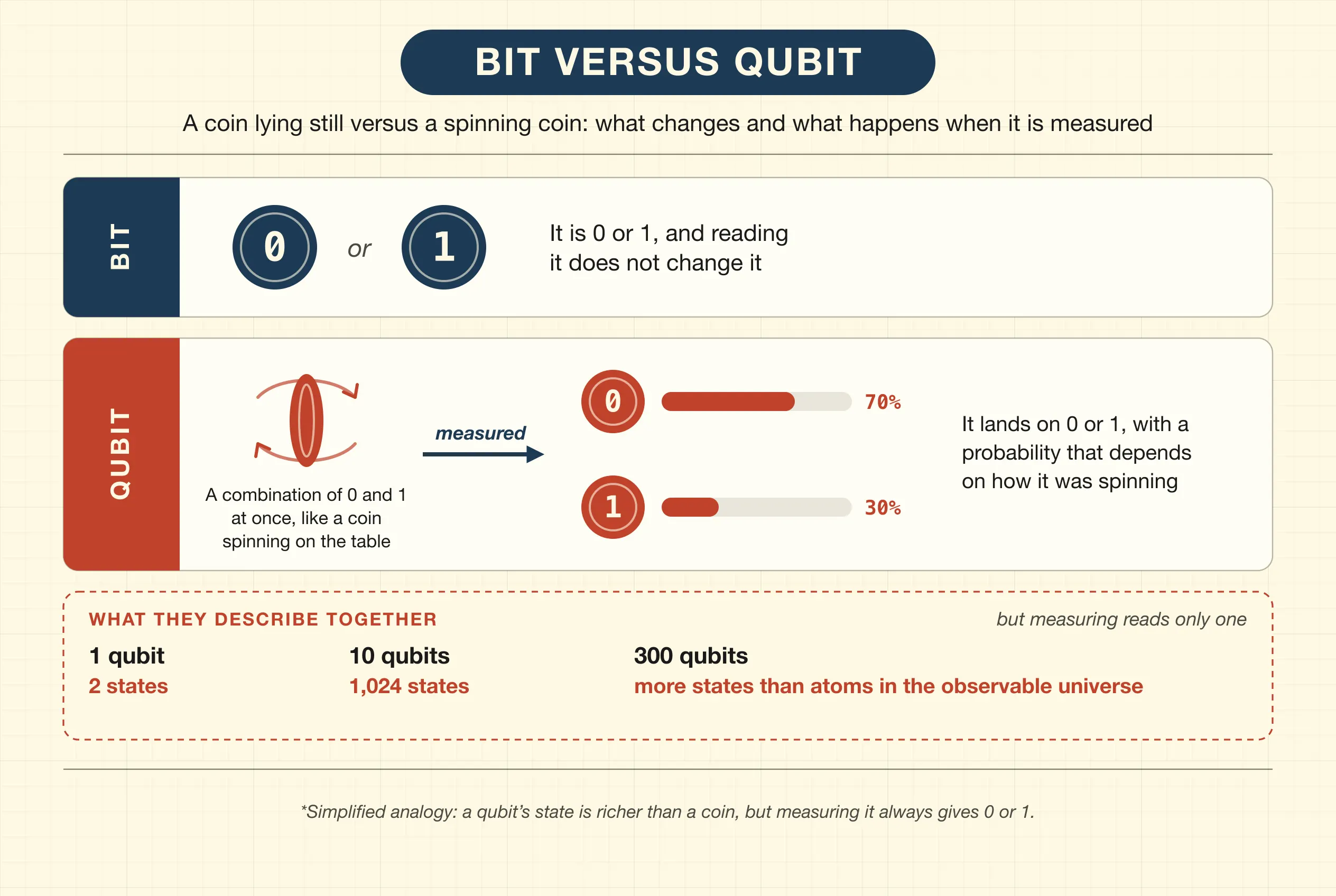
While classical computing processes information with bits, which are either 0 or 1, quantum computing uses qubits (quantum bits), which are governed by two principles of quantum physics:
- Superposition: a qubit can be in a combination of 0 and 1 at once. Imagine a coin that is not resting on heads or tails but spinning on the table: only when it stops, when it is measured, does it land on one side, with a probability that depends on how it was spinning.
- Entanglement: two qubits can become linked in such a way that, when measured, their results are correlated even if they are very far apart. This correlation does not allow information to be sent faster than light, but it is a computational resource that no classical computer can imitate efficiently.
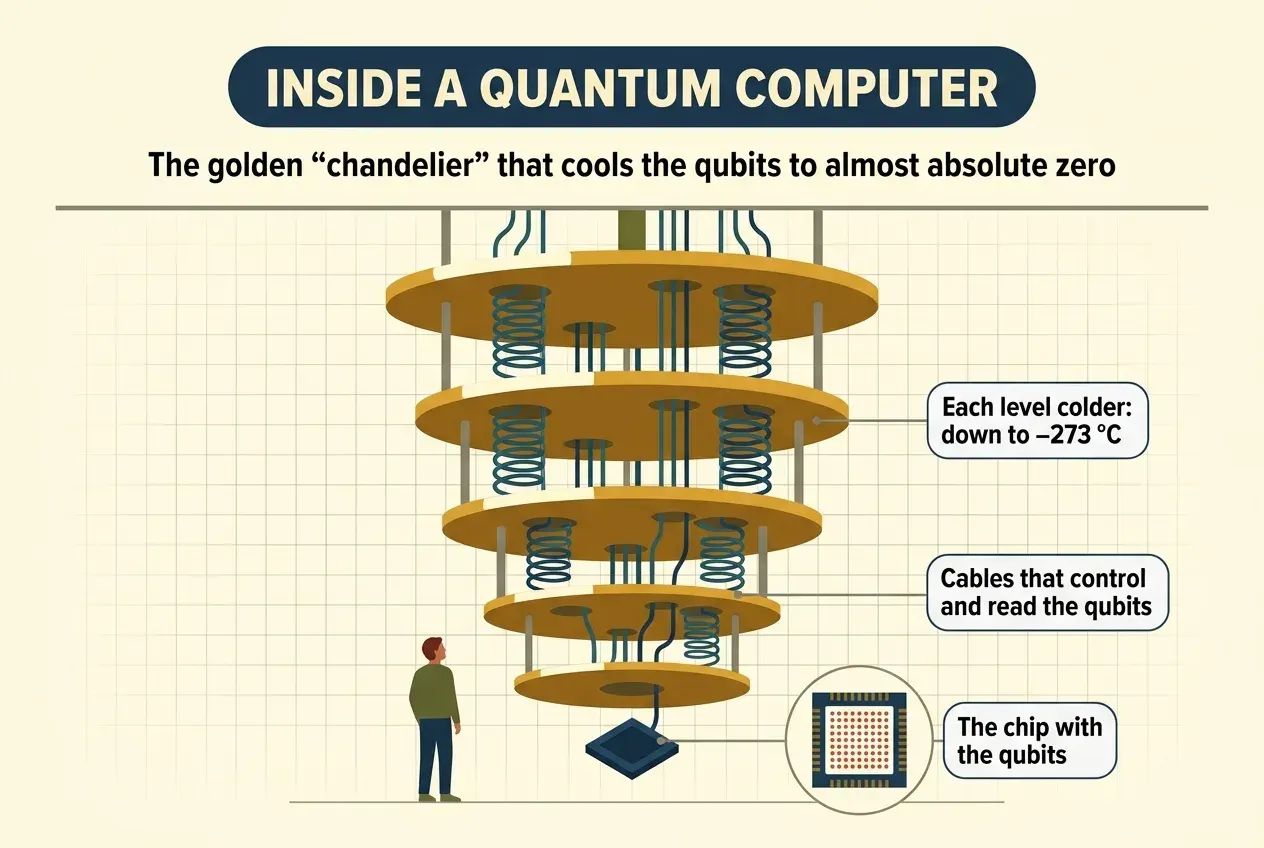
Today’s quantum computers are still at a very fragile, experimental stage: they have anywhere from dozens to a few thousand qubits, they make frequent errors and many need temperatures close to absolute zero. In 2024, Google showed for the first time that adding qubits to correct errors reduces failures instead of multiplying them, an essential step towards building useful machines, which will need hundreds of thousands or millions of qubits.
How could quantum computing help AI?
Its intersection with machine learning, so-called quantum machine learning, has raised great expectations. It is worth separating what has been shown from what has been promised:
- Optimisation: training a neural network means looking for the lowest point in a mountainous landscape of millions of dimensions, the loss function. It is often said that a quantum computer, thanks to superposition, could travel all the paths at once. That is not so: when measured, the superposition collapses to a single result, and the advantage only appears when an algorithm manages to make the wrong answers cancel each other out and the right one reinforce itself. For general search problems, the proven speed-up is at most quadratic, not exponential, and quantum neural networks have obstacles of their own: their training landscapes tend to become so flat that it is almost impossible to find which way to improve.
- Linear algebra: neural networks draw all their power from massive matrix multiplications. The HHL quantum algorithm solves certain systems of linear equations exponentially faster than a classical computer, but with decisive fine print: the matrices must meet very strict conditions, loading the data into the quantum computer can cost as much as the calculation itself, and the result is not the full solution but a quantum state from which only some information can be extracted. What is more, for several of its machine learning applications, classical algorithms almost as fast have since been found.
- Molecular simulation and materials science: this is where the most solid promise lies. Traditional computers struggle to simulate the real behaviour of molecules because chemistry is quantum by nature, as Richard Feynman pointed out back in 1982. A quantum computer with error correction could simulate with great precision reactions that are out of reach today, such as the one bacteria use to fix nitrogen from the air, and that data could feed AI models to design superconducting materials or catalysts to capture carbon.
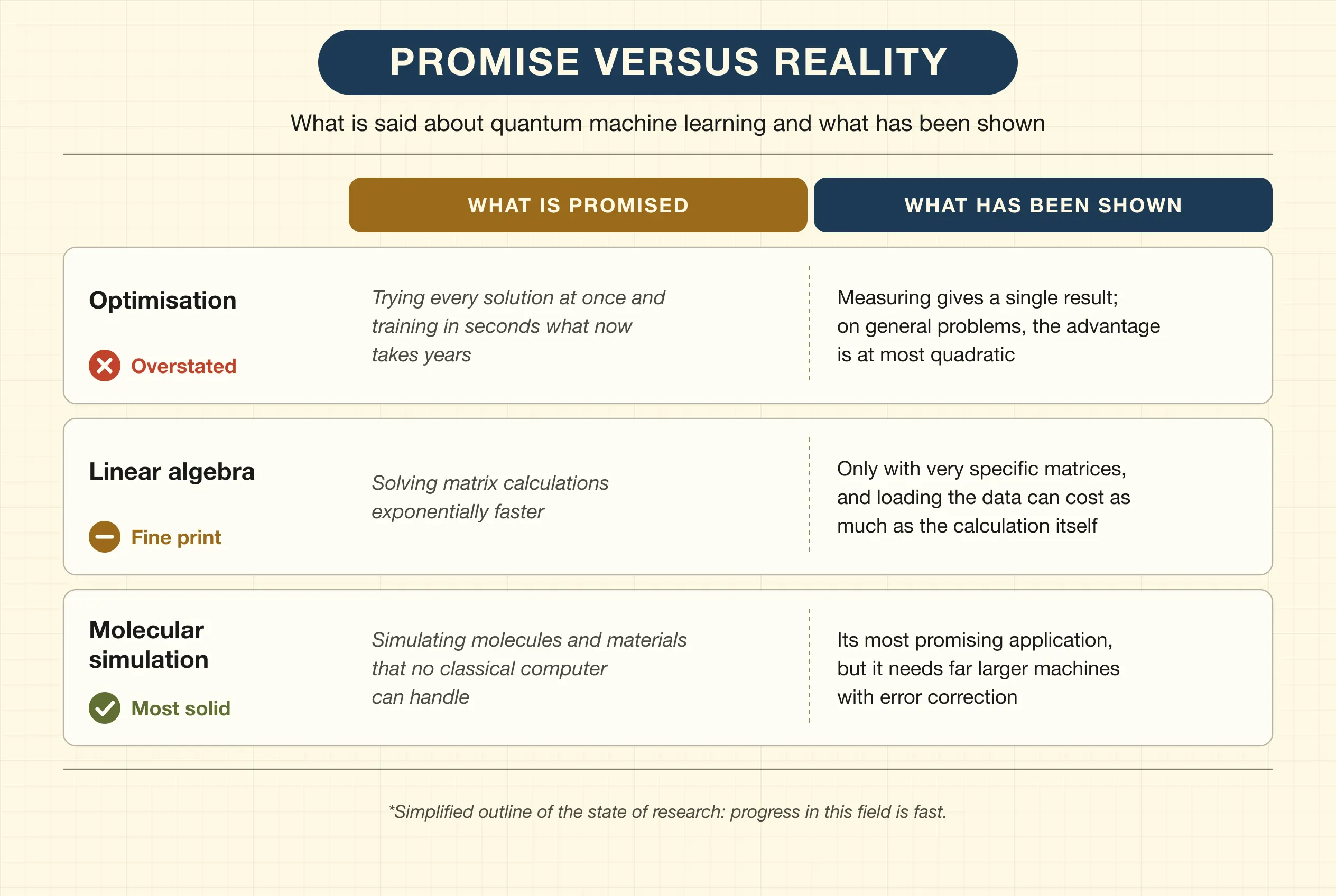
The real potential of quantum computing therefore lies not in making chatbots answer faster or in training language models: quantum computers are particularly clumsy at handling large volumes of data, which is exactly what today’s AI needs. Their most likely role is that of a scientific instrument able to simulate physics and chemistry where classical computers cannot reach, whose results AI will be able to exploit to tackle highly complex scientific problems, such as designing new materials. The collaboration also works the other way round: in 2024, an AI system from Google DeepMind learned to detect the errors of a quantum processor better than hand-designed methods.
The role of humans in the synthetic era
With the arrival of systems able to take on analytical, programming, design and even creative tasks that for centuries were the exclusive preserve of the human intellect, a deep existential unease inevitably arises: what is the purpose and value of the human being in the synthetic era?
The automation paradox
Far from the dystopia of total replacement, economic history shows that automation does not destroy work but transforms it, shifting human effort towards higher levels of abstraction. So far, each technological wave has eliminated tasks but created new ones, although the transition has been hard on those who lost theirs, and economists debate whether AI, which also reaches intellectual work, will follow the same pattern.
Instead of seeing AI as an all-powerful substitute that will completely replace the individual, the most rigorous and realistic approach defines it as a cognitive prosthesis. Just as the calculator did not remove the need to understand mathematics, but raised the level of complexity of the problems we could solve, AI acts as an amplifier of human intentions. The first studies point in that direction: in a customer service centre, an AI assistant raised productivity by 14% on average, and by 34% among the least experienced employees.
As machines take over routine execution and mass data processing, what is intrinsically human acquires unprecedented economic and social value:
- Critical judgement and ethical responsibility: a machine can calculate probabilities, but it lacks moral agency. The responsibility for deciding what is done with technology and where its ethical limits lie rests exclusively with human beings.
- Empathy, intuition and embodied experience: deep emotional connection, creativity born of suffering and the joy of physical experience are dimensions alien to silicon.
- Asking the right questions: in a world where automated answers are plentiful and cheap, the human ability to frame the right problems, question dogmas and exercise intellectual curiosity becomes the scarcest and most valuable asset.
Conclusion
Artificial intelligence is neither an omniscient deity nor an alien monster destined to subjugate us of its own accord. It is, in essence, a mathematical mirror of our own civilisation: an artefact built from the texts, the code, the contradictions, the mistakes and the strokes of genius accumulated by humanity over millennia.
In the face of this constantly shifting landscape, polarised positions —whether the naive optimism that trusts in a frictionless utopia or the catastrophism that freezes in the face of the future— are of little use. Technological change is neither an avoidable accident nor a sudden curse; it is an inexorable process of civilisational reconfiguration. History teaches us that tools shape societies, but societies also decide how to adopt and govern them.
In this new ecosystem, adaptation is no longer an abstract option but a demand on each individual’s attitude. The responsibility lies with each person: cultivating critical thinking, embracing constant updating as a habit of life and rejecting the cognitive atrophy that comes from handing intellectual effort over to the comfort of the machine. The future is not written to be feared or blindly celebrated, but to be travelled with clarity.
References and scientific support
- A proposal to measure progress towards AGI in levels, according to the system’s performance and the range of tasks it masters. Morris, M. R., Sohl-Dickstein, J., Fiedel, N., Warkentin, T., Dafoe, A., Faust, A., Farabet, C., & Legg, S. (2024). Position: Levels of AGI for operationalizing progress on the path to AGI. Proceedings of the 41st International Conference on Machine Learning, PMLR 235, 36308-36321. View study on arXiv
- Scaling laws: a language model’s performance improves predictably as parameters, data and compute increase. Kaplan, J., McCandlish, S., Henighan, T., Brown, T. B., Chess, B., … & Amodei, D. (2020). Scaling laws for neural language models. arXiv, 2001.08361. View study on arXiv
- Giving a model more computing time when it answers can pay off more than making it bigger. Snell, C., Lee, J., Xu, K., & Kumar, A. (2025). Scaling LLM test-time compute optimally can be more effective than scaling model parameters. International Conference on Learning Representations (ICLR). View study on arXiv
- The case for a hybrid AI that combines neural networks with symbolic reasoning and knowledge of the world. Marcus, G. (2020). The next decade in AI: Four steps towards robust artificial intelligence. arXiv, 2002.06177. View study on arXiv
- The opposite view: in the long run, general methods that exploit more computation beat those that build in human knowledge. Sutton, R. S. (2019). The bitter lesson. Incomplete Ideas. View the essay
- Who controls each link in the semiconductor chain and how concentrated it is. Khan, S. M., Mann, A., & Peterson, D. (2021). The semiconductor supply chain: Assessing national competitiveness. Center for Security and Emerging Technology. View report (DOI)
- The first quantum processor in which adding qubits to correct errors reduces failures instead of multiplying them. Google Quantum AI and Collaborators. (2025). Quantum error correction below the surface code threshold. Nature, 638(8052), 920-926. View paper (DOI)
- A review of what quantum machine learning promises and the obstacles it still has to overcome. Biamonte, J., Wittek, P., Pancotti, N., Rebentrost, P., Wiebe, N., & Lloyd, S. (2017). Quantum machine learning. Nature, 549(7671), 195-202. View paper (DOI)
- Barren plateaus: the training landscapes of quantum neural networks become so flat that they are almost impossible to optimise. McClean, J. R., Boixo, S., Smelyanskiy, V. N., Babbush, R., & Neven, H. (2018). Barren plateaus in quantum neural network training landscapes. Nature Communications, 9, 4812. View paper (DOI)
- The HHL algorithm, which solves certain systems of linear equations exponentially faster. Harrow, A. W., Hassidim, A., & Lloyd, S. (2009). Quantum algorithm for linear systems of equations. Physical Review Letters, 103(15), 150502. View paper (DOI)
- The fine print of that advantage: the conditions that must be met for the algorithm to be truly useful. Aaronson, S. (2015). Read the fine print. Nature Physics, 11(4), 291-293. View paper (DOI)
- A classical algorithm that almost matches a quantum one expected to have an exponential advantage. Tang, E. (2019). A quantum-inspired classical algorithm for recommendation systems. Proceedings of the 51st Annual ACM SIGACT Symposium on Theory of Computing, 217-228. View study (DOI)
- The original proposal: to simulate nature, which is quantum, you need a quantum computer. Feynman, R. P. (1982). Simulating physics with computers. International Journal of Theoretical Physics, 21(6-7), 467-488. View paper (DOI)
- How a quantum computer could unravel the reaction bacteria use to fix nitrogen, which is out of reach for classical ones. Reiher, M., Wiebe, N., Svore, K. M., Wecker, D., & Troyer, M. (2017). Elucidating reaction mechanisms on quantum computers. Proceedings of the National Academy of Sciences, 114(29), 7555-7560. View paper (DOI)
- AI in the service of quantum computing: a model that detects a processor’s errors better than hand-designed methods. Bausch, J., Senior, A. W., Heras, F. J. H., Edlich, T., … & Kohli, P. (2024). Learning high-accuracy error decoding for quantum processors. Nature, 635(8040), 834-840. View paper (DOI)
- Why, after two centuries of automation, there is still so much work: machines replace tasks, but they also complement people. Autor, D. H. (2015). Why are there still so many jobs? The history and future of workplace automation. Journal of Economic Perspectives, 29(3), 3-30. View paper (DOI)
- Automation displaces workers from some tasks and creates new ones; the net effect depends on the balance between the two. Acemoglu, D., & Restrepo, P. (2019). Automation and new tasks: How technology displaces and reinstates labor. Journal of Economic Perspectives, 33(2), 3-30. View paper (DOI)
- An AI assistant in a customer service centre: 14% more productivity, and 34% among the least experienced employees. Brynjolfsson, E., Li, D., & Raymond, L. (2025). Generative AI at work. The Quarterly Journal of Economics, 140(2), 889-942. View paper (DOI)
We're building the space for you to comment on the articles.
Continue reading

The heart in the skin
How ultraviolet radiation releases the skin's nitric oxide to regulate blood pressure and fight cardiovascular risk

The Zeigarnik effect, or the cost of having brilliant ideas
The psychological phenomenon that sabotages your rest in the name of creativity

Structured water: the terrain of health
The liquid battery in your cells, and how to protect it from the modern environment