The creator's workshop
Models, tools and the keys that let artificial intelligence connect with the real world
Popular culture has absorbed a kind of technological metonymy, much like what once happened with brands such as Hoover or Sellotape: we use the name of a commercial product to refer to an entire scientific discipline. For most users, “ChatGPT” is synonymous with artificial intelligence, in the same way that “hoover” replaced the vacuum cleaner in everyday speech.
In today’s technology ecosystem it is essential to separate the foundation model (the mathematical intelligence that processes patterns) from the commercial application (the friendly interface designed for the general public). Understanding this distinction is not academic whim: it is the first step towards regaining control over our data, understanding how the tools behave and knowing what is really happening behind the screen.
Anatomy of an AI application
To understand how the modern AI ecosystem works, we need to tell apart two concepts that marketing tends to merge into one: the model and the tool (or interface).
The model
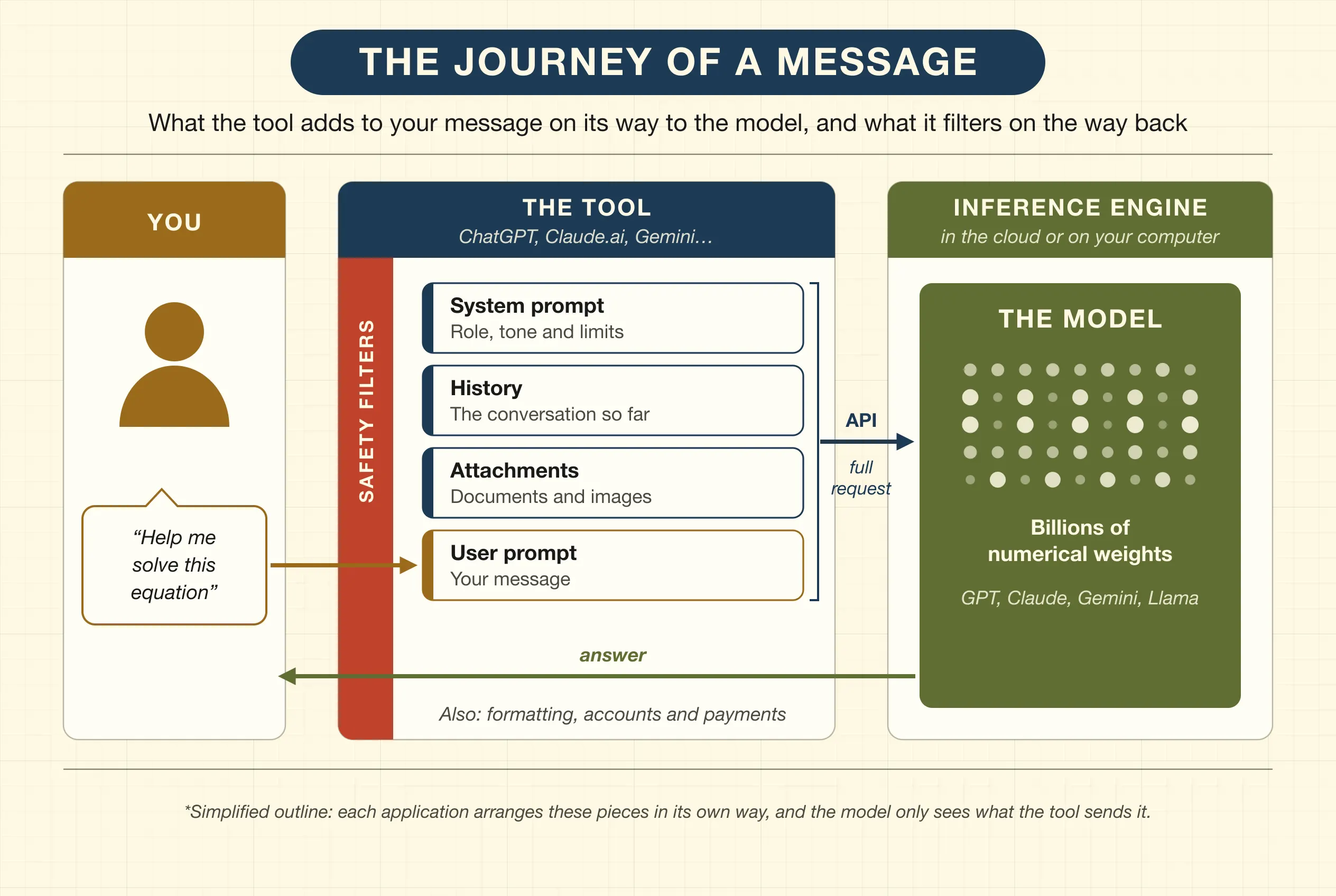
This is the mathematical core: billions of numerical parameters (the synaptic weights) tuned for months on supercomputers. On its own, a weights file is like a compressed archive full of organised static: it has no buttons, no chat bar, no history and none of the moderation filters that applications add, although it does keep the behaviour it learned during training, such as refusing certain requests. To use it you need an inference engine to run it and, usually, an application programming interface (API) through which other applications send it requests and receive its answers.
- Examples of models are GPT-6.1 Terra, Claude Opus 5.5, Gemini 4 Carbon and Llama 4.
The tool
These are the applications that translate our keystrokes into requests the model can understand and present its answer as formatted text, buttons or pleasing graphics.
This software layer formats the text, keeps the history of our conversations, lets us upload attachments, handles payments and, above all, applies the safety and moderation filters before and after the model generates an answer.
- Examples of tools are the ChatGPT website, the Claude.ai app and the Gemini interface. The name itself gives it away: ChatGPT is the tool, and GPT the family of models running inside it.
The life cycle of a model
Before it can be built into an application, a model goes through a rigorous process in three fundamental phases:
-
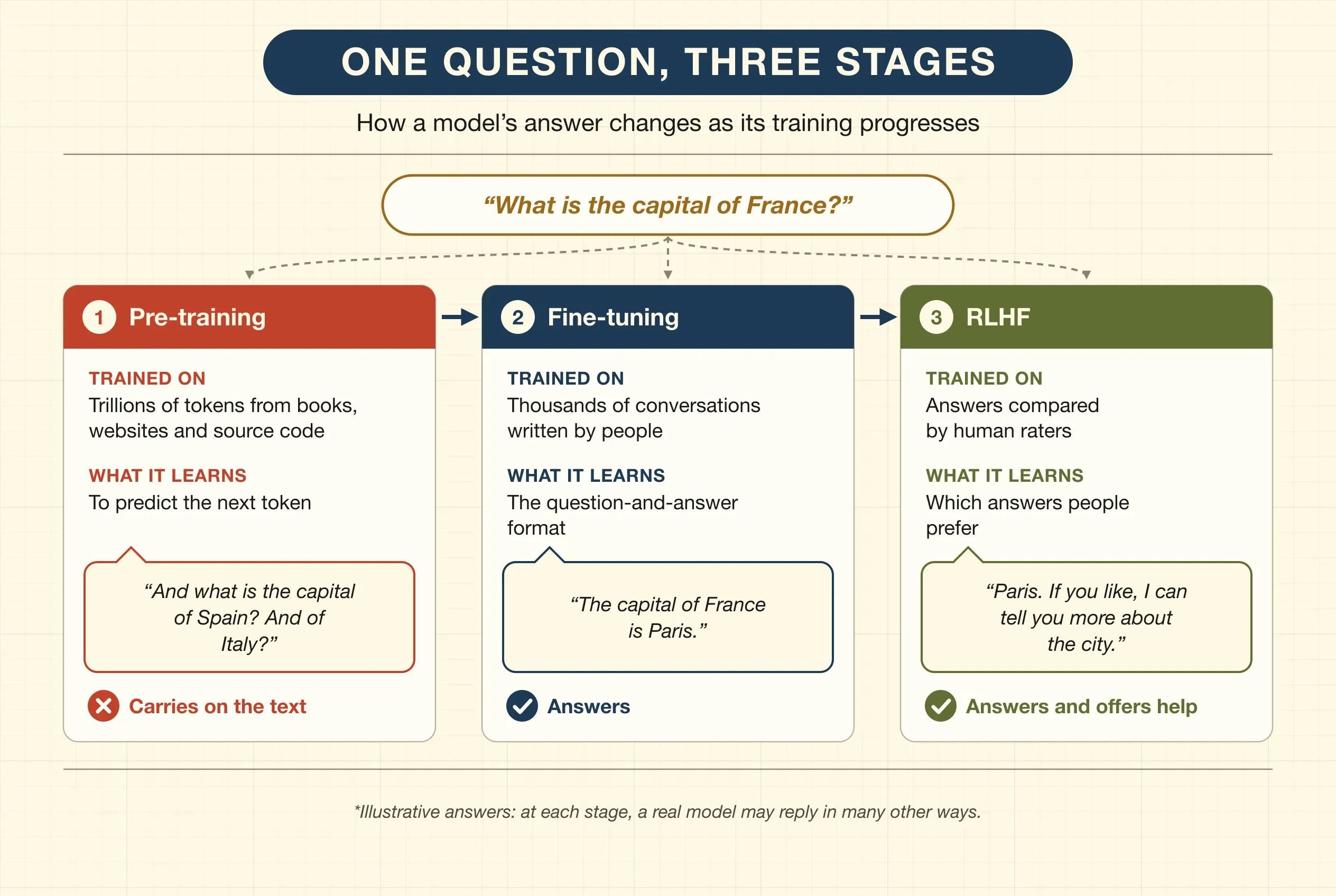
Pre-training: the model “reads” the internet on a massive scale, with its books, articles and source code. This is where it acquires its general understanding of language and of the world, by predicting the next token. The process takes supercomputers running for months and costs millions.
At the end of this phase the model is a pure “text completer”: if you ask it “What is the capital of France?”, it may not answer “Paris” but carry on writing “And what is the capital of Spain?”, because it has learned to imitate the structure of what it reads, and in a list of exercises one question is usually followed by another.
-
Supervised fine-tuning: the model is trained on thousands of example conversations written and reviewed by people, which teach it to adopt a useful and safe question-and-answer format. The same procedure can give it specific skills in a particular field, such as medicine, law or programming.
-
RLHF (Reinforcement Learning from Human Feedback): reinforcement learning from human preferences. Raters compare several of the model’s answers and pick the best; those choices are used to reward or penalise it according to how useful and truthful its answers are, which shapes its final tone.
The most recent models add a further stage of reinforcement learning, this time on problems whose solution can be checked automatically, such as maths or programming problems. This is what teaches the so-called reasoning models to “think” step by step before answering.
Prompts and native multimodality
Recent popular writing has spread the idea of the prompt as simply the question a user types into the chat box. In real software architecture, however, there is a crucial distinction between two kinds of instruction.
System prompt
This is the set of invisible rules that the tool’s developers put in place before the user types a single letter. The system prompt sets the framework, the role, the tone and the limits of the AI.
- For example, a system prompt might say: “You are a maths tutor for ten-year-olds. Never give the answer directly; explain the concepts step by step with simple metaphors and always keep an encouraging, patient tone.”
User prompt
This is the user’s direct input (“Help me solve this linear equation”). The model always processes the user prompt through the lens and the restrictions set beforehand by the system prompt.
Models are trained to give the system’s instructions priority, but that hierarchy is not foolproof: a skilful user, or malicious text hidden in a web page or a document the model reads, can manage to get round it. This is known as prompt injection.
Native multimodality
For years, for an AI to analyse an image, a separate vision system described it in words and then sent that description to the language model. Today the most advanced models are natively multimodal: they are trained from the start on text, images, audio and video, which they process and relate to one another within the same vector space, with no intermediate translators.
The model’s “hands”
A pure language model is confined to a sandbox: it can only predict text based on the static memory of its training. To be truly useful in the real world, it needs extensions that act as its limbs and its senses.
Tool use
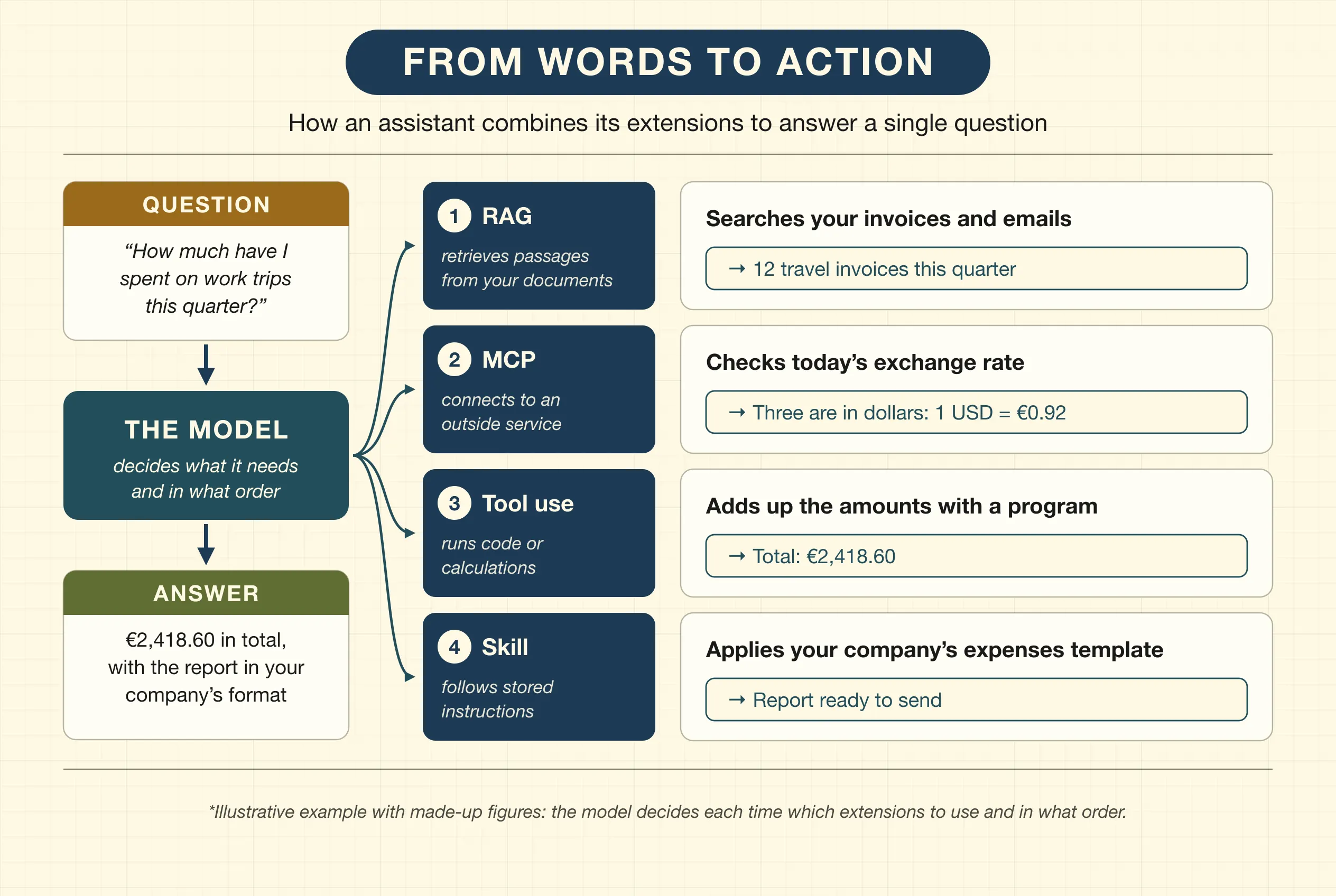
The basic building block is the model’s ability to recognise when a task is beyond its reach. If you ask it to multiply two 15-digit numbers or to know the latest news, a well-trained model knows that its probabilistic calculation may fail or that it lacks the information. Instead of making it up, it issues a structured request to call an external function: the application opens a calculator, runs a Python program or does a web search, returns the result, and the model uses it to give you the correct answer.
It does not always judge correctly when it needs help, but this ability, known as tool use or function calling, is the basis of everything that follows.
Skills
A skill is a structured set of instructions, rules, examples and resources given to an AI agent so that it knows exactly how to carry out a specific task. It can include step-by-step instructions, best practices, constraints, code examples, corporate templates or helper programs.
Skills are especially useful for repetitive, complex or multi-step tasks that require following a very specific format, tone or procedure. They work like an instruction manual or a recipe that the AI consults when it needs to do a particular job, which saves writing a long prompt every time.
Anthropic introduced the format in October 2025, and it is now an open standard. Each skill is a folder with an instructions file, and the agent reads only its name and description until a task needs it; then it loads the rest.
MCP (Model Context Protocol)
A language model on its own is a brain isolated in a dark room: it knows a great deal about the past, but it cannot see the current time, does not know what the weather is like outside and cannot look at your private documents. To solve this, engineers have given models the ability to interact with tools and data sources in the “outside world” through MCP connectors.
Introduced by Anthropic in late 2024 and later adopted by OpenAI, Google and Microsoft, the Model Context Protocol (MCP) standardises the connection between AI models and local or corporate data sources. It acts like a universal USB port: it defines a common protocol so that any model can connect in both directions to databases, business tools or specific programs such as Figma, Slack or Notion. Since late 2025 it has been run by an independent foundation within the Linux Foundation.
Through an MCP connector, a model can, for example, query a weather service to find out what the weather is like right now. Without this kind of tool it would have no way of knowing, because that information was not in its training data. The flip side is that every connector opens a door: a malicious or badly configured one can leak data or slip instructions to the model, so it is wise to install only those from trusted sources.
RAG (Retrieval-Augmented Generation)
Retrieval-augmented generation is the technique companies favour to make AI work on their private documentation without spending millions on retraining the model. Instead of having the model learn the information by heart, a RAG system works like an open-book exam: when the user asks a question, the tool searches the documents in milliseconds for the most relevant passages (comparing their meaning thanks to the embeddings we saw in part one), attaches them invisibly to the prompt and asks the model to write its answer based exclusively on those fragments.
This greatly reduces made-up answers, although it does not eliminate them: if the search brings back the wrong passage, the model will answer with the same confidence.
Running locally and open-weight models
Until recently, using artificial intelligence meant going through the servers of the big tech companies, which involved sending private data to the cloud. Today, software optimisation has opened the door to data sovereignty: running powerful models directly on our own computer, completely disconnected from the internet. This is what the open-weight models we saw in part two make possible.
Why run locally?
- Complete privacy: your documents, financial data or creative writing never leave your hard drive.
- No intermediaries or subscriptions: you set the rules of use and do not depend on monthly fees, changes to terms of service or server outages.
- Offline work: full processing power in areas with no coverage or in high-security environments.
The price is that the models that fit on a home computer still lag behind the big closed models in the cloud, especially on the most complex tasks.
Quantisation
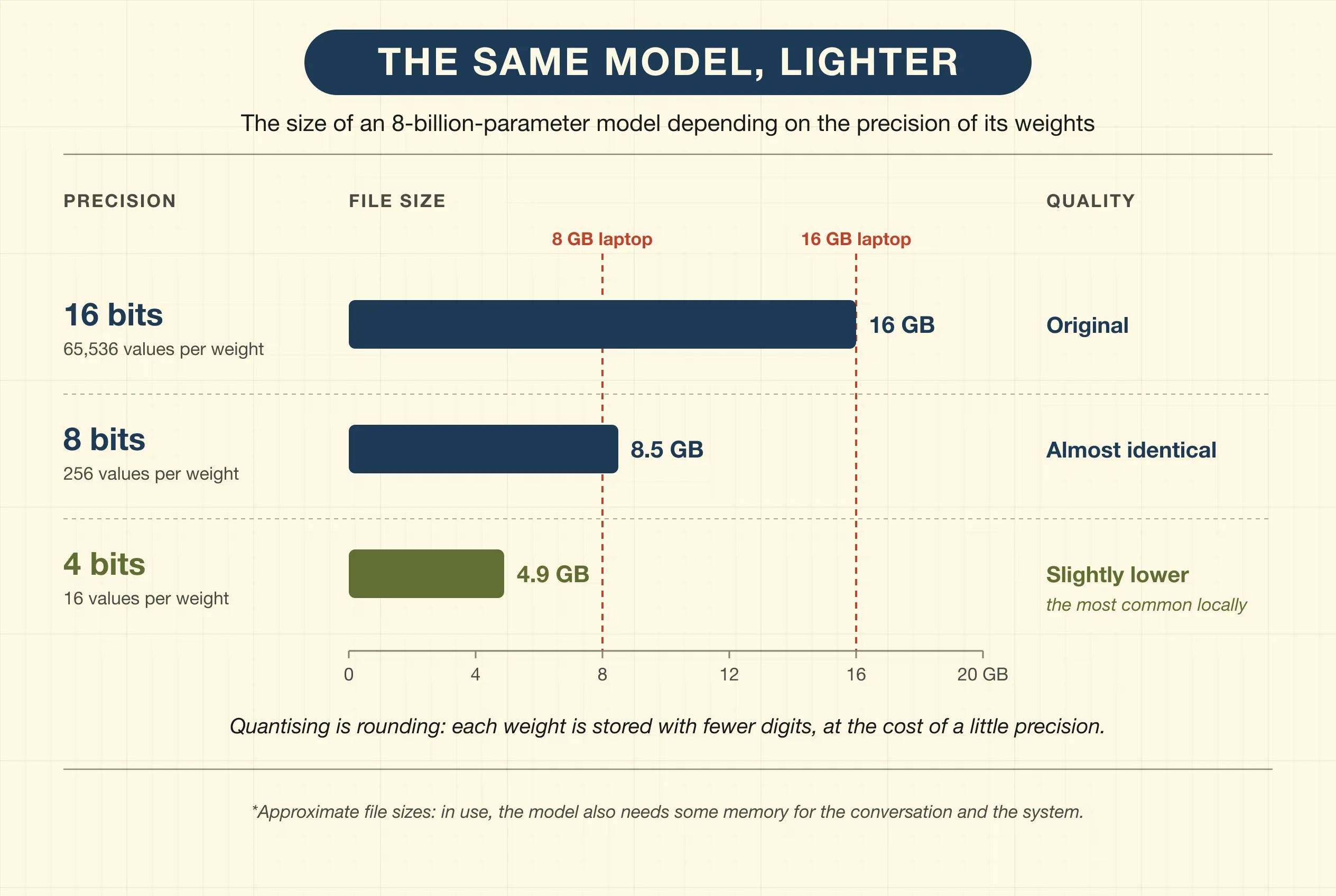
The original models weigh tens or hundreds of gigabytes and need farms of professional graphics cards. However, through a mathematical process called quantisation, which reduces the numerical precision of the weights (for example, replacing 16-bit decimal numbers with 4-bit integers), a model can be compressed into an efficient format such as GGUF. A model with 8 billion parameters, which takes up about 16 GB in its original form, shrinks to about 5 GB this way, with a small loss of quality. As a result, a mid-range laptop with a decent graphics card, or with enough shared memory, can comfortably run very capable models.
Local inference tools
Applications such as Ollama, LM Studio and Jan let you download, manage and run open-weight models in a couple of clicks, and offer a private chat interface that works without an internet connection. Under the bonnet, many of them rely on the same open-source engine, llama.cpp, the project that created the GGUF format.
- Ollama: it started as a command-line tool and has become one of the most popular ways to download and run open models (Llama, Mistral, Qwen, DeepSeek) with a single command. Since 2025 it has also had a desktop app.
- LM Studio and Jan: desktop applications with a polished graphical interface, as intuitive as ChatGPT’s, that let you chat with local models with no connection at all.
The creative and productive arsenal
The modern creator’s toolbox goes far beyond text answers and spans an unprecedented multimedia repertoire:
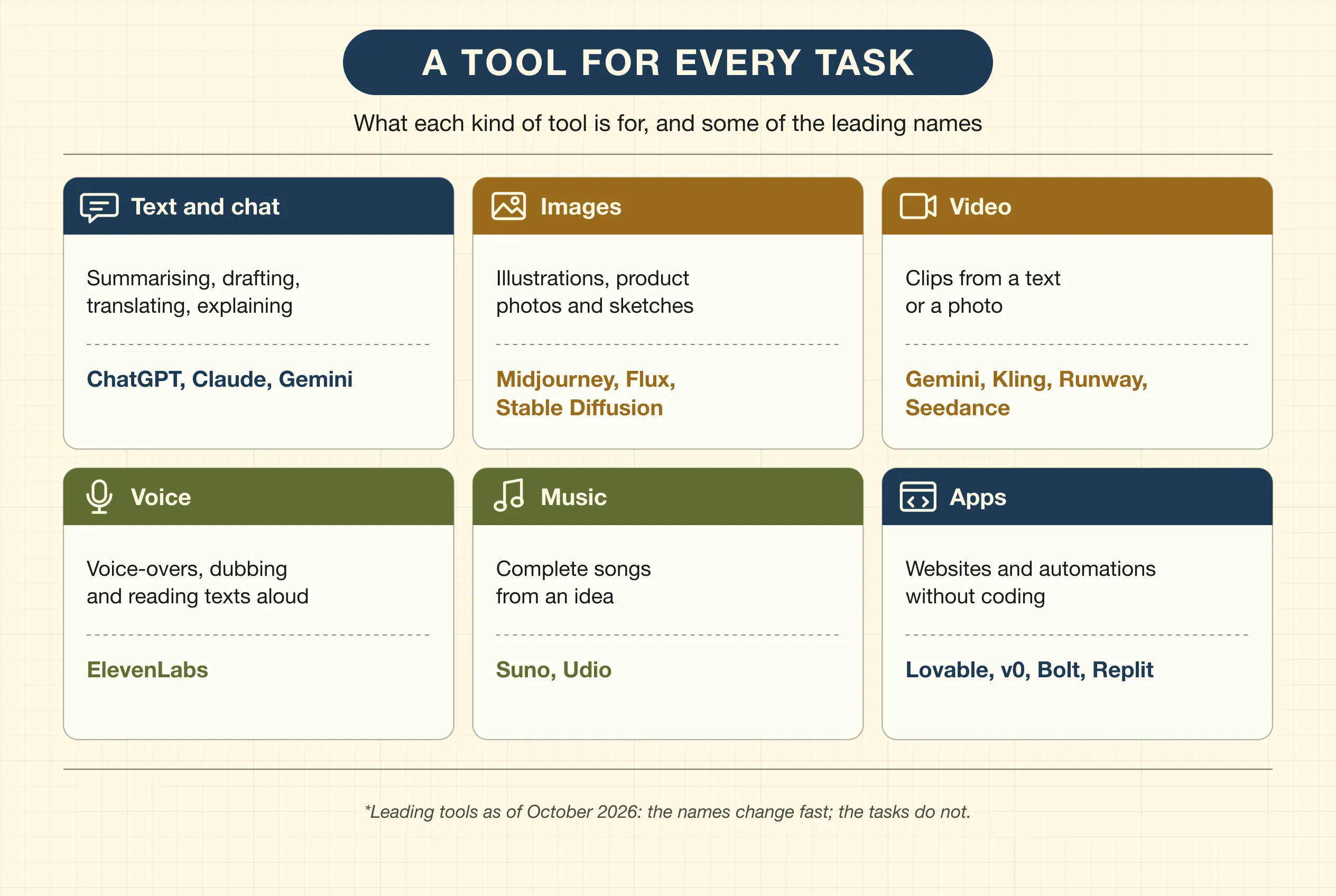
- Image generation: tools such as Midjourney, Flux, Stable Diffusion or the generators built into ChatGPT and Gemini, able to interpret complex descriptions and create illustrations, product photographs or concept art with fine control over lighting and style. Most are based on variants of the diffusion we saw in part two.
- Synthetic video: the frontier of photorealism in motion (Gemini, from Google, Kling, Runway or Seedance), able to generate fluid sequences from text instructions or still images. Their physical coherence has improved a great deal, but it is only apparent: these models imitate how the world looks without having learned its laws.
- Audio, voice cloning and music: hyper-realistic voice synthesis and cloning platforms (ElevenLabs) and full music composition engines (Suno, Udio) able to create structured songs in any genre from a poem or a general idea. A few seconds of recording are now enough to imitate a voice, which means treating unexpected audio messages with suspicion even when they sound like someone we know.
- Programming and app building: AI-assisted editors for programmers (Cursor) and platforms (Lovable, v0, Bolt, Replit) that let people with no prior training build web applications, automations and interactive sites by describing what they want in natural language. The gain is not always what it seems: in a 2025 controlled study, experienced programmers took 19% longer with AI assistance on projects they knew well, even though they believed they had been faster.
Understanding what goes on behind the scenes of artificial intelligence —telling apart the model’s static weights, the interfaces that wrap it, connection tools such as MCP and the real possibility of hosting the technology on our own hardware— radically transforms our stance towards technology. We stop being mere passive consumers of closed products and become the architects of our own digital workflow.
References and scientific support
- The language model before tuning: GPT-3 learned new tasks from just a few examples in its own input text. Brown, T. B., Mann, B., Ryder, N., Subbiah, M., Kaplan, J., Dhariwal, P., … & Amodei, D. (2020). Language models are few-shot learners. Advances in Neural Information Processing Systems, 33, 1877-1901. View study on arXiv
- How a text completer becomes an assistant: fine-tuning on human examples and reinforcement learning from human preferences. Ouyang, L., Wu, J., Jiang, X., Almeida, D., Wainwright, C. L., Mishkin, P., … & Lowe, R. (2022). Training language models to follow instructions with human feedback. Advances in Neural Information Processing Systems, 35, 27730-27744. View study on arXiv
- Reinforcement learning on problems with checkable solutions, which teaches a model to reason step by step. Guo, D., Yang, D., Zhang, H., Song, J., Wang, P., Zhu, Q., … & Zhang, Z. (2025). DeepSeek-R1 incentivizes reasoning in LLMs through reinforcement learning. Nature, 645(8081), 633-638. View paper (DOI)
- How a model is trained so that the system’s instructions outweigh the user’s or those in an external text. Wallace, E., Xiao, K., Leike, R., Weng, L., Heidecke, J., & Beutel, A. (2024). The instruction hierarchy: Training LLMs to prioritize privileged instructions. arXiv, 2404.13208. View study on arXiv
- Indirect prompt injection: malicious text hidden in a website or a document can take control of an AI application. Greshake, K., Abdelnabi, S., Mishra, S., Endres, C., Holz, T., & Fritz, M. (2023). Not what you’ve signed up for: Compromising real-world LLM-integrated applications with indirect prompt injection. Proceedings of the 16th ACM Workshop on Artificial Intelligence and Security, 79-90. View study (DOI)
- A family of models trained from the start on text, images, audio and video together. Gemini Team, Google. (2023). Gemini: A family of highly capable multimodal models. arXiv, 2312.11805. View report on arXiv
- A model that teaches itself when and how to call a calculator, a search engine or a translator. Schick, T., Dwivedi-Yu, J., Dessì, R., Raileanu, R., Lomeli, M., Zettlemoyer, L., Cancedda, N., & Scialom, T. (2023). Toolformer: Language models can teach themselves to use tools. Advances in Neural Information Processing Systems, 36, 68539-68551. View study on arXiv
- The introduction of skills: folders of instructions and resources that the agent loads only when the task needs them. Zhang, B., Lazuka, K., & Murag, M. (2025). Equipping agents for the real world with Agent Skills. Anthropic Engineering. View Anthropic’s article
- The announcement of MCP, an open standard for connecting models to external data and tools. Anthropic. (2024). Introducing the Model Context Protocol. View Anthropic’s announcement
- How MCP works and what security risks each connected server opens up. Hou, X., Zhao, Y., Wang, S., & Wang, H. (2026). Model Context Protocol (MCP): Landscape, security threats, and future research directions. ACM Transactions on Software Engineering and Methodology, 35(10), 1-37. View paper (DOI)
- The paper that named the RAG technique: combining a language model with a document search engine. Lewis, P., Perez, E., Piktus, A., Petroni, F., Karpukhin, V., Goyal, N., … & Kiela, D. (2020). Retrieval-augmented generation for knowledge-intensive NLP tasks. Advances in Neural Information Processing Systems, 33, 9459-9474. View study on arXiv
- A review of the variants of RAG, how they are evaluated and their limits. Gao, Y., Xiong, Y., Gao, X., Jia, K., Pan, J., Bi, Y., … & Wang, H. (2023). Retrieval-augmented generation for large language models: A survey. arXiv, 2312.10997. View study on arXiv
- Reducing the precision of the weights to 8 bits without losing quality, to run large models with far less memory. Dettmers, T., Lewis, M., Belkada, Y., & Zettlemoyer, L. (2022). LLM.int8(): 8-bit matrix multiplication for transformers at scale. Advances in Neural Information Processing Systems, 35, 30318-30332. View study on arXiv
- 3- and 4-bit quantisation, which made it possible to run language models on a single graphics card. Frantar, E., Ashkboos, S., Hoefler, T., & Alistarh, D. (2023). GPTQ: Accurate post-training quantization for generative pre-trained transformers. International Conference on Learning Representations (ICLR). View study on arXiv
- The variant of diffusion behind Stable Diffusion 3 and its successors. Esser, P., Kulal, S., Blattmann, A., Entezari, R., Müller, J., Saini, H., … & Rombach, R. (2024). Scaling rectified flow transformers for high-resolution image synthesis. Proceedings of the 41st International Conference on Machine Learning, PMLR 235, 12606-12633. View study on arXiv
- Video generators produce plausible scenes but fail to predict how objects behave under the laws of physics. Motamed, S., Culp, L., Swersky, K., Jaini, P., & Geirhos, R. (2026). Do generative video models understand physical principles? Proceedings of the IEEE/CVF Winter Conference on Applications of Computer Vision (WACV), 948-958. View study (DOI)
- VALL-E: imitating any voice from a recording just three seconds long. Chen, S., Wang, C., Wu, Y., Zhang, Z., Zhou, L., Liu, S., … & Wei, F. (2025). Neural codec language models are zero-shot text to speech synthesizers. IEEE Transactions on Audio, Speech and Language Processing, 33, 705-718. View paper (DOI)
- A controlled trial with experienced programmers: with AI assistance they took 19% longer, although they believed they had been faster. Becker, J., Rush, N., Barnes, E., & Rein, D. (2025). Measuring the impact of early-2025 AI on experienced open-source developer productivity. arXiv, 2507.09089. View study on arXiv
We're building the space for you to comment on the articles.
Continue reading

The heart in the skin
How ultraviolet radiation releases the skin's nitric oxide to regulate blood pressure and fight cardiovascular risk

The Zeigarnik effect, or the cost of having brilliant ideas
The psychological phenomenon that sabotages your rest in the name of creativity

Structured water: the terrain of health
The liquid battery in your cells, and how to protect it from the modern environment