Procrastination and the limbic hijack
Neuroscience shows that procrastination is not a lack of willpower or organisation, but a defence mechanism for regulating frustration

Procrastination is, in essence, the act of voluntarily delaying a planned task despite knowing that the delay will bring us negative consequences. For decades, society has labelled this behaviour as a mere synonym for laziness, lack of willpower or dreadful time management. Cognitive psychology and modern neuroscience, however, have taken this myth apart completely. Putting things off until tomorrow is not an organisational problem: it is a complex mechanism of emotional regulation and a biochemical conflict that literally plays out in our central nervous system.
The battle in your head and the myth of the lazy person
It is 11:15 p.m. on a Sunday. First thing tomorrow you have to hand in a crucial report at work, or that all-important university assignment that could decide your final grade. You know perfectly well that you should be sitting at your computer, focused. Yet over the last two hours you have watched countless kitten videos, sorted all your books by colour and alphabetical order, and spent a good while scrolling through your favourite social network.
At that precise moment a familiar, bitter feeling surfaces: guilt. You have done things you should have enjoyed, but there is no sense of relief at all; instead, a suffocating feeling of anxiety and self-contempt sets in. An inner voice tells you that you are irresponsible, a lazybones with no willpower, or an organisational disaster. Modern neuroscience, however, sees it differently.
If this were laziness, the process would be pleasant or, at the very least, apathetic. A lazy person simply decides to do nothing and suffers no inner torment for it. Someone who procrastinates, by contrast, wants to do the task and knows they must, yet finds themselves trapped in an active paralysis.
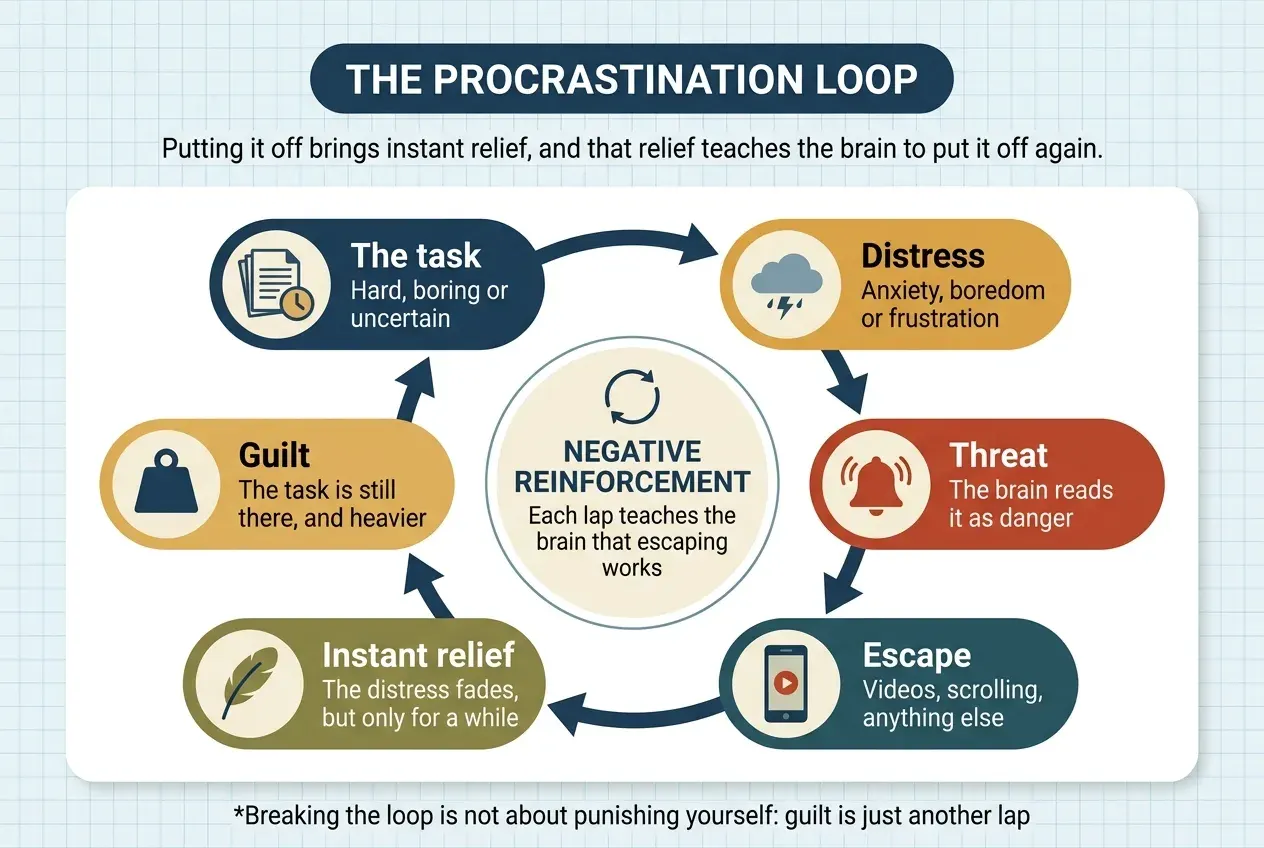
From a scientific perspective, procrastination is defined as an acute failure of self-regulation. When we face an activity that triggers negative emotions —such as evaluation anxiety, boredom, frustration or insecurity—, our brain carries out an automatic cognitive appraisal. Instead of processing the task as a constructive goal, the nervous system reads it as a psychological threat. To protect us from that discomfort, the brain deploys a defensive strategy known as short-term mood repair. By postponing the task and replacing it with something harmless or pleasant, the brain gets immediate relief. This produces negative reinforcement: the brain learns that «running away» removes the discomfort, which makes the habit chronic and ingrains it at a subconscious level.
So, from a neurobiological and psychological point of view, procrastination is not a character flaw, it is not idleness, and it does not reflect a lack of time-management skills; it is a misaligned adaptive defence mechanism. In other words, a desperate strategy by your brain to regulate a negative emotion in the present at the expense of your wellbeing in the future.
The limbic system versus the prefrontal cortex
To understand why we fall into this trap, we need to look at human neuroanatomy and peer inside our skull, where a pitched battle is being fought between two brain regions separated by millions of years of evolution.
On one side we have the limbic system, colloquially nicknamed the «primitive hunter». In evolutionary terms it is one of the oldest structures in our brain. It works automatically and emotionally, and it is programmed for basic survival. The limbic system operates on the principle of immediate pleasure: it seeks instant rewards and orders us to flee from any stimulus that causes discomfort or stress. Within this network the amygdala stands out as the processing centre for fear and threats.
On the other side, right behind our forehead, sits the prefrontal cortex, the «responsible adult». It is the most recently evolved area in hominids and the seat of the so-called executive functions: long-term planning, logic, considered decision-making and self-control. It knows perfectly well that the report is due tomorrow and calculates the catastrophic consequences of not delivering it.
Why does the primitive brain usually win? Mainly because of an evolutionary and energetic imbalance of forces. The limbic system is extremely fast, runs in the background and requires no conscious effort. The prefrontal cortex, by contrast, demands a lot of energy (glucose) and active attention to keep cognitive control over aversive emotions.
Functional magnetic resonance imaging (fMRI) research shows that chronic procrastinators tend to display amygdala hyperreactivity. When a task causes anxiety, the amygdala fires —what psychology calls an «amygdala hijack»— and functionally inhibits the resources of the dorsolateral prefrontal cortex. With the prefrontal cortex blocked and unable to exercise rational control, the primitive brain takes charge of our actions.
When you face a heavy or uncertain task, your limbic system does not see an «excellent career opportunity»; it sees a danger, a source of stress that causes emotional discomfort. And the primitive response to danger is flight. Since a brain worn down by tiredness or stress loses processing capacity in the prefrontal cortex, the primitive brain —faster and more automatic— usually wins the game.
The biochemistry of the brain
This neuroanatomical battle has a molecular counterpart in an imbalance of neurotransmitters and hormones that distorts our perception of effort and time. At the biochemical level, it translates into a disruption of the brain’s reward system, orchestrated mainly by dopamine.
There is a popular myth that dopamine is the pleasure molecule. In reality, dopamine is the neurotransmitter of anticipation and motivation. It is the fuel that moves us to act before we obtain a reward.
When we face a task we consider aversive, or whose reward lies far off in time, there is barely any anticipation of pleasure, and the chemistry of motivation plummets. But the brain also puts on the brakes. When an activity overwhelms us, the ventral striatum becomes active and sends inhibitory signals to the ventral pallidum, a circuit that has been demonstrated in primates and that acts as a biological handbrake on the urge to get started. Physically, we feel that our body is «heavy» and we struggle to move towards the task.
At the same time, the adrenal glands pump out cortisol and the brain releases noradrenaline because of the accumulated anxiety. When these substances flood the prefrontal cortex, they cloud logical thinking and push us to look for a painkiller. Where do we find it? In quick distractions, which deliver a sudden, unexpected spike of dopamine, temporarily relieving stress at the expense of our future.
We only change course when the danger is imminent, and this is where the chemistry of panic comes into play. Unable to act through dopamine, we end up relying on an emergency injection: adrenaline and cortisol. When the deadline closes in and the threat of failure becomes real, the body releases stress hormones on a large scale. This «panic injection» forces last-minute concentration, but at an enormous biological cost in the form of exhaustion and anxiety.
The psychology of procrastination: what is your profile?
Personality psychology, especially through the Big Five personality traits model, shows that we do not all procrastinate for the same reasons. The key usually lies in the combination of levels of neuroticism (emotional instability) and conscientiousness.
The anxious perfectionist
What drives this profile is not laziness but a paralysing fear of failure, or a low tolerance for it. Paradoxically, the wish for everything to turn out perfectly generates such outsized anxiety that the brain associates the task with the possibility of destroying their self-esteem. They prefer to put off starting, under the unconscious premise that it is better not to do something at all than to do it badly.
The impulsive (low conscientiousness)
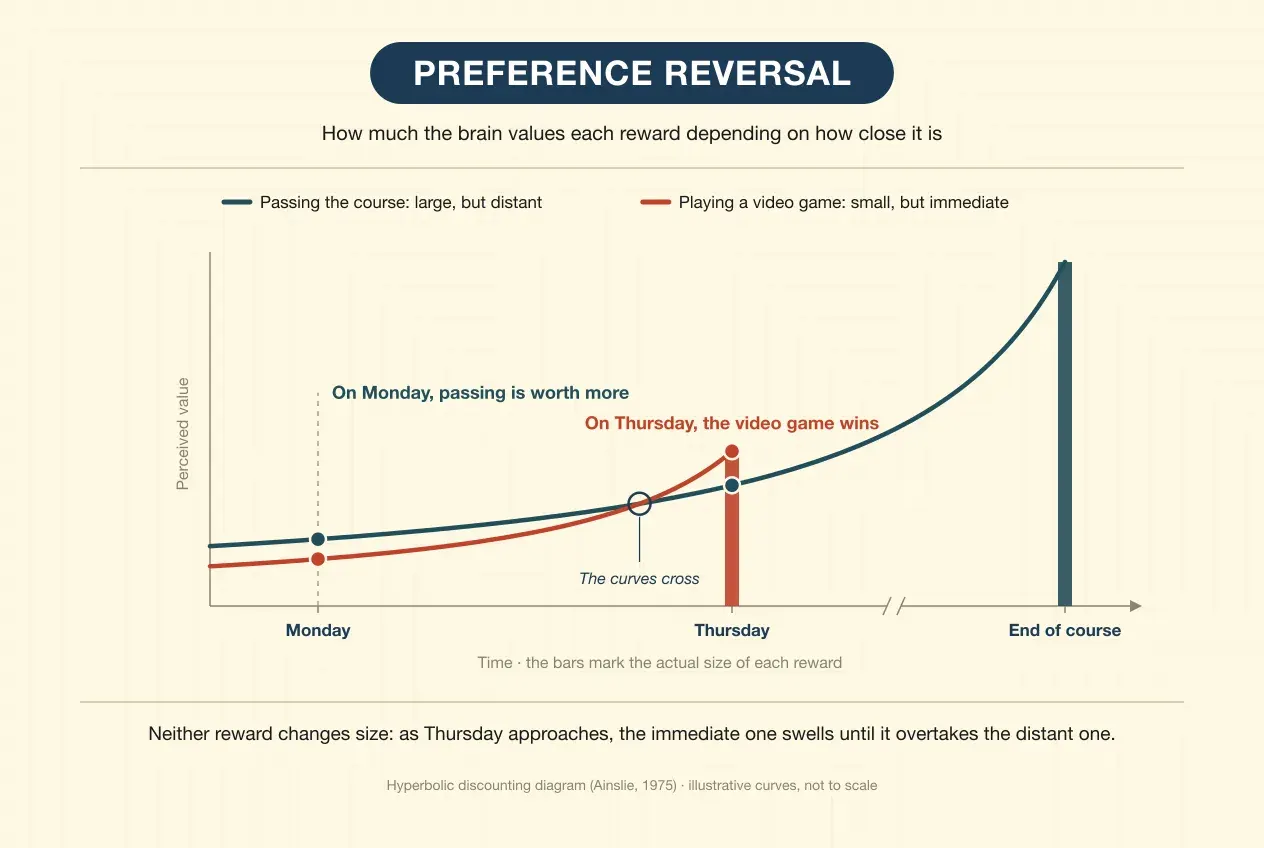
People with intrinsic difficulties in controlling their impulses suffer more severely from temporal discounting. This cognitive bias makes the brain drastically reduce the value of a future reward (passing the course three months from now) compared with the value of a present reward (playing a video game right now). Their mind suffers from dynamic inconsistency: what on Monday seemed an excellent idea to plan for Thursday gets dropped on Thursday, because the cost of the effort is immediate and the benefit is still far away.
The adrenaline junkie
This is the profile that uses procrastination almost deliberately as a performance tool. Lacking intrinsic motivation, they need to trigger the last-minute cocktail of adrenaline and stress to find the focus their ordinary brain chemistry denies them.
The immune
At the opposite extreme are the highly conscientious profiles and self-regulated optimists. These people have strong functional connectivity between their prefrontal cortex and the limbic system, which allows them to perceive difficult tasks as challenges rather than threats, avoiding the amygdala’s emotional hijack.
A Trojan horse in your pocket
It is common to hear older generations complain that today’s young people lack the discipline of yesteryear. The claim is partly true, but scientifically unfair. We are not actually weaker than previous generations; rather, we face a hostile environment designed with millimetric precision to exploit our cognitive vulnerabilities for the benefit of third parties.
In evolutionary terms, getting dopamine required considerable effort (gathering food, socialising face to face, making tools). The internet and mobile devices introduced the concept of the zero-friction immediate reward. Today, the limbic system has an all-you-can-eat dopamine buffet in its pocket.
Digital entertainment platforms and social networks operate on a principle from behavioural psychology known as the variable reinforcement schedule. It is exactly the same mechanism that makes casino slot machines addictive: users never know what they will find when they swipe the screen (the infinite scroll). Sometimes the content is bland, but sometimes a highly rewarding stimulus appears. This uncertainty keeps the brain in a state of constant dopaminergic anticipation.
When we work on a complex task, our prefrontal cortex goes through small moments of fatigue or frustration (micro-boredoms). In the past, getting past that friction took effort or meant putting up with boredom. Today, before we can consciously process the discomfort, our hand unlocks the phone as an automated reflex. Using a phone to dodge obligations has been given the technical name cyberloafing, and it should be understood not as passive distraction but as a self-administered emotional anaesthetic to escape cognitive effort.
Strategies for neutralising procrastination
Since procrastination is a problem of biology and affective regulation, the solutions for fighting it are not about «buying a new planner» or «drawing up a to-do list», but about intervening strategically in our biochemical circuits.
- Increase environmental friction. Since the brain seeks the path of least emotional resistance, the best defence is to make the distraction harder to reach. Keep your phone in another room or use app blockers. Adding even ten seconds of effort to get to the distraction gives your prefrontal cortex time to step in and break the automatism.
- The minimum-chunks rule, or divide and conquer. To stop the ventral striatum from flagging the task as a threat and slamming on the brakes, trick your brain by splitting it into absurdly small micro-actions. Do not set out to «write the report»; set out to «open the document and write a single sentence». By reducing the perceived threat to zero, the resistance disappears, and the very momentum of acting generates the dopamine needed to keep going.
- External commitment mechanisms. Humans are intrinsically subject to present bias, and self-imposed deadlines are fragile because the prefrontal cortex knows it can renegotiate them with itself. Set intermediate, public deadlines with colleagues or supervisors. External control artificially stands in for the functions of a fatigued prefrontal cortex.
Conclusion
The psychologist Hal Hershfield, now a professor at the University of California, Los Angeles (UCLA), and his team at Stanford discovered, using functional magnetic resonance imaging, a revealing fact: when people think about themselves ten years from now, the areas of the brain that light up are exactly the same as the ones that turn on when they think about a stranger or a television celebrity.
This is the neurobiological core of procrastination. To your brain, leaving the work undone on Sunday night is not a conscious act of self-destruction: your limbic system believes, at the molecular level, that it is offloading the punishment of hard work onto a stranger.
To break this cycle at its root, science tells us that the paradoxical solution is not punishment or severity, but self-compassion and empathic connection. Treating relapses with kindness reduces distress and evaluation anxiety, which keeps the amygdala from blocking our executive brain again the next time around. The next time you catch yourself watching videos at midnight, do not punish yourself. Recognise your brain’s signal, breathe, shrink the task to its bare minimum, and do a favour for that dear friend who will be you tomorrow.
References and scientific support
- Procrastination as short-term mood regulation: putting off the task relieves the distress it causes, at the expense of the future self. Sirois, F., & Pychyl, T. (2013). Procrastination and the Priority of Short-Term Mood Regulation: Consequences for Future Self. Social and Personality Psychology Compass, 7(2), 115-127. View study (DOI)
- The brain-scanning experiment: thinking about oneself ten years from now resembles thinking about another person more than about the current self, and the greater that distance, the more steeply future rewards are discounted. Ersner-Hershfield, H., Wimmer, G. E., & Knutson, B. (2009). Saving for the future self: Neural measures of future self-continuity predict temporal discounting. Social Cognitive and Affective Neuroscience, 4(1), 85-92. View study on PubMed Central
- Continuity with the future self: why feeling it as a stranger pushes us towards the immediate reward. Hershfield, H. E. (2011). Future self-continuity: How conceptions of the future self transform intertemporal choice. Annals of the New York Academy of Sciences, 1235, 30-43. View study on PubMed Central
- The origin of preference reversal: under hyperbolic discounting, a small, immediate reward ends up overtaking a large, distant one once it is within reach. Ainslie, G. (1975). Specious reward: A behavioral theory of impulsiveness and impulse control. Psychological Bulletin, 82(4), 463-496. View study on PubMed
- Students who forgave themselves for procrastinating before the first midterm procrastinated less before the second, because they felt less distress. Wohl, M. J. A., Pychyl, T. A., & Bennett, S. H. (2010). I forgive myself, now I can study: How self-forgiveness for procrastinating can reduce future procrastination. Personality and Individual Differences, 48(7), 803-808. View study (DOI)
- The disconnection from the future self and the strategies for closing the gap, told by Hershfield himself. Hershfield, H. (2023). Your Future Self: How to Make Tomorrow Better Today. Little, Brown Spark. See the book at Hachette Book Group
- People who find it hardest to move from decision to action have a larger amygdala and weaker connectivity between the amygdala and the dorsal anterior cingulate cortex. Schlüter, C., Fraenz, C., Pinnow, M., Friedrich, P., Güntürkün, O., & Genç, E. (2018). The Structural and Functional Signature of Action Control. Psychological Science, 29(10), 1620-1630. View study on PubMed
- In macaques facing a task with punishment, the ventral striatum brakes the ventral pallidum and saps the drive to start; silencing that pathway restores motivation. Oh, J. N., Amemori, S., Inoue, K. I., Kimura, K., Takada, M., & Amemori, K. I. (2026). Motivation under aversive conditions is regulated by a striatopallidal pathway in primates. Current Biology, 36(3), 692-706.e6. View study (DOI)
We're building the space for you to comment on the articles.
Continue reading

The (harmful) obligation to socialize
Why forcing extroversion wears down the nervous system, and why protecting your mental energy is an act of health

The infinite scroll trap
What happens in your brain when you fall into the short-video loop

What did I come in here for?
What science says about those small everyday lapses that prove your mind is (far too) efficient