The (harmful) obligation to socialize
Why forcing extroversion wears down the nervous system, and why protecting your mental energy is an act of health
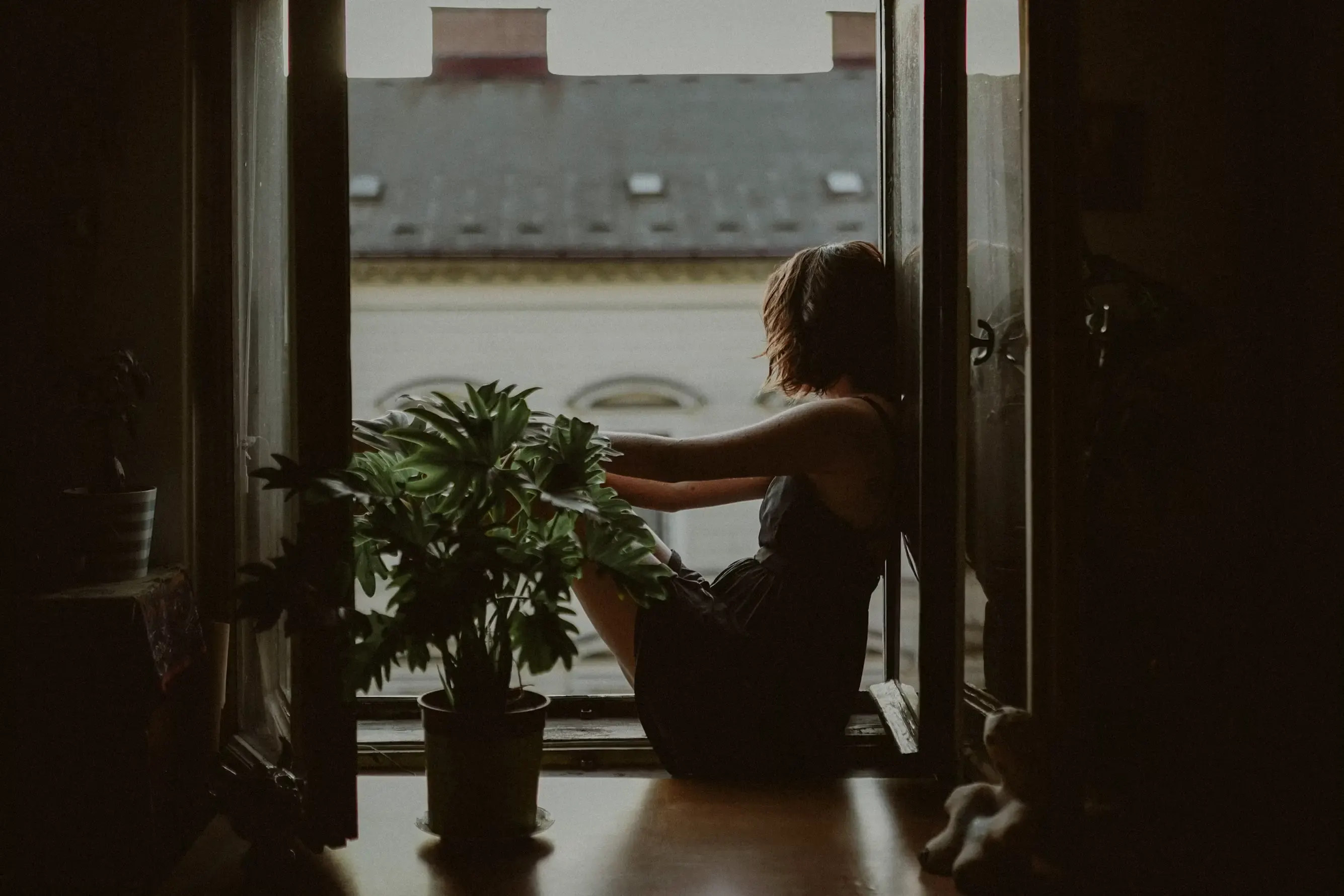
We live in a society that rewards constant motion. Popular culture and social media sell an ideal model of happiness packed with events, travel and unbroken social interaction. Seen that way, choosing to stay home on a Friday night is often read as a sign of apathy, sadness or extreme introversion. Psychology and neuroscience, however, offer a very different reading: preferring the shelter of home is neither laziness nor a rejection of other people, but a physiological mechanism of self-regulation.
The battery metaphor is enough to understand it. Where markedly extroverted people seem to charge their energy through external stimulation, noise and interaction with others, more introspective or sensitive profiles spend their mental energy in those same settings. For them, solitude and the quiet of home are not a punishing isolation, but the charger they need to plug into in order to function.
The theory of the optimal level of stimulation
Biologically, the human brain does not merely react to basic needs such as hunger or sleep: it constantly seeks a state of balance, a physiological homeostasis. Part of that regulation depends on a structure in the brainstem, the ascending reticular activating system (ARAS), which works as a filter and controls both alertness levels and how much sensory information reaches the cerebral cortex.
Not every brain filters its surroundings the same way. In the mid-twentieth century, psychology formulated the theory of the optimal level of stimulation, which holds that each individual has their own threshold of stimuli needed to feel comfortable and alert.
- Low baseline arousal: a brain less sensitive to stimuli needs a highly dynamic environment in order not to get bored.
- High baseline arousal: a naturally more sensitive brain perceives its surroundings more intensely, so it reaches its optimal level of well-being in calm settings.
Did you know? To illustrate this biological drive to balance stimulation, it is worth recalling the celebrated sensory deprivation studies run at McGill University in the 1950s: when volunteers were cut off from all sound, light and physical contact, the brain became disoriented and even produced hallucinations. The brain needs stimulation; what varies radically from one person to the next is exactly how much.
Stress, performance and differences in personality
The relationship between external stimulation and psychological well-being is usually described by the Yerkes-Dodson law, drawn as an inverted U-shaped curve.
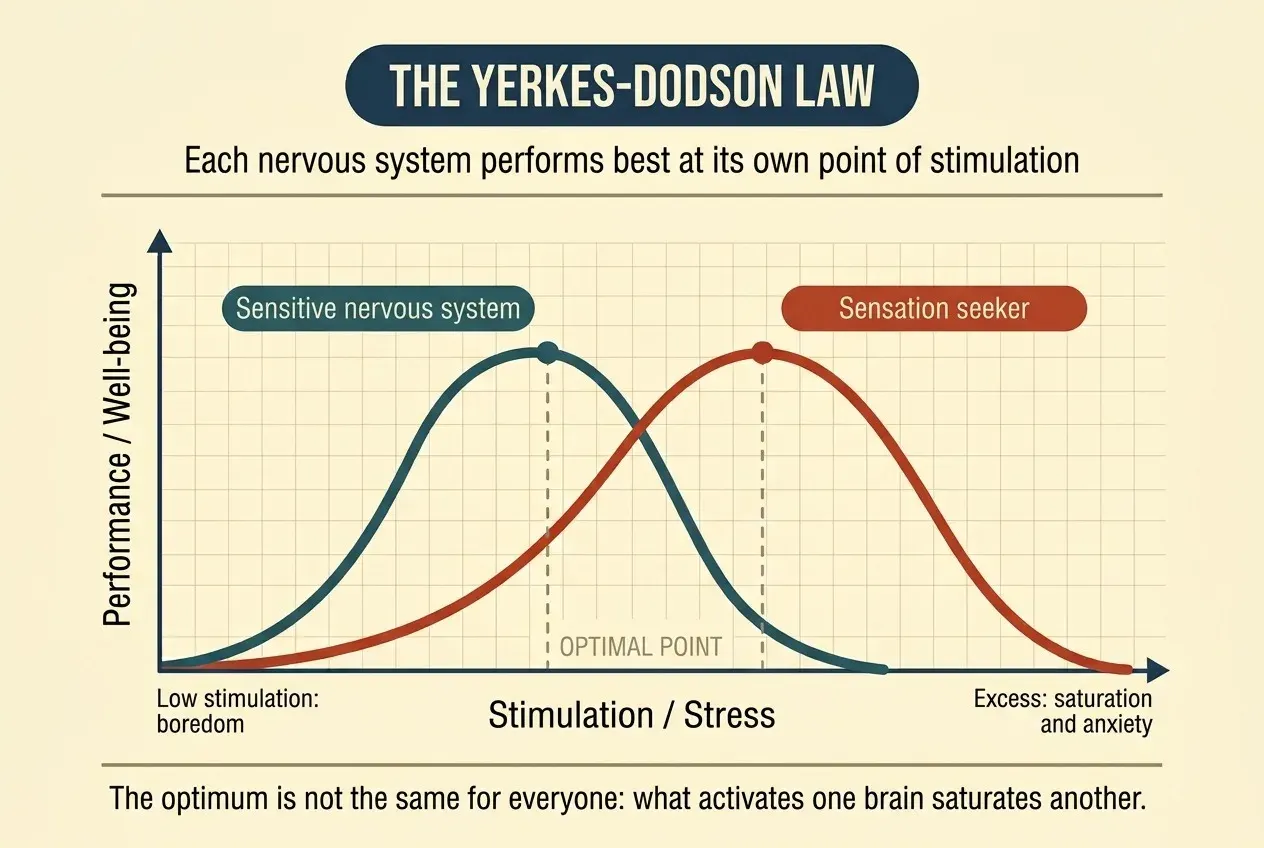
Reading that curve is straightforward: a moderate amount of stimulation produces motivation and alertness but, once the individual optimum is passed, performance falls and saturation and anxiety set in.
Psychologist Marvin Zuckerman explored these differences further by studying the trait of sensation seeking. Where high sensation seekers need novel, intense experiences to reach their optimum, more sensitive nervous systems hit that limit very quickly in noisy or unpredictable environments. For the latter, withdrawing in time is not a character flaw but the optimal strategy for avoiding sensory overload.
Highly Sensitive People (HSP), or when the brain’s processor runs at double speed
There is one neurobiological profile in which the need to retreat home shows up with particular clarity: that of Highly Sensitive People (HSP). Far from being a diagnosis or a clinical disorder, high sensitivity is a genetically determined personality trait, present in roughly 15% to 20% of the population, formally known in neuroscience as sensory processing sensitivity (SPS).
The brain of a highly sensitive person does not work differently by «choice», but because of how their central nervous system is wired. To explain why HSPs have a natural inclination to enjoy being at home, the scientific literature usually sums up their cognitive functioning with the DOES framework:
- D (Depth of processing): HSPs do not merely take in information from their surroundings, they analyse it more intensely and automatically. Functional magnetic resonance imaging studies show that, faced with the same stimuli, they activate the brain areas associated with integrating information and with deep planning more strongly.
- O (Overstimulation): as a direct consequence of processing everything more deeply, the nervous system reaches the point of saturation or cognitive fatigue much sooner than average.
- E (Emotional reactivity & empathy): they show greater activation of the mirror neuron system, so they «absorb» and process the emotions of the people around them almost automatically, which increases the energy drain in crowded social settings.
- S (Sensing the subtle): they pick up small details that pass others by: a background hum, the intensity of a fluorescent light, slight changes in tone of voice or faint smells.
The urban environment versus the regulating one
If we look at a conventional night out — a crowded restaurant, a party, a shopping centre — from the perspective of high sensitivity, the neurological demand is enormous. Where a brain of average sensitivity dampens ambient noise or ignores flickering lights, the HSP brain processes every element at once.
In that context, home works as a space for neurosensory decompression. It is not that highly sensitive people fail to enjoy company or social life; on the contrary, they tend to build deep interpersonal connections. But after a few hours exposed to the sensory and interactional bombardment of the outside world, their nervous system enters a state of hyperarousal.
Staying home then acts as a deliberate physiological pause:
- Reducing allostatic load: it lets the body bring down the cortisol and adrenaline built up by overexposure to stimuli.
- Switching off the constant filter: in their own space, a person does not have to make the conscious effort to ignore noise, lights or unpredictable group dynamics.
- Restoring the capacity for attention: focused attention wears out with continuous use; the domestic environment, being predictable, lets the brain rest and recover its cognitive agility.
Home as a refuge of control and a catalyst for creativity
The outside world is inherently unpredictable: harsh lights, interruptions, traffic and social dynamics that demand constant attention. For anyone who processes information more deeply, staying exposed to that environment for long stretches is exhausting.
Home, by contrast, offers something fundamental: environmental control. At home it is possible to regulate the lighting, the noise level, the temperature and the pace of activities. That predictability lowers the cognitive load and lets the nervous system stand down from alert.
Far from being «wasted» time, moments of solitude at home favour high-level cognitive processes:
| Cognitive benefit | Mechanism |
|---|---|
| Introspection | Activates the default mode network, associated with memory consolidation and self-knowledge. |
| Creativity | The absence of external noise makes it possible to connect apparently unrelated ideas. |
| Problem solving | With less pressure from the environment, the mind processes complex information more efficiently. |
The clinical nuance: preference or avoidance?
To handle this subject rigorously it is crucial to draw a distinction between the conscious choice of restorative isolation and defensive avoidance.
- Staying in by preference: the person chooses to stay home because they enjoy time alone, feel a sense of peace and use that space for rewarding activities. Going out remains a viable option and causes no panic.
- Staying in by avoidance: the decision not to go out is driven by fear of other people’s judgement, social anxiety, agoraphobia or the emotional blunting characteristic of depression. Here staying home brings no real rest, only temporary relief followed by discomfort or guilt.
One simple question helps tell the two states apart:
Do you stay home because your own space nourishes you and makes you feel good, or because the idea of going out feels like an overwhelming burden you are trying to dodge?
Conclusion
Understanding the psychology behind a preference for home lets us dismantle the prejudice that constant sociability is the only route to well-being. The need for introspection and for space of one’s own is not a sign of weakness, but a biological response meant to maintain mental balance. Learning to respect our own thresholds of stimulation is, ultimately, one of the most basic forms of self-care.
References and scientific support
- The system that regulates alertness. Moruzzi, G., & Magoun, H. W. (1949). Brain stem reticular formation and activation of the EEG. Electroencephalography and Clinical Neurophysiology, 1(4), 455-473. Read the study on PubMed
- The optimal level of arousal. Hebb, D. O. (1955). Drives and the C.N.S. (conceptual nervous system). Psychological Review, 62(4), 243-254. Read the study on PubMed
- The inverted U-shaped curve. Yerkes, R. M., & Dodson, J. D. (1908). The relation of strength of stimulus to rapidity of habit-formation. Journal of Comparative Neurology and Psychology, 18(5), 459-482. Read the full text on Classics in the History of Psychology
- The McGill sensory deprivation studies. Bexton, W. H., Heron, W., & Scott, T. H. (1954). Effects of decreased variation in the sensory environment. Canadian Journal of Psychology, 8(2), 70-76. Read the study on PubMed
- Sensation seeking as a trait. Zuckerman, M. (1994). Behavioral Expressions and Biosocial Bases of Sensation Seeking. Cambridge University Press. See the book at Cambridge University Press
- High sensitivity, distinct from introversion. Aron, E. N., & Aron, A. (1997). Sensory-processing sensitivity and its relation to introversion and emotionality. Journal of Personality and Social Psychology, 73(2), 345-368. Read the study on PubMed
- Depth of processing measured with functional imaging. Jagiellowicz, J., Xu, X., Aron, A., Aron, E., Cao, G., Feng, T., & Weng, X. (2011). The trait of sensory processing sensitivity and neural responses to changes in visual scenes. Social Cognitive and Affective Neuroscience, 6(1), 38-47. Read the study on PubMed Central
- Empathy and the response to other people’s emotions. Acevedo, B. P., Aron, E. N., Aron, A., Sangster, M.-D., Collins, N., & Brown, L. L. (2014). The highly sensitive brain: an fMRI study of sensory processing sensitivity and response to others’ emotions. Brain and Behavior, 4(4), 580-594. Read the study on PubMed Central
- How many people are highly sensitive. Lionetti, F., Aron, A., Aron, E. N., Burns, G. L., Jagiellowicz, J., & Pluess, M. (2018). Dandelions, tulips and orchids: evidence for the existence of low-sensitive, medium-sensitive and high-sensitive individuals. Translational Psychiatry, 8, 24. Read the study in Translational Psychiatry
- Allostatic load, the price of being permanently switched on. McEwen, B. S. (1998). Protective and damaging effects of stress mediators. The New England Journal of Medicine, 338(3), 171-179. Read the study on PubMed
- The depletion and restoration of focused attention. Kaplan, S. (1995). The restorative benefits of nature: toward an integrative framework. Journal of Environmental Psychology, 15(3), 169-182. Read the study on ScienceDirect
- The default mode network. Buckner, R. L., Andrews-Hanna, J. R., & Schacter, D. L. (2008). The brain’s default network: anatomy, function, and relevance to disease. Annals of the New York Academy of Sciences, 1124, 1-38. Read the study on PubMed
- What solitude does to mood. Nguyen, T. T., Ryan, R. M., & Deci, E. L. (2018). Solitude as an approach to affective self-regulation. Personality and Social Psychology Bulletin, 44(1), 92-106. Read the study on PubMed
- Preference versus avoidance: not all withdrawal is alike. Nelson, L. J. (2013). Going it alone: comparing subtypes of withdrawal on indices of adjustment and maladjustment in emerging adulthood. Social Development, 22(3), 522-538. Read the study on Wiley Online Library
We're building the space for you to comment on the articles.
Continue reading

Procrastination and the limbic hijack
Neuroscience shows that procrastination is not a lack of willpower or organisation, but a defence mechanism for regulating frustration

The infinite scroll trap
What happens in your brain when you fall into the short-video loop

What did I come in here for?
What science says about those small everyday lapses that prove your mind is (far too) efficient